Chess

Beasts of the board

The Dutch artist Theo Jansen has a unique speciality. His ‘Strandbeest’ (beach animals) are kinetic sculptures, which he likes to set free upon a windswept beach. Fashioned from plastic tubes, bottles and the like, these imposing skeletons appear to ‘walk’ along the seafront with a gait at once laboured and graceful: a compelling synthesis of engineering and art.  When I first watched this magnificent spectacle on YouTube, I was immediately reminded of the cold, gusty walks along the beach at Wijk aan Zee, the town in Holland where the annual Tata Steel tournament is held. (Curiously, Jansen hails from Scheveningen, a seaside resort which lends its name to a variation of the Sicilian defence and to a format of team chess).

Meeting an idol

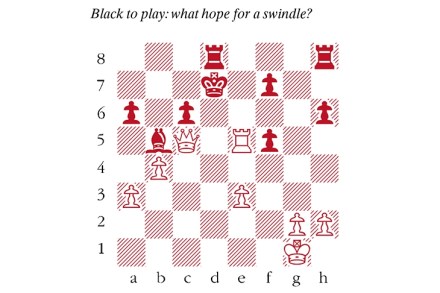
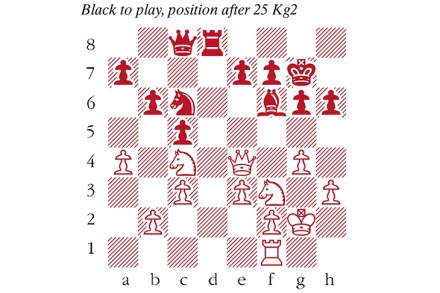
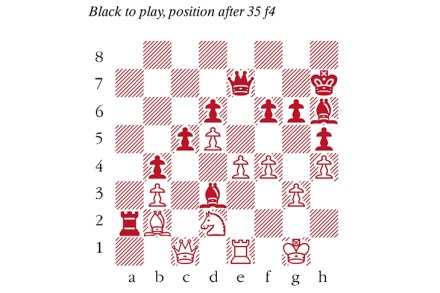
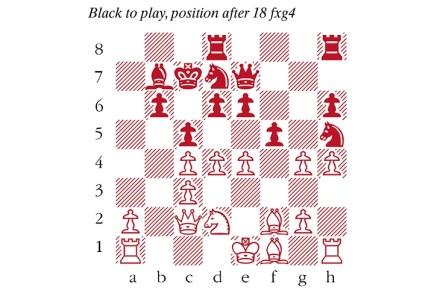
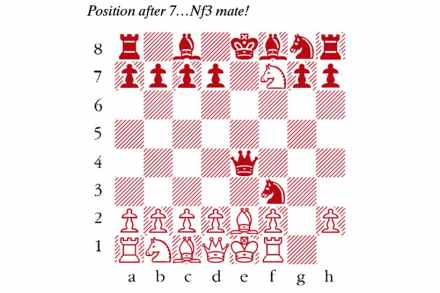
We had never met, but David Paravyan, from Russia, has been something of a personal idol since August 2018. My veneration was exclusively based on one game whose dazzling ingenuity was, to my eyes, awesome. Last week he took first place (and a £30,000 prize) at the Gibraltar Masters, one of the most prestigious open tournaments in the world. Paravyan is an accomplished grandmaster, but this was a huge career breakthrough in a field that included the likes of Shakhriyar Mamedyarov and Maxime Vachier-Lagrave. Seven players tied for first place on 7½/10, and Paravyan triumphed in a gruelling series of tiebreak games after the final day’s play. Nevertheless, I cannot resist showing the earlier game which so impressed me.

Women’s World Championship

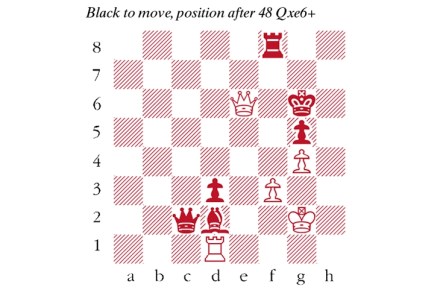
Looking at the first 12 games of the 2018 Carlsen-Caruana World Championship, which all ended in draws, I saw a statistical blip where others saw an ossified match format and the death of classical chess. But nobody could decry the drama at this year’s Women’s World Championship, in which reigning champion Ju Wenjun from China saw off a fierce challenge from 21-year-old Russian Aleksandra Goryachkina.   The early games saw Goryachkina willing to engage in protracted battles, but it was Ju who got the first win from a tricky queen ending in the fourth game. Undeterred, Goryachkina struck back immediately, and went on to take the lead herself in the eighth game. Ju was rewarded for several bold decisions in the ninth, leaving the scores level.

More than a game

Cars, computers and cadavers: taking them apart is normally reserved for experts and the pathologically curious. In his new book, The Moves that Matter, Jonathan Rowson takes a scalpel to the game of chess itself, and finds abundant meaning in its cultural, psychological and metaphorical aspects. Or as he puts it: ‘Chess is just a game in the way that the heart is just a muscle.’ It’s ambitious stuff, but we’re in good hands. Dr Rowson is a three-time British champion (2004-2006), writer, philosopher and co-founder of Perspectiva, a research institute that examines the relationship between complex global challenges and the inner lives of human beings.   The Moves that Matter is unusual in that Rowson has written a chess book with a general audience in mind.

12 rules for chess

As backhanded Christmas gifts go, a copy of 12 Rules for Life, must be up there with wrinkle cream or a nose-hair trimmer. One generous soul decided that Jordan Peterson’s bracing self-help book, published two years ago, was just the tonic I need to improve my life and character.   Who knows what advice to take, when feedback from the game of life is so wickedly fuzzy? Most decisions are inconsequential, and some which look good will come back to haunt you. But in the game of kings, results are unambiguous: win, lose or draw, and then you get reincarnated. So in the spirit of January resolutions, this is how those dozen rules might apply to chess.   1. Stand up straight with your shoulders back. A good start: sit up straight at the board.

chess-110120

‘Every day is different’, people like to say about their jobs. For the world’s best chess players, that’s only partly true. The game will be different, but the day will look much the same, and so will the international hotel room. In fact, professional players love a routine: they keep their energy for the game, not on deciding where to eat. That monastic focus can’t be taken for granted, especially when you’ve already achieved the highest goals. When Vladimir Kramnik, the former world champion who defeated Garry Kasparov in London in 2000, announced his retirement from chess last year, he put it down to a drop in motivation. The results of his games had stopped mattering quite so much to him.

A multitude of contests

Besides the Grand Chess Tour final, an abundance of chess was played at this year’s London Chess Classic. More than 2,000 children visited the festival, which was organised by the charity Chess in Schools and Communities. Fittingly, two talented youngsters shared first place in the Fide Open event — 14-year-old Rameshbabu Praggnanandhaa from India and 18-year-old Anton Smirnov, from Australia.   Michael Adams added another title to his collection by winning the British Knockout Championship. He had a close shave in the quarter finals, narrowly surviving an Armageddon game against the promising young player Marcus Harvey, who sailed through a qualifying tournament with 8.5/9 the previous day.

Ding’s wings

Ding Liren, from China, was a convincing winner of the 2019 Grand Chess Tour, which reached its climax in London last weekend. The Grand Chess Tour Finals, a four-player knockout, was the flagship event at this year’s London Chess Classic. The match format was a blend of classical (slow), rapid and blitz games. Although the slower games held more weight in the scoring, the very inclusion of faster time limits reflects their increased status in the modern game.   The first semi-final, between Magnus Carlsen and Maxime Vachier-Lagrave, went to a tiebreak. The Frenchman won a topsy-turvy game in his beloved Najdorf Sicilian, as Carlsen went astray amid wild complications. In the second semi-final match Ding defeated Levon Aronian with a dominant performance in the rapid games.

The Saric Supremacy

There is a gritty fight scene in The Bourne Supremacy, in which Jason Bourne (played by Matt Damon) faces down his adversary Jarda at an apartment in Munich. Both men are skilled assassins, but they aren’t wielding their weapons of choice. The villain’s hands are tied, but he lands the first blow with his elbows. He somehow turns up a kitchen knife, and frees his wrists on some shattered glass furniture. Bourne rolls up a magazine and you know he could kill with it. You wish someone would answer the shrieking telephone. They’re soon back to bare knuckles and slamming into the tables. At last, Bourne throttles him with an electric power cord, and the audience breathes a sigh of relief.

A good year for Carlsen

Magnus Carlsen is the star attraction at this year’s London Chess Classic. The festival, now in its 11th edition, runs from 29 November to 8 December at the Olympia Conference Centre in Kensington. The World Champion will play in the final leg of the Grand Chess Tour, in a four-player knockout event with a $350,000 prize fund which begins on Monday 2 December. He will be joined by Ding Liren, Levon Aronian and Maxime Vachier-Lagrave.   ‘The Classic’ as the festival is affectionately known, features a wide variety of events, including a Fide-rated Open tournament, weekend events, and a ‘Super Blitz Open’ on the final Sunday.

A fresh approach

Reimagine democracy. Reimagine capitalism. Reimagine education. For all the reimagining thrown at big ideas, they don’t seem much perturbed. You can reimagine a problem too, but it probably won’t be fruitful. It won’t help you find the end of the Sellotape, or balance the books (unless you worked for Enron).   But some problems really are amenable to a fresh perspective. According to legend, the mathematician Carl Friedrich Gauss was tasked at primary school with adding up the numbers from 1 to 100. The obvious approach is (to quote the King of Hearts from Alice in Wonderland) ‘Begin at the beginning, and go on till you come to the end: then stop.’ Gauss saw the problem in a different light.

Dubov’s dynamite

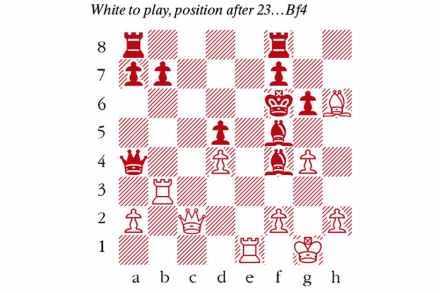
When Daniil Dubov advanced his queen’s pawn in Batumi last month, he might as well have chewed the head off a bat and set fire to the board. For diehard chess fans, it was a true rock’n’roll moment, still more transgressive for being done in a team event on behalf of Mother Russia. The 23-year-old had just come from a grotty performance at his previous event. ‘They asked me to calm down and not play some ridiculous lines,’ he said with a grin.   His brazen sacrifice is steeped in history. In 1918, Frank Marshall unleashed the related gambit with 8… d5 against José Raúl Capablanca. Never mind that he was not the first to try it, and that Capablanca won the game: Marshall’s concept was vindicated in the long run.

Bronze in Batumi

The hammering downpour before the last round in Batumi was, in retrospect, a precious omen. After all, England’s medal drought in international team competitions has lasted nearly 20 years. This year our rain dances finally took effect, as we brought home the bronze medals from the European Team Championship last week. It’s our second major success of the year, following silver medals in an elite team event in Kazakhstan, in March. England last won gold in Pula, 1997 and the women’s team got the bronze in Leon, 2001.   I’ve played in the Black Sea resort of Batumi three times, and I like it. The Georgians have khachapuri (cheesy bread) to celebrate and the city’s boulevard is glorious in the sunshine.

Seizing the moment

‘If the ball came loose from the back of the scrum, which it won’t of course…,’ said Boris, about his prospects of becoming prime minister. Disingenuous or not, it’s surely not a job won by determination alone. One needs a little help from events.   Despite a strong start, Wang Hao, from China, downplayed his chances of winning the Fide Chess.com Grand Swiss, so fierce was the competition. The field comprised most of the world’s top 100, plus a number of promising juniors, women and players from the Isle of Man where the event was held. But his score of 8 points from 11 games marked a career breakthrough for a player who has generally ranked just outside the world’s top 20 for a decade.

Great sacrifices

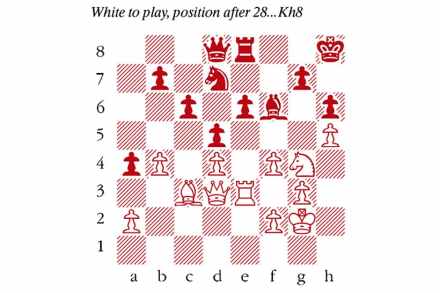
Impelled by his engineer’s mindset, the former world champion Mikhail Botvinnik wrote a short essay to answer a simple question: ‘What is a combination?’ I like his succinct conclusion, which certainly captures the essence: ‘A combination is a forced variation with a sacrifice.’   Like the fizz in champagne, the sacrificial element is the sine qua non and the va va voom. In its absence, a forcing manoeuvre of the pieces may, like wine, still have much to recommend it, but it is a different libation. Nonetheless, an avid taxonomist might like to ponder Nigel Short’s victory against Jan Timman from Tilburg 1991, where the sacrifice of a rook is incidental to an extraordinary king procession. (The game can be found online.

Atmospheric pressures

‘Poor indoor air quality hampers cognitive performance significantly’, concluded a recent study in the IZA (Institute of Labour Economics). Of course, ‘fresh air is good for you’ fits squarely in the category of things you knew already, but the research was specifically about chess: ‘An increase in the indoor concentration of fine particulate matter (PM2.5) by 10 µg/m3 increases a player’s probability of making an erroneous move by 26.3 per cent.’ Intriguingly, the effect seems most pronounced when players are in time pressure.   By my reckoning, that makes it pretty easy to induce mild stultification: burning a few incense sticks ought to do it. It’s scarcely credible now, but smoking at the board was once commonplace.

Plates in the sink

‘Chess is a constant struggle between my desire not to lose and my desire not to think.’ I’m fond of that wry insight, neatly expressed by German grandmaster Jan Gustafsson. For a select few, such as the late, irrepressible Viktor Korchnoi, the desire not to lose burns through life like the Olympic flame. For the rest of us, only youthful naivety makes it easy to summon maximal mental effort. Thereafter, the struggle is perennial, like a pile of dirty plates in the sink; sometimes you can’t bring yourself to care. But letting this notion occur to you too early in life is a career-limiting move for a chess-player.   Upon reaching the final of the World Cup, Teimour Radjabov spoke frankly, reflecting on the tension endured by the players.

Visky business

‘Visky,’ said the man driving the taxi.   ‘Risky?’   ‘Visky.’   ‘Ah… whisky! Or vodka.’ I grinned as I got out. ‘Maybe see you last year,’ I ventured in bungled Russian.   There was no bottle to hand, but my wounded ego was soothed by the prescription. I’d been freshly eliminated from the World Cup in Siberia in a blitz tiebreak by Daniil Yuffa, an amiable young Russian. Two years ago, Daniil appeared on a Russian talent show (and YouTube). He simultaneously played three games of chess — blindfolded — and accompanied his own spectacle with a classical piano medley. Two days after beating me, he was out too. So it goes.

Double fianchetto

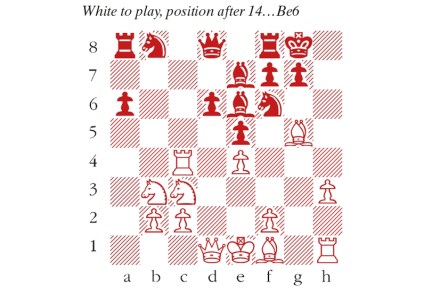
In my pantheon of heroes a particular place of honour is occupied by the hypermodern grandmaster Richard Réti, the first to adopt the double fianchetto since the days of Howard Staunton.   Réti-Yates: New York 1924; Réti Opening (See diagram 1)   12 Rc2 This manoeuvre connected with this rook move must have struck onlookers as nothing short of revolutionary. Réti is planning to place his queen, the most powerful piece, on the extreme flank at a1. This is consistent with his theory that occupying the centre with pawns in classical style, as Black has chosen to do, exposes the pawns to pressure from the wings. 12 ...

Adopt a hero

I am often asked which players I admire most and which grandmasters, writers and champions exerted the most influence on my own chess development. In general I was most impressed by the strategists and writers such as Richard Réti, whose games were brilliantly elucidated in an anthology by grandmaster emeritus Harry Golombek OBE, and Aron Nimzowitsch, who expounded his own theories in the two didactic masterpieces, My System and Chess Praxis. Others who fall into the strategic category are Mikhail Botvinnik and Tigran Petrosian; and two superlative tacticians in the persons of Alexander Alekhine and Mikhail Tal.   In the weeks ahead I will be coupling creative achievements by these heroes with games of my own which were plainly inspired by illustrious forebears.