Chess

Speed freaks

Writing in January, I described internet bullet chess, where the players have one minute for all their moves, as ‘popular, addictive and pointless’. Bullet games are shallow and unwholesome because if you stop to think, you lose the game on time. Never mind a junk food tax: taxing bullet chess is the real social imperative — or indeed banning it. Blitz chess, where the players have three or five minutes per move, is a much healthier proposition. The pleasure of a well-played blitz game goes beyond a mere adrenalin rush and the experience might well be beneficial — as part of a balanced diet, of course. Were he alive, I presume that Mikhail Botvinnik, the Soviet world champion, would take exception even with that.

The Brick

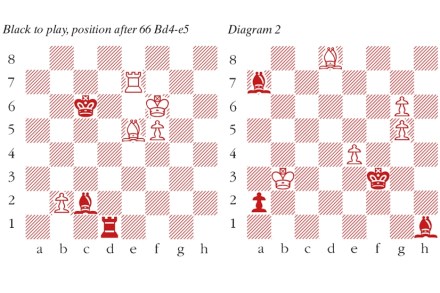
I own a few chess books that could serve as a murder weapon, but none so hefty as Chess: 5334 Problems, Combinations and Games. Nicknamed ‘The Brick’ by its fans, its thousand-odd pages forgo instructional text in favour of an escalating procession of puzzles, mostly mates in 1, 2 or 3 moves. These illustrate the most important patterns in chess, which form the vocabulary of any skilled player. This is a primer with a pedigree: the book was written by Laszlo Polgar, the father of the famous Polgar sisters, who believed that geniuses are made, not born. The manifest effort of compilation demands commensurate exertion from the reader.

The Queen’s Gambit – Accepted

‘It’s chess. We’re all prima donnas.’ You can hear it spoken with a wink in the Netflix miniseries The Queen’s Gambit, released two weeks ago in seven episodes of about an hour. My heart swelled to hear the game’s essence so appreciated: of course nothing else matters when you’re playing chess. So yes, we are prima donnas, thank you, and roundly indulged by this fine TV series, which is based upon the novel of the same name by Walter Tevis, published in 1983. (My edition includes an endorsement from Lionel Shriver on the cover.) Anya Taylor-Joy is mesmeric in the role of Beth Harmon, the novel’s troubled hero.

Collapsing barricades

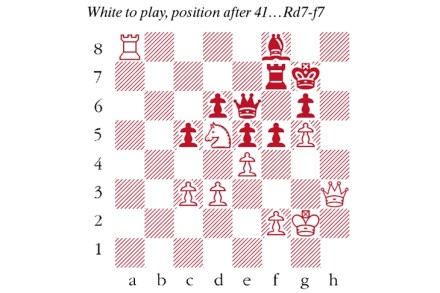
Geometry shmometry. The pirouette of a knight may be pleasing to the eye, but sometimes what I really crave is a demolition. I don’t mean a smash-and-grab king hunt. I want to see a crumbling edifice, a colossal concrete barrier wilting beneath a torrent of water, as in The Dam Busters. On the chessboard, diagonal chains of pawns are our barriers: daunting, manmade and ostensibly impermeable. Aron Nimzowitsch theorised in My System that pawn chains should be attacked at their base. Sound strategy, but when the base lies beyond reach, a more drastic bombardment can be called for, such as that which occurred in a recent game between two computers. Leela Chess Zero has been hunkering down since the opening, and Stockfish has lain siege. We join the game at move 150(!

Sweet surrender

It’s over. Magnus Carlsen’s undefeated streak in classical chess has finally come to an end, after 125 games. It is hard to exaggerate what an unlikely accomplishment this is: Carlsen faced top-flight opposition in almost every game, winning 42 and drawing 83. He was beaten by the Polish grandmaster Jan-Krzysztof Duda at the Altibox Norway Chess tournament (played over the board!) earlier this month. Carlsen’s preceding loss came against Shakhriyar Mamedyarov during a difficult period in late 2018. Back then, the talk of the town was Ding Liren’s progress toward what became a 100-game unbeaten streak, while Carlsen’s confidence looked at a low ebb. With gritted teeth, he defended his world championship title against Caruana.

Chess players on ice

We are what we do. Alas, in its zeal to suppress the virus, this government would have many people doing not very much. Since March, many musicians, actors, sportspeople and more have had precious few opportunities to perform. In his 2008 book Outliers, Malcolm Gladwell claimed that the hundreds of live performances played by the Beatles in Hamburg 1960-1962 were a key ingredient in their later success. If he is right, 2020 marks a daunting setback for countless aspiring artists. Government handouts can mitigate the long-term damage to their careers, but they cannot possibly make them whole. Chess is in the same boat: it’s a communal activity where performance and practice are central.

A trout in the milk?

I can’t tell you why the Armenian grandmaster Tigran Petrosian was found guilty of cheating last month, because I don’t know. The event was the 2020 PRO Chess League, an online team event organised by Chess.com. Petrosian (not to be confused with his namesake, who was World Champion in the 1960s) was playing for the Armenia Eagles, who appeared to overcome the St Louis Archbishops by 9.5-6.5 in a David and Goliath final. Petrosian’s 3.5/4 score against the mighty Archbishops’ squad (including wins against Fabiano Caruana, Wesley So and Leinier Dominguez) was exceptional. After his games were investigated and the results overturned, the title (and $20,000 first prize) was re-awarded to the team from St Louis.

Real live chess

It is nigh on seven months since I sat opposite a flesh and blood opponent, so I expected to feel unusual playing my first games in the Schachbundesliga, Germany’s team competition. I had no special concern on grounds of health. German case numbers look (relatively) low, the playing hall was cavernous, to facilitate social distancing, and the organisation was slick. Rather, I feared that the trappings of Covid might tarnish the atmosphere. There was talk of mass testing before the event began. Plexiglass screens divided the board, and players wore masks as they paced around. Handshakes were out, hand sanitiser was in — tiny bottles wherever you looked. There was no coffee. No coffee! What gritty reportage might one dispatch from this brave new world? Nothing of the sort.

When Garry met Fabi

Send in haste, repent at leisure. It is a cruel certainty that you will sooner or later text your intimate thoughts to the wrong person, or hit ‘reply all’ by accident. The second you spot this, your heart will leap into your mouth. That sensation is much like how a mouse slip feels during an online game of chess, when you move a piece and release it on the wrong square. If the universe is merciful, it hardly matters and the game goes on. In the worst case, you’re done for: it’s time to resign. Internet chess provides another way to shoot yourself in the foot. To make a ‘pre-move’, you draw an arrow on the board to indicate a move before it’s your turn. As long as your move is legal, it will be played regardless of what your opponent does.

Changing the rules

Nothing courts us so nimbly as technology. Perhaps the chess computers have already won you over — I am dazzled by the riches they have revealed. For a jaw-dropping sense of wonder, try playing over a forced mate in 549 moves. Still, many yearn for a simpler time. A time when the mysteries of chess were plentiful, but studying the game ‘by hand’ yielded steady nourishment. A time when chess engines had not yet tempted us with their very own tree of the knowledge of good and evil. These days, that tangle of variations and verdicts is irresistible, but who can look at their own play without a sense of shame? Meanwhile, professional players must work harder than ever to harvest fresh ideas.

Internet trouble

It was as baffling to me as quantum entanglement. Every time the Algerian player on the Zoom call shared his screen, my own screen share would stop working. That we were playing in separate matches was beside the point — this was online chess under something like exam conditions, and the software glitch left me briefly in breach of the rules. For 20 years, I have treated online chess as a delightful form of escapism, where wine is welcome, clothes are optional, and my queen can be freely sacrificed in the pursuit of glory. So it was a strange experience, representing England in the Online Olympiad last month. Suddenly there were cameras and protocols and responsibility. All this feels normal in the tournament hall, but not when seated in front of my laptop.

Act of God

Man plans, God laughs. Fide, the international federation, organised an Online Olympiad, with 163 teams taking part. We got a global internet outage during the final. The disruption hit the Indian players at a critical stage, in the second of two matches against Russia. (The first was tied 3-3). India were soon to be trailing 2.5-1.5, but had realistic hopes to even the score on the two remaining boards. But when those two players lost their connection to the website where the games were played, their time elapsed and they lost. The Indians lodged an appeal, but the appeals committee couldn’t reach a unanimous verdict. It fell to Fide president Arkady Dvorkovich to settle the matter. Dvorkovich is Russian, so an impartial ruling was impossible.

Carlsen vs Nakamura

Facing Magnus Carlsen, you have two problems. The first is obvious — he’s the best player in the world. The second lies in your awareness of the first. Countless players have seemed bewitched by the world champion, drained of the confidence needed to push for a win. In a single game, a strong grandmaster may well hunker down and steer the game towards a draw, but that’s a doubtful strategy in a long match, where critical mistakes will inevitably occur. I didn’t credit Hikaru Nakamura with much of a chance against Carlsen in the finals of the Magnus Carlsen Chess Tour, the series of elite online events held over recent months. On paper, he is a strong contender. Online rapid chess plays to Nakamura strengths, and he is even more dangerous in blitz playoffs.

Streaks of brilliance

Last week, snooker ace Ronnie O’Sullivan won his sixth World Championship at the age of 44, a full 19 years on from his first title. A few days earlier, he had taken a pop at the younger generation: ‘They’re not that good really… I’ve probably got to lose an arm and a leg to fall outside the top 50!’ You wouldn’t expect the same blunt turn of phrase from Vishy Anand, but in terms of longevity, he’s the obvious counterpart in chess. Almost 25 years have passed since he first challenged Kasparov for the world title. Anand turned 50 last year, and just three years ago added another World Rapid Championship to his collection.

The King’s Gambit

Does Bear Grylls play chess? If he does, I’m sure he would favour the King’s Gambit. As chess openings go, it is primitive and hazardous. Playing it well demands a kind of reckless, wholehearted optimism that few can muster. Ostensibly, you sacrifice just a pawn (1 e4 e5 2 f4), but really, you’re already in deeper, since the aspiring gambiteer mustn’t flinch from chucking a piece or more on the bonfire. Most players find it more agreeable to watch others sacrifice their pieces. Indeed, sacrificial classics such as the ‘Immortal Game’ (Anderssen–Kieseritzky, London 1851) have a timeless appeal. But for those with the requisite swagger, nothing stokes the imagination like playing the opening.

The view from on high

‘Cabin crew, ten minutes to landing!’ Are there any more exhilarating words? Soon, for a few precious minutes, one can fix one’s gaze on the approaching landscape. The patchwork fields, the lines of terraced houses and shuffling cars — all woven together in an intricate fractal. From a certain point of view, these simple things are the crowning achievements of civilisation. Photographers at large chess tournaments often choose to capture an aerial view of the playing hall. To my eyes, it makes for a similarly uplifting sight. Hundreds of chess boards aligned in an arena, their occupants riveted with dedication — what better evidence of human society in rude cultural health?

Tech mate

I am sure I have posed more questions to the chess engine Stockfish than to any living being. I love the instant gratification: you give it a chess position and it gives you an answer: the best move and an evaluation measured in hundredths of a pawn, like +1 24. Leave it alone, it will delve deeper; move a piece, it will respond anew. In human terms, ‘Ooh, a smidgen better for White’ gives way to ‘Go there, and your rook gets blown away’. The chess engine is, by turns, a spirit level and a hurricane forecast. The basic design of a traditional chess engine like Stockfish is simple: check all the moves, back and forth, for both sides, and tot up the value of the pieces in each scenario. Then choose a move accordingly.

The maestro

‘Had I not become a composer, I would have wanted to be a chess player, but a high-level one, someone competing for the world title.’ So said Ennio Morricone, who died earlier this month at the age of 91. Looking back on a lifetime of work, you don’t doubt that he could have done it. The Italian ‘maestro’ was best known for his transcendent film scores; the coyote howl theme from Sergio Leone’s The Good, the Bad and the Ugly, came to symbolise the Italian Western genre. Less well-known is that Morricone composed ‘Inno degli scacchisti’ (‘Chess players’ anthem’) for the Turin Olympiad in 2006.

An ugly duckling problem

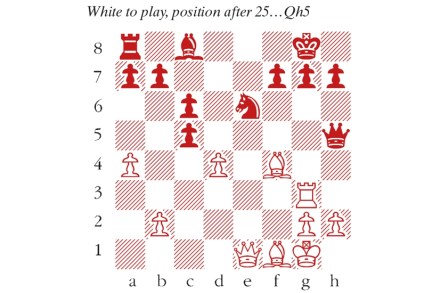
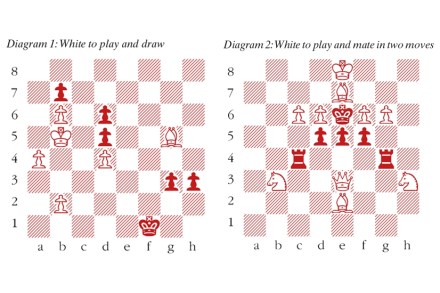
The position shown in this week’s main diagram is the starter problem for the Winton British Chess Solving Championship, an annual competition. White must force mate in two moves, against any defence. (White moves, then Black moves, then White delivers checkmate.) For entry details, see the final paragraph. Many composed positions have an ugly duckling problem. Practical players are accustomed to discernible pawn structures and an approximate balance of material. An irrational starting position, like this one, is apt to draw a little wince. But look deeper, as there is grace and harmony to be found. Composed problems teem with ingenious and beautiful ideas expressed in ways that you might never encounter in practical play.

The Streisand effect

There is no sight so compelling as one that would be hidden. I am fascinated by the Streisand effect, named after Barbra Streisand, whose Malibu house appears in a large online collection of aerial photographs documenting the California coastline. In 2003, she filed a lawsuit to have it removed, which as well as being unsuccessful drew much more publicity to the photo. You can count on that appetite for mischief: Goya’s ‘Portrait of the Duke of Wellington’ was more in the public eye after it was stolen from the National Gallery in 1961 than before. (Wittily, the painting ‘appeared’ the following year in the hideout of Bond villain Dr No; the real thing was returned in 1965).