Chess

The Polgar Challenge

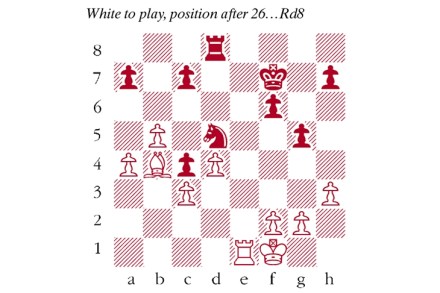
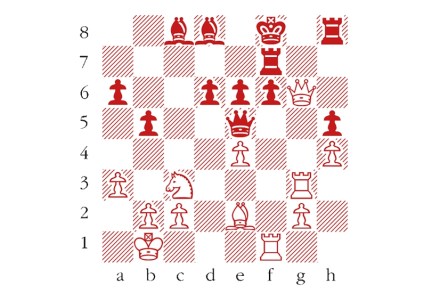
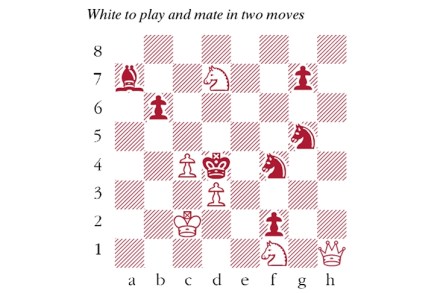
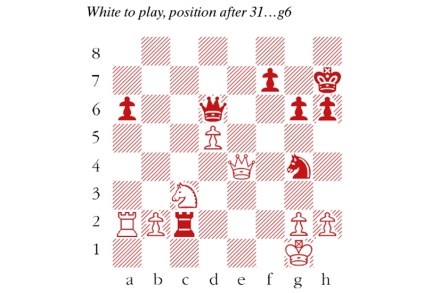
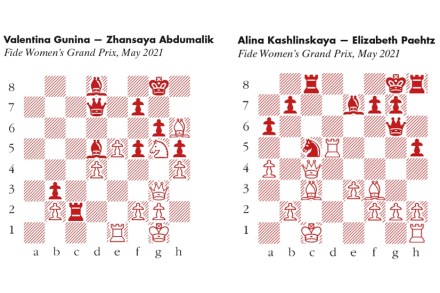
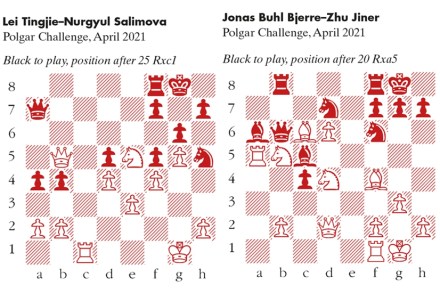
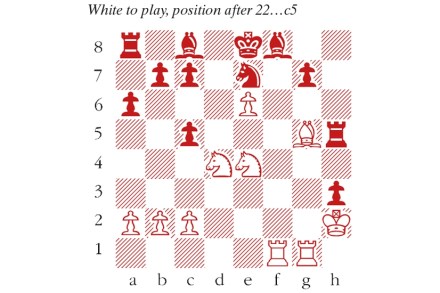
Rameshbabu Praggnanandhaa, at 15 years old one of India’s most exceptional young players, emerged as the winner of the Polgar Challenge, an online event between 20 of the world’s brightest talents which took place earlier this month. It was the opening event of the $100,000 Julius Bär Challengers Chess Tour, and Praggnanandhaa earned himself a qualifying spot in the next Meltwater Champions Chess Tour event, alongside Carlsen and others. The mixture of ten male and ten female players gave the event an interesting spin. The top two women were both from China: Lei Tingjie and Zhu Jiner scored 10/19. The examples below show each get the better of a sharp tactical exchange. Lei Tingjie–Nurgyul SalimovaPolgar Challenge, April 2021 Strategically, Black is busted.

European Online Club Cup

Since the start of the pandemic, opportunities for serious competition between players ranked outside the world’s top 20 have been scarce. So there was a pent-up appetite for the European Online Club Cup, which took place at the end of March, with more than 500 players registered (including more than 150 grandmasters) across 91 teams. Several teams from the 4NCL (Four Nations Chess League) took part: current champions Guildford, as well as Wood Green, Wood Green Monarchs, and Celtic Tigers. With backing from Roger Emerson and Nigel Povah, the Guildford lineup consisted of England team regulars Michael Adams, David Howell, myself and Gawain Jones, as well as Ivan Cheparinov from Bulgaria.

Unfair play

Twenty players were disqualified from the Fide World University Online Championships, out of almost 900. Does that call for moral despair, righteous jubilation, or just a weary shrug? It is no revelation that policing the game has become a major challenge, made all the more urgent by the shift toward playing online. The first obstacle is a technical one — how to identify all the bad apples without picking up false positives? Kenneth Regan is a computer scientist and international master whose statistical research has shown that the raw moves are packed with clues. Using the suggested moves from a top chess engine as a benchmark, his software can quantify how precisely a player has played.

Fortune favours the brave

If you wish to unsettle your opponents, first attack them and second, play the moves quickly. It’s far from easy to pull it off, but nobody does it better than Ian Nepomniachtchi. Among the world’s best, ‘Nepo’ stands out for his aggressive play, made all the more dangerous by marshalling an element of bluff. Are those moves coming so fast because he is still playing from memory, following his sharp opening repertoire? Has he already seen that the attack is overwhelming, and barely merits a second thought? One cannot know for sure, but Nepo is such a strong player (fourth in the world, at the last count) that one has to take him seriously. Nor does staring down a bluff promise an easy victory.

Everybody must get stoned

Have you ever played the Frankenstein-Dracula variation? The Monkey’s Bum? The Nescafé Frappé Attack? These are all real chess openings, and each has some merit. That is more than can be said for the Bongcloud, which begins with the moves 1 e4 e5 2 Ke2. This daft opening exploded in popularity last year when it was championed (in jest) by grandmaster and Twitch streamer Hikaru Nakamura. In fact the Bongcloud has hung in the air for much longer than that. According to one origin story (which appears genuine, but who knows?) an online persona named Lenny_Bongcloud was already playing it more than a decade ago. The Bongcloud has impeccable memetic credentials.

When the universe winks

I write this with a sunny feeling. That’s partly because spring is upon us, but mostly because I have just spotted one of those winsome coincidences which lifts the spirits with its serendipity. The first part of this delightful dyad occurred in the preliminary stage of the latest (and ongoing) Magnus Carlsen invitational event. Shakhriyar Mamedyarov–Daniil Dubov,Magnus Carlsen Invitational, March 2021 Two pawns up, Mamedyarov is certainly expecting to grind out a win. His last move, 66 Bd4-e5 threatens Re7-c7+, skewering the bishop on c2. Quick as a whip, Dubov fires back with 66…Rf1!! to attack the pawn on f5. If White loses that pawn, the game is bound for a draw, and anyway Mamedyarov’s move 67 Rc7+ appears to win the bishop.

Armenian champions

In the 21st century, which country has won more international chess Olympiads than any other? Russia? USA? China? None of the above — it’s Armenia, which won gold three times (2006, 2008 and 2012). Despite a population of just 3 million, the country has a healthy number of top flight grandmasters, and Levon Aronian (the current world no. 5, and former world no. 2) has been its pre-eminent player for many years. So Aronian’s announcement that he will switch federations, representing the USA in future events, is significant. He will relocate to St Louis, which has become a major chess centre in recent years, with the backing of the American philanthropist Rex Sinquefield.

Play from home

Is working from home the future of a productive society, or a fleeting aberration? Nobody knows yet, but a significant minority (at the very least) have found it viable, and even desirable. The shift in perception creates possibilities that weren’t there before. Similarly, chess organisers are discovering a strong appetite for ‘play from home’ events, and I anticipate that we will see lots of new online tournament formats in the coming years. Last summer, Fide’s Online Olympiad was the first of its kind, and later in 2020 came the Online Olympiad for People with Disabilities, which I wrote about last week. February 2021 saw another new event — the Fide Online World Corporate Chess Championship.

Synthetic diamonds

Diamonds are forever, they say. Likewise, brilliant games of chess have an everlasting sparkle. I will never tire of replaying the combination from Steinitz–von Bardeleben, Hastings 1895. So I’m a huge fan of tournaments which award brilliancy prizes, in recognition of these achievements. Fide recently organised an Online Olympiad for People with Disabilities. This excellent initiative was a reminder that the game is uniquely accessible, and saw 61 teams competing from 45 different countries. Many players overcame significant physical obstacles in order to take part. Vladimir Trkaljanov, who is visually impaired, was awarded the Gazprom Brilliancy prize, his game singled out from the shortlist by six out of 13 international judges.

He who hesitates…

If there was one ingredient which separated the two finalists of the Opera Euro Rapid, it was confidence. The third event of the Meltwater Champions’ Chess Tour, which concluded last weekend, saw Wesley So take on Magnus Carlsen in the final. That was the same match-up we saw in the final of the Skilling Open in November, and yet again So emerged as the victor. Wesley So has become a difficult opponent for the World Champion, since he also beat him in the 2019 Fischer-Random World Championship. Carlsen has looked out of sorts for months now. ‘I don’t trust myself,’ he said regretfully, after the match ended. ‘This shows in critical moments.’ The game below was typical of that hesitancy.

Knights before bishops

In 2005 Steve Jobs gave a commencement address at Stanford University. The late Apple CEO kicked off with a story about a calligraphy course he took after dropping out of college in the 1970s. He was fascinated by the artistry of it, but what seemed like a whim of idle curiosity found a practical application ten years later when it came to designing typography for the Mac. Jobs’s tale of resurgent aesthetic ideas came to mind when I read an interview which Demis Hassabis, the CEO of artificial intelligence company DeepMind, gave to the Times last year. Hassabis is a brilliant technologist, but while growing up he was also one of the top-ranked junior chess players at international level.

Double Dutch

Are you not entertained? The climax of this year’s elite Tata Steel tournament was as riveting as it was vulgar. After two weeks of sublime classical chess played over-the-board in the Dutch town of Wijk aan Zee, the winner was decided by two blitz games and an armageddon playoff — crash, bang, wallop. Surprisingly, neither Carlsen nor Caruana remained in contention. Instead, it was the Netherlands’ two top players, Anish Giri and Jorden van Foreest, vying for the title. Giri is a steady world-class player who already tied for first in 2018, losing out to Carlsen in the playoff. The Dutch no. 2, van Foreest, is less experienced, but his games have always fizzed with ideas. He seems to have fused that with some extra maturity, and, like Giri, was undefeated on 8.5/13.

Remembering Kavalek

‘I began my escape from the communist Czechoslovakia 42 years ago, on Sunday, September 1, 1968. According to Wikipedia, I bought several crates of vodka with my winnings at the Akiba Rubinstein Memorial in the Polish spa of Polanica Zdroj, bribed the border guards and drove to West Germany.’ Thus began an article written by Lubomir Kavalek in the Huffington Post in 2010. How curious to write ‘according to Wikipedia’ about oneself! Was this, I speculate, a gentle hint to the reader that the story might be apocryphal? The Soviet tanks in Prague were decidedly real. Born on 9 August 1943, ‘Lubosh’ Kavalek had studied journalism, and was the reigning chess champion of Czechoslovakia when he defected.

History at Hastings

The Hastings International Chess Congress hasn’t skipped a year since the second world war, so I was delighted to learn that the tradition would be honoured by a strong online event which took place earlier this month, featuring a dozen top British players. For the second year running, the event was sponsored by Caplin Systems, makers of financial trading technology. (The Caplin British Online Championships were held last month and won by Michael Adams. Matthew Wadsworth and Matthew Turner secured qualifying spots for Hastings.) Reading that this year’s event would be a centenary caused me some puzzlement, because I was certain that the Hastings centenary took place in 1995 — I was there. My event, the Hastings Challengers, was played on Hastings pier.

Missed opportunities

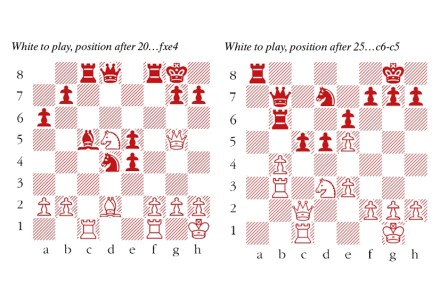
In game 1 of his Airthings Masters Final against Radjabov, Aronian’s pawn push 21 e4-e5 (shown in the first diagram) created a tactical explosion. This was rapid chess at its best — stylish and exuberant. And yet, as thrilling as this game was, it was a pity that the players had so little time to navigate the complications. If they had, each player might have unearthed an even deeper idea. In the first diagram, Radjabov had an improvement, as subtle as it is stunning: 21…d3!! 22 Qxd3 fxe3 23 Qg6+ reaches the same position as in the game, with one crucial difference; the missing pawn on f4 benefits Black, for reasons explained in the comment to 26…Bf5. The second diagram shows Aronian’s missed opportunity. The immediate 29 Ng5 allows 29…Qc4+.

Antiques Roadshow

It is one of life’s comforts to see a forgotten trinket being dusted off and appreciated afresh. So in chess, I am gently heartened to see a chess opening pass through that same phase of life. The game has its share of magpies, for whom a shiny new opening gambit is irresistible. Their approach has merit — after all, an ambushed opponent is a weakened one. But with time, the defence is remedied, and when the opening begins to look tarnished, it will soon be stuffed in the attic. It might be years, or decades, before it attracts any more attention. Even in the 19th century, some chess fashions had already been and gone, and come back around.

A puzzling dozen

This Christmas, government guidance says that board games are out and quizzes are in. Thus, 12 questions for Christmas. Answers here. 1. The Candidates tournament decides a challenger for the World Championship. Seven rounds were played in Yekaterinburg in March, but scheduling the second half is proving difficult. Which player declared ‘I’m ready to play, so to speak, in a garage, basement, zoo or train station.’ 2. The Queen’s Gambit was watched by 62 million households in its first 28 days, according to Netflix. ‘I thought nothing would beat THE TRIAL OF THE CHICAGO SEVEN but this does’. Which American author tweeted that?

Birthday surprise

The Magnus Carlsen Chess Tour is back. This time, the series of online events is rebranded as the Champions Chess Tour with a total $1.5 million prize fund. It marks an ambitious step forward for the Play Magnus group, which floated on the Oslo Stock Exchange in October and is currently valued in the ballpark of $100 million. Norwegian companies NRK and TV2 have purchased domestic broadcasting rights for the tour, while a separate deal with Eurosport looks set to attract a fresh audience. Games will be played on the chess24 platform, and the tenth and final event in the series will finish on Sunday 3 October, 2021. It’s a mundane observation that chess tournaments usually end on a Sunday. Usually, participants and organisers have jobs to return to on Monday.

Chess improvement

The juicy prospect of improvement constantly dangles above a chess player. Those morsels of knowledge one has acquired whet the appetite for others which lie just out of reach. Even players at peace with their ambient proficiency can’t help but acknowledge that their better games coexist with lousy ones. Once you admit that, it’s a hop, skip and a jump to the idea that replicating the good games might confer improvement. Unless you have the equanimity of a monk, wanting to play well becomes an unshakeable existential burden. Many chess books will promise to boost your results at the board. Usually, it is taken for granted that absorbing the book’s insights will generate the desired improvement.

Forbidden pairings

Put yourself in the shoes of Aryan Gholami, the teenage master from Iran who was paired with an Israeli opponent in Sweden in January 2019. It’s a blitz tournament, so you’re due to begin in minutes. For political reasons, your country expects that you will refuse to play the game, and there may be repercussions if you do play it. Gholami duly forfeited the game. His ‘virtue’ of omission was celebrated back in Iran, where he was photographed with Supreme Leader Ali Khamenei and General Qasem Soleimani (the latter was killed in a drone strike earlier this year). Recent years have seen a spate of incidents in which Iranian players boycotted their games with Israelis. It is a paradox that this regrettable practice attests to a flourishing chess scene in Iran.