Chess

Titles bonanza

At the beginning of August, seeing his outstanding performance at the Fide World Cup in Sochi, I wrote that Ravi Haria ‘must now sense that the grandmaster title is well within reach’. But who could expect that he would achieve two more grandmaster ‘norms’ before the month was out? Haria, 22, now has all three norms (tournament results at grandmaster standard) he needs, and requires just a small boost to his international rating before he is awarded the title. Over-the-board chess has sprung back to life this summer, and Haria is one of many players making up for lost time.

Best-laid plans

A popular conceit among chess authors, particularly dead ones, is to describe a fine game as the execution of a multi-stage plan. In fact, a close inspection often reveals that the plan could only have been mapped out in hindsight, and the loser’s fate was entirely avoidable. Grand plans are overrated, but modest plans are indispensable. I like to wonder, what would I do with two or three moves? If I could place this piece anywhere on the board, where would it go? What would a prettier version of my position look like? Most of these ideas should be pruned ruthlessly, as they won’t survive contact with the enemy. But when you hit upon something the opponent can’t comfortably prevent, that’s a plan!

Remembering Evgeny Sveshnikov

There be dragons! What we now call the Sveshnikov variation of the Sicilian defence was, in the 1970s, largely uncharted territory, and viewed with deep suspicion. Its modern name immortalises the Russian grandmaster whose pioneering analytical efforts, and practical success, put the variation on the map. Evgeny Ellinovich Sveshnikov died on 18 August at the age of 71. After his graduation in 1972, Sveshnikov worked towards a PhD at the Department of Internal Combustion Engines in the USSR. But his career turned towards chess, and in 1976 he was part of the Soviet team which won gold medals at the World Student Team Championship. The following year he was awarded the grandmaster title, and he went on to participate in nine USSR championships.

Containment

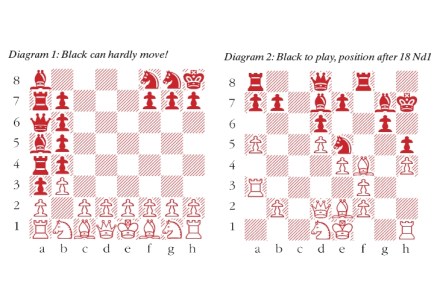
‘Exchange chess’ (also known as bughouse) is the chess equivalent of a three-legged race. It is played in teams of two, on adjacent boards with opposite colours, and it works best when nobody takes it seriously. The only essential rule is that when you capture an opponent’s piece, you hand it to your partner, who may later plonk it down on an empty square in lieu of moving a piece. A checkmate on either board wins, no matter how dire the adjacent situation. A long time ago, when we couldn’t convene a foursome, a friend taught me to play ‘one-board exchange chess’. This variant, which I now see is listed as ‘Replacement chess’ in the Classified Encyclopedia of Chess Variants, requires just two players.

Calculated risks

Two years ago, the brilliant young Polish player Jan-Krzysztof Duda made a baffling decision. In the second game of his knockout match with Wesley So at the Moscow Grand Prix, Duda needed just a draw to advance to the next round, having won the first game with remarkable ease. Perhaps he was mindful that when one only needs a draw, excessively timid play is rarely rewarded. Even so, it was an eccentric choice to employ one of the wildest variations in the Sicilian Dragon. Duda’s risk barometer looked all out of whack — like a diner who has decided the mussels look a bit dodgy, and orders the pufferfish instead. (He went on to lose the game, and later the match.

The Fide World Cup

As I write this, the Fide World Cup is underway in Sochi, the Black Sea resort in Russia which hosted the 2014 Winter Olympics. It’s a thrilling event for spectators, who get to watch high-stakes chess in all its forms — fast, slow, wonderful and blunderful. The main knockout event began with a field of 206 players (with 50 seeded into the second round), while the women’s event had half that number. Each match sees two classical games on consecutive days, followed by a day of tiebreaks at fast-paced time limits. It is a brutal competitive environment, and those who reach the final stages have spent almost a month in fear of that one mistake which would put them on the next flight home.

The king of no castling

In the body of chess rules, castling is a clumsy protuberance. Once per game, you get to move king and rook at the same time, with a bewildering list of exceptions. (One dreads having to broach these gotchas with a novice opponent who has castled improperly.) Despite its convoluted logic, castling is nothing more than a convenience, and the game could function perfectly well without it. Five hundred years ago, the rules of chess were still evolving, with significant regional variations. The ‘king’s leap’, a precursor of modern castling, permitted the king to make one move as a knight jump (perhaps from e1 to g2), while in other forms it could step two squares any which way (so, for example, e1 to g3 was also on the menu).

Kasparov’s tailspin

In a game between top players, the opening moves signify not only the battleground they have embraced, but also the terrain they have avoided. In his prime, Garry Kasparov’s opponents would often duck the most critical choices, fearing the champion’s formidable advantage in home analysis of complex positions. But those who yielded an inch at the outset faced an uphill struggle of a different sort, and Kasparov won countless games from that psychological vantage point. Since his retirement in 2005, Kasparov has made sporadic appearances in speed events against the world elite, with respectable results. But his appearance earlier this month at the Grand Chess Tour’s blitz event in Zagreb was disastrous, as he scored just 2.5/18. What went wrong?

Lock-picking

In his autobiographical book Surely You’re Joking, Mr Feynman! the late American physicist Richard Feynman described how he amused himself by cracking open the safes at Los Alamos, which stored design papers for the Manhattan Project. He started out picking locks, which he describes like this: Now, if you push a little wire gadget — maybe a paper clip with a slight bump at the end — and jiggle it back and forth inside the lock, you’ll eventually push that one pin that’s doing the most holding, up to the right height. The lock gives, just a little bit, so the first pin stays up — it’s caught on the edge. Now most of the load is held by another pin, and you repeat the same random process for a few more minutes, until all the pins are pushed up.

The world has a new youngest grandmaster

Abhimanyu Mishra became the world’s youngest grandmaster last month, at 12 years and 4 months old. The boy from New Jersey achieved the milestone by scoring 7/9 at the Vezerkepzo GM Mix event in Budapest last month. In doing so, he has broken the record set almost 20 years ago by Sergey Karjakin, who became a grandmaster at 12 years and 7 months old, and went on to challenge Magnus Carlsen for the World Championship in 2016. His father, Hemant Mishra, made it clear that they treated breaking this record as an end in itself, which has required extraordinary dedication and persistence. Along the way, Mishra suffered a run of 35 games without a win — an exacting experience for any player.

Firestarter

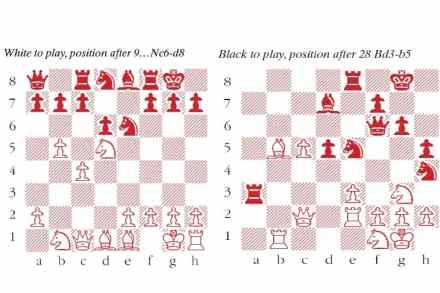
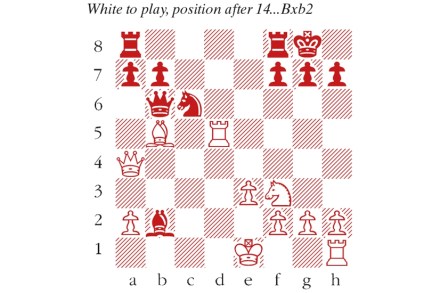
It’s a joy to watch a player like Shakhriyar Mamedyarov, who can light a fire with his bare hands. Where most are content to develop their pieces in the opening moves, he has a knack for igniting the play at the slightest provocation. In the game below, Caruana’s move 9 h3 looks unremarkable, but Mamedyarov saw a ‘hook’ for his attack which began with 9…g5 (see diagram), since the imminent advance g5-g4 threatens to open the g-file, so that a rook on g8 can menace the White king on g1. Mamedyarov’s vigorous assault brought him an important win on his way to tournament victory at the Superbet Chess Classic, held in Bucharest last month. The event marked a welcome return for the elite Grand Chess Tour, whose 2020 season was cancelled.

How to lose

Millions of people would see losing to Anand as a privilege rather than a disgrace. So it is simply astonishing that one lucky opponent, facing the Indian star in an online simultaneous display, squandered the opportunity by cheating. ‘Checkmate Covid, celebrity edition’, hosted earlier this month by Chess.com, was supposed to be a lighthearted event, with a handful of Indian celebrities taking on the former world champion to raise funds to tackle the pandemic in India. Billed as India’s youngest billionaire, Nikhil Kamath is the co-founder and CIO of Zerodha, an Indian brokerage company, but his claim to have been a chess champion in his youth looked doubtful when he blundered a pawn on the very first move.

Macaques and defence

January normally brings cheerful photos from the Gibraltar Chess Festival, where visiting chess-players get an impromptu snap with the Barbary macaques which inhabit the island. Alas, the 2021 festival was off, while the Fide Women’s Grand Prix, a 12-player all-play-all which forms part of the Women’s World Championship cycle, was planned for January and then postponed. Gibraltar vaccinated most of its adults by March, and by mid-May the government announced that there were no active cases among residents or visitors. That was good timing for the Fide Women’s Grand Prix, which had been rescheduled for later in May, and offered a refreshing glimpse of over-the-board chess. Zhansaya Abdumalik, 21, from Kazakhstan, won the event convincingly. With a magnificent 8.

The back-rank mate

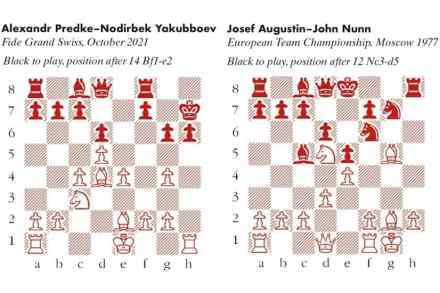
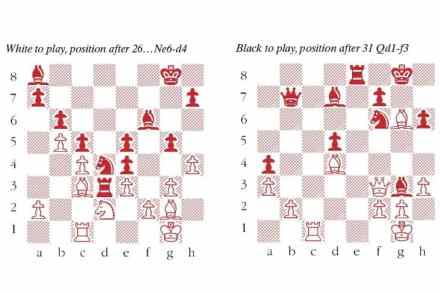
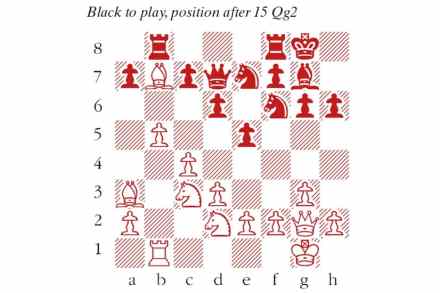
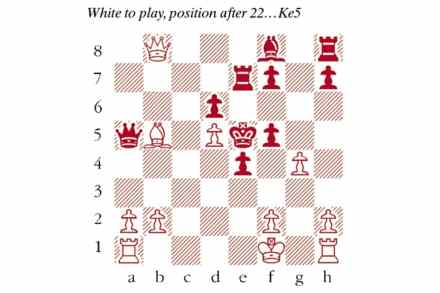
Compared with Anastasia’s mate, or an epaulette mate, the humble back-rank mate is named without imagination or whimsy. It is the Ronseal of mating patterns, administered by a rook or queen to a hapless king stuck on the rank behind its own pawns. But there is a rich variety of tactical motifs which culminate in this simple pattern, as shown by two of Magnus Carlsen’s recent games. Dubov–Carlsen FTX Crypto Cup Prelims, May 2021 (see left diagram) Carlsen has just grabbed a pawn on e4, so the knight on d5 lacks support. The simple 21 Nc3 looks roughly equal, but Dubov launched a volley of tactics with 21 Qxe5. His idea was revealed after 21…Rf5 22 Qxd4 Bxd4 23 Rxc8, because after 23…Qxc8 24 Ne7+ White emerges a knight up.

Hybrid chess

Chess was played by cable in the 19th century because… well, why not? And because everything old is new again, 2021 has brought us ‘Hybrid chess’, in which players play online, but congregate in hubs shared with other players under the supervision of an arbiter. This time, put it down to human frailty and our need to visit the loo. In a time when a smartphone will suggest moves to beat the world champion, competitive online chess relies on the watchful eye of a webcam to deter casual cheating when people play from home. For that reason, online games are overwhelmingly played at rapid and blitz time controls, because when games last less than 40 minutes, it is reasonable to require that players remain at their desk throughout.

Daredevil kings

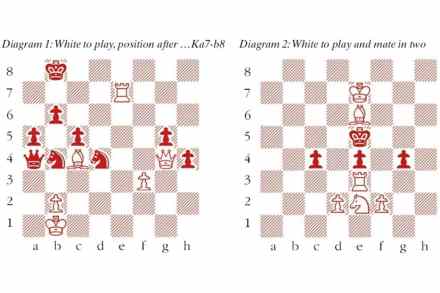
The fifth match game between Potter and Zukertort, played in London in 1875, saw a dogged struggle. The final position is shown in the diagram below, where the players agreed to a draw after 91 Kb5-c4. William Norwood Potter, an English master, must have reasoned as follows: the protected passed pawn on d4 obliges the White king to stand guard. The passed a- and b-pawns cannot overcome Black’s king on their own, and so a draw is inevitable. But Potter missed a splendid winning idea, in which the White king makes a heroic charge up the board. An illustrative variation: 91…Kc6 92 b5+ Kb7 93 b6 Ka6 94 Kb4 Kb7 95 Kb5! d3 96 a6+ Kb8 97 Kc6 d2 98 a7+ Ka8 99 Kc7 d1=Q 100 b7+ Kxa7 101 b8=Q+ Kxa6 102 Qb6 mate! There is no room for error in this kind of operation.

Indian variant

Modern chess includes a panoply of ‘Indian’ openings, which share a common root in the starting moves 1 d4 Nf6 and include the King’s Indian, Nimzo-Indian, Queen’s Indian, Bogo-Indian, and Old Indian. But before 1900, the prevailing wisdom held that it was advisable for Black to contest the centre with a pawn advance. So the ‘Indian defence’, whose main characteristic was the fianchetto of the king’s bishop to g7, was a rarity — at least in games whose records survive. It was championed, with considerable flair, in a remarkable series of games played in Calcutta. John Cochrane was a Scottish barrister who practised in India for much of his career.

What’s it worth?

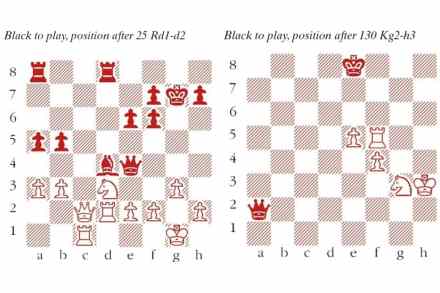
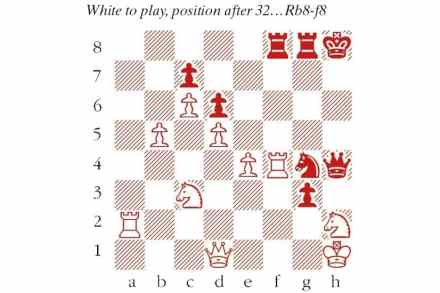
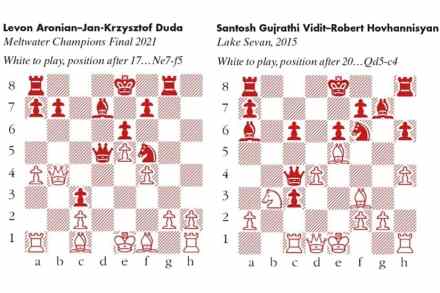
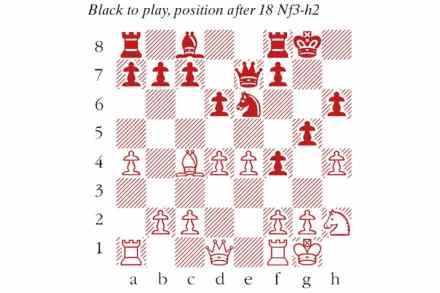
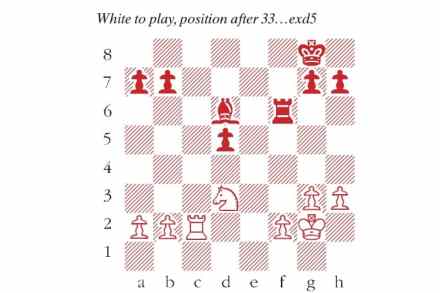
The rule of thumb for weighing up piece exchanges says that pawns are worth one, knights and bishops three, rooks five and queens nine. It is such a useful guideline that one can go a long way without ever questioning it, but strong players have a feeling for the limitations. The first diagram shows a critical moment from the final of the New in Chess Classic, the latest online event in the Meltwater Champions Chess Tour, which was won by Magnus Carlsen. He didn’t hesitate to sacrifice rook for knight and pawn, because the resulting position looks so cosy for Black. The knights on f6 and h5 are secure and ready to jump into e4 and g3. White’s pawn on f5 is an impediment to his own pieces, so the bishop and rooks are bystanders, while the pawn on e3 is permanently weak.

Dead brain cells

As round 14 of the Candidates tournament unfolded, I had the feeling of watching an anti-climactic post-exam bender. Ian Nepomniachtchi had already passed with distinction, wrapping up tournament victory with a round to spare. The Russian plays energetic chess, but part of his success in Yekaterinburg was surely attributable to tempering his impulses throughout the event. In the final round he knocked out a few brain cells with his exuberant attack against Ding Liren. It was soundly refuted, but that hardly mattered. Nepomniachtchi’s instinctive aggression promises a thrilling clash of styles in the World Championship match against Magnus Carlsen, which is scheduled to commence in November 2021.

Immovable object meets irresistible force

The Candidates tournament resumed on 19 April in Yekaterinburg. Eight players competed for a €500,000 prize fund, but only one prize mattered — first place, and the right to challenge Magnus Carlsen in a world championship match. It was Russia’s Ian Nepomniachtchi who triumphed — more on that next week. But the clash below, a true chess epic, gets my vote for the best game. At the halfway mark, Fabiano Caruana trailed his next opponent, Maxime Vachier-Lagrave, by a full point. Caruana is feared for the depth of his preparation and had a year to prepare for this game, knowing that Vachier-Lagrave is stubbornly principled in sticking to his Najdorf Sicilian (characterised by the move 5…a6), whose intricacies he knows inside out.