Chess

The battle of the sexes

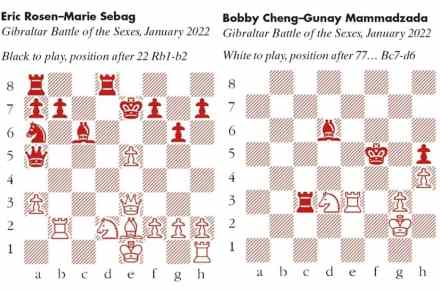
One tradition at the annual Gibraltar Masters is a high-spirited skittles match played in the evening between teams of men and women, dubbed the ‘Battle of the Sexes’. In 2020, to much amusement, the women won a playful miniature after the flamboyant 3…f5 quickly backfired: 1 e4 e5 2 Nf3 Nc6 3 Bc4 f5 4 d3 fxe4 5 dxe4 Nf6 6 Ng5 Qe7 7 Bf7+ Kd8 8 Ne6+ Black resigns. This year, Gibraltar hosted a real ‘Battle of the Sexes’ event with a £100,000 prize fund. It featured the unusual Scheveningen format where players in teams (ten women and ten men respectively) faced each member of the opposing team over ten days. The teams (with one reserve on each side) were carefully selected to ensure a balanced match.

Magnus’s tasks

World championship match play has a stony logic, where there are no prizes for glorious endeavour. It calls to mind the old joke about two hunters who encounter a bear. One puts on his running shoes. ‘You can’t outrun a bear,’ objects his friend. ‘I don’t have to outrun the bear, I only have to outrun you.’ After beating Ian Nepomniachtchi in December, Magnus Carlsen reflected on his experience of winning five world championship matches. ‘I managed to stay relatively process- and passion-driven against Anand in 2013, while in the last four matches it has been all about results.’ Those months consumed by a single opponent surely take a toll on the psyche.

Pixel this

When Magnus Carlsen won last year’s Meltwater Champions Tour, they made two trophies. One was for Carlsen, and the second was auctioned online, fetching a sum in digital currency of around $25,000. The trophy only exists as a video showing a stack of rotating gold squares, like a Donald Trump skyscraper from the future. If you bought it, you’d be right on trend. Earlier in 2021, the winning bid at Christie’s for a digital artwork named ‘Everydays: the First 5000 Days’ came in at $69 million. That was for an elaborate collage created by graphic designer Mike Winkelmann, using the pseudonym ‘Beeple’. The pixels aren’t worth diddly squat, since anyone can download a copy.

A multitude of queens

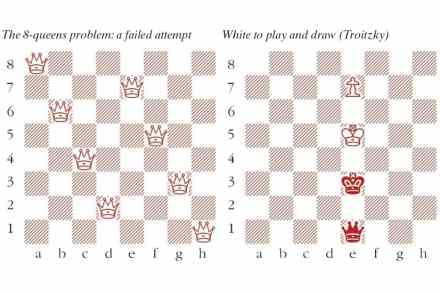
Here’s a challenge which appeared in a German chess magazine in 1848: place eight white queens on an empty chessboard so that no two queens occupy the same file, rank or diagonal. In other words, none of the queens may defend each other. Perhaps you start with a queen in the top left corner, on a8. The next might be placed on the adjacent file, nearby but not touching, on the b6 square, a knight’s move away from the first. Following the pattern, you put another on c4, and a fourth one on d2. For the e-file, we need to break the pattern, so let’s revert to near the top of the board, on e7. Flushed with success, you see that the ‘knight move’ pattern still works, and plonk two more queens on f5 and g3.

When travel unravels

Recently, with some regret, I declined an invitation to play chess in the Netherlands. I fancied the trip, but alas it made little sense to commit to what would have been a fleeting visit. Travel hurdles have become a Rumsfeldian ‘known unknown’, and sure enough, that country was in lockdown not a week later, requiring quarantine on entry from the UK regardless of vaccination status. Would they ease restrictions in time? It was a relief not to have to think about it. I was mildly bitten last summer, when my plans to play in Germany were left in limbo a couple of months before the start. Owing to what was then called the ‘Indian variant’, travel from the UK was temporarily verboten. But how long would it last?

Fresh start

Chess offers one ultimate consolation in defeat: the opportunity to set the pieces up and start again. At least in theory, a new game is a clean slate, and a release from past tribulations. But in practice, sometimes one simply cannot manage to air out the miasma of what came before. In the second half of the world championship match held in Dubai last month, Ian Nepomniachtchi was unrecognisable. Magnus Carlsen had landed a devastating blow in the sixth game, in a match hitherto tied at 2.5-2.5. His win, lasting 136 moves and almost eight hours (see my article of 11 December), seemed to utterly demoralise the challenger. A cascade of blunders in subsequent games allowed Carlsen to retain his title with a 7.5-3.5 victory.

Twelve questions for Christmas

1. ‘I like the game, the money, and the fame.’ Which Twitter-loving top grandmaster said that, in response to an interviewer’s question: ‘What three things do you absolutely love about chess?’ 2. Which former women’s world champion chose to sue Netflix, seeking damages of ‘at least $5 million’ for her portrayal in The Queen’s Gambit? 3. Who described recently, in The Spectator, his experience of being stopped at airport security in Beirut, when his chess set and clock set off the baggage scanner? 4. Which 18-year-old became, at the start of this month, the second ranked player in the world, behind Magnus Carlsen? 5.

Carlsen’s breakthrough

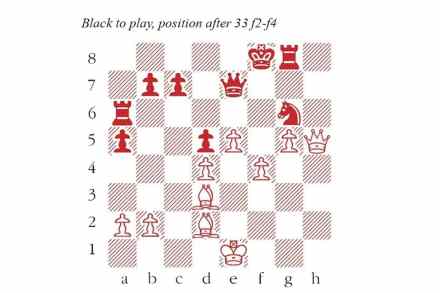
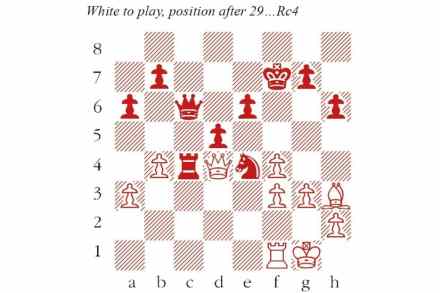
Game 6 of the Carlsen–Nepomniachtchi world championship match was one for the ages. After draws in the first five games, the world champion broke the deadlock with a 136-move victory — the longest in world championship history. It lasted almost eight hours, and Nepomniachtchi made the final mistake in an endgame with a lone queen against rook, knight and two pawns. In a balanced middlegame, ‘Nepo’ took a risky decision at move 25, offering an exchange of two rooks for Carlsen’s queen, creating winning chances for both sides. Magnus Carlsen–Ian Nepomniachtchi World Championship Game 6, Dubai 25… Rac8 26 Qxc8 Rxc8 27 Rxc8 Qd5 Attacking the pawn on b3. It’s important that 28 Nf4 Bxf2+ wins.

Mar del Plata

Alireza Firouzja produced a momentous performance for France at the European Team Championships, held in Slovenia last month. The 18-year-old, originally from Iran, had taken first place at the Fide Grand Swiss in Latvia just a few days earlier. In Slovenia, his seven wins and two draws was a staggering achievement, earning him an individual gold medal and propelling him to second place in the world rankings. In the overall team standings, it was Ukraine that took gold, finishing narrowly ahead of France on tiebreak. The England team got off to a shaky start, and we didn’t come close to repeating our bronze-medal-winning performance from the previous edition in 2019.

The world championship

‘Time to say Dubai,’ tweeted Magnus Carlsen, like some wry Bond villain, when he learned that the Russian Ian Nepomniachtchi would be his next challenger for the world championship title. Hosted at the Dubai Expo, battle will commence on Friday 26 November. Carlsen wrested the title from Viswanathan Anand in 2013, and since then has defended his title against Anand (again), Sergey Karjakin and Fabiano Caruana. But the Norwegian downplayed his match experience in appraising his prospects against the new challenger: ‘My biggest advantage is that I am better at chess.’ Still, world championship matches have an intensity all of their own, in which nerves and stamina are as indispensable as good moves.

Sacrificing the queen

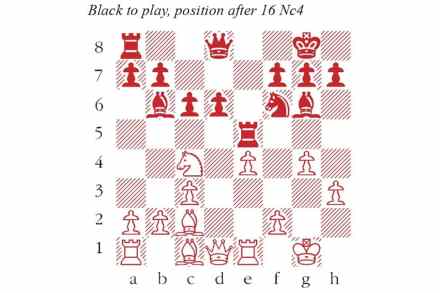
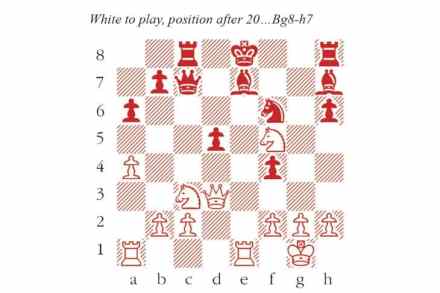
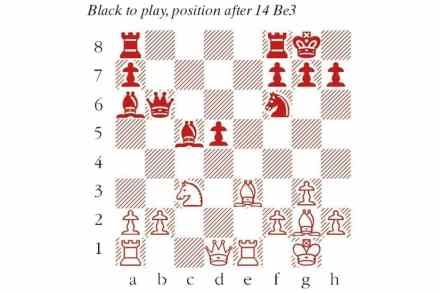
One of the most eye-catching games from the recently concluded Fide Grand Swiss in Riga saw an early sacrifice of queen for knight, bishop and pawn. This exotic balance of material usually favours the queen, based on the rule of thumb that pawn = 1, knight = 3, bishop = 3, rook = 5, queen = 9. But when the minor pieces coordinate well, particularly with rooks alongside, they can be more than a match for the queen. A queen’s greatest strength is her ability to attack, and perhaps fork, any pieces that are not nailed down. So when you jettison your queen for a miscellany of pieces, they had better resemble a florentine more than a fruit salad. It helps when the minor pieces have a clear target of their own. That is the situation that occurred after 14 Be2 (see diagram 1).

Fide Grand Swiss

Alireza Firouzja, just 18 years old, was the clear winner of the Fide Grand Swiss, which concluded in Latvia last weekend. Originally from Iran but now settled in France, Firouzja already looks like a credible future contender for the world championship, and his victory in the Grand Swiss has earned him a spot in the 2022 Candidates tournament, which will select the next challenger for the world title. The current challenger, Ian Nepomniachtchi, who won the Candidates tournament in April, will face the world champion Magnus Carlsen in Dubai later this month. Play begins on 26 November. England’s David Howell also produced an outstanding performance in Riga, finishing in a tie for fourth place.

Short fights

If you play chess like a wet rag, sooner or later you will be made to regret it. In Nigel Short’s new book Winning (Quality Chess, 2021), that precept pops up in countless guises, and nobody is above criticism. Peter Leko ‘infamously offended the gods by attempting to draw his way to the title’ in his world championship match against Vladimir Kramnik in 2004. Mikhail Gurevich pursued a ‘craven objective’ in trying to draw his way to qualification at the 1990 Manila Interzonal. (He was undone by Short himself.) Bronstein’s chances against Botvinnik in 1951 perished with his ‘abject capitulation’ in game 23. Russian grandmaster Aleksey Dreev was punished for a ‘wanton act of timidity’.

The Varsity match

Anyone who has attended the Varsity chess match knows that an online version just wouldn’t be the same. The annual event is held in great style at the Royal Automobile Club in London’s Pall Mall, and has tradition at its heart. This year’s, the 139th edition, could not be held at the usual time in March, but it took place last weekend, to coincide with the RAC Chess Circle’s Annual Dinner. Since the 2020 edition also took place just weeks before the onset of the first national lockdown, the mighty tradition of the Varsity match remains uninterrupted by the pandemic. (The last year without a contest was during the second world war.

Eaten by a bear

I don’t like losing at chess. It feels bad in the moment, whether my position subsides like a failed pudding, or crashes like a severed tree. It feels bad right afterwards too, staring at a big fat zero on the scorecard. But worst of all is the lingering knot of disgust, because usually one’s mistakes are echoes of shortcomings one knew about already, and there is no hiding from them. The chorus from Radiohead’s ‘Just’ (from The Bends) could as well be an anthem for sulking chess players. You do it to yourself, you do And that’s what really hurts Is you do it to yourself Just you, you and no one else You do it to yourself… But last week I lost a game and felt, well, pretty much fine.

The sudden mate

The hero pauses, plays the move, and announces ‘Checkmate!’ The villain crumples in shock. It’s a scene played out countless times on screen, but it so often looks ludicrous. In slow games between skilled players, checkmate on the board is much rarer than resignation. Occasionally, when the denouement is brisk and elegant, it will be played out to a finish. But in those cases, volunteering for the guillotine is a sporting gesture from the vanquished party. More often, the final phase of a chess game isn’t much of a spectacle. Extra piece, mop up some pawns, promote a pawn, hunt down the king, yadda yadda yadda. There’s no harm in playing it out, particularly if you think your opponent might stumble into a stalemate.

Chess sets

Since tennis matches are decided in sets, they are sometimes won by the player who has won fewer games. For example, with a 0-6, 6-4, 6-4 scoreline, 12 wins can beat 14. This statistical quirk goes by the name of Simpson’s paradox, and from a sporting point of view it is quite attractive. Even an abysmal start allows for a comeback. I’m not aware of chess matches ever being scored in this way. But when the Champions Chess Tour kicked off in the early months of the pandemic, the scoring system of the knockout stages was an appealing adaptation of that idea. Knockout matches were, in effect, decided over two ‘sets’, with each set lasting for four rapid games, played over one day.

The Manx Liberty Masters

I sat on the plane to the Isle of Man, leafing through a copy of Nigel Short’s new book, Winning. Since I was about to play a chess tournament, you would imagine that Short’s analysis of eight memorable tournament victories contained insights for my own campaign. Strange to say, that thought hardly crossed my mind. I was on my way to the Manx Liberty Masters, a ten-player all-play-all tournament, held in elegant surroundings in the town hall of the capital, Douglas. Dietmar Kolbus, who also captains the Manx Liberty team in the Four Nations Chess League, took on the demanding dual role of being a player and organiser.

Nona vs Netflix

Last year’s Netflix mini-series The Queen’s Gambit hit all the right notes. For the neophytes, it was quirky and intriguing. For those already smitten with the game, it was a rare joy to see that chess-wise, they mostly got the details right. Mostly. One awkward exception was the portrayal of Nona Gaprindashvili, the contemporary women’s World Champion, who held the title from 1962 to 1978. Now 80, she is suing Netflix, claiming false light invasion of privacy and defamation and seeking damages of ‘at least $5 million’. The point of controversy occurs in the final episode, when the heroine Beth Harmon is playing at an elite tournament in Moscow. The commentator intones: ‘The only unusual thing about her, really, is her sex.

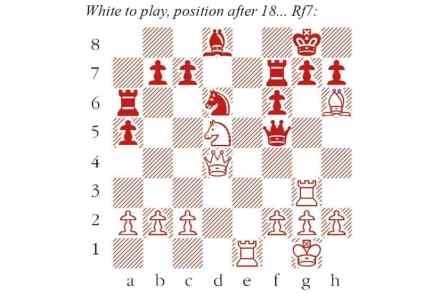
Detecting vulnerabilities

I suspect many players perceive the chess board in rich contrast, like a heat map. Glowing bright red are those pieces which are attacked but not defended. A gentler shade applies to pieces which are vulnerable to attack in future, or squares that are ripe for occupation. In the diagram below, the intrusion 10 Nd5-e7+ is tempting, to win rook for knight. But Wesley So’s stunning move 10 Nf6+ showed an exquisite sense for the soft spots in Black’s position. The key point is that after 10…gxf6 11 Qh6, Black’s awkward clump of pieces have almost no way to influence the f6-square, so Qh6-f6 and Be1-c3 is very hard to meet. It is remarkable that the attack is viable even when White’s supporting pieces have yet to leave the barracks.