Chess

Syntactical error

The chess lexicon has adopted a useful word from German, fingerfehler, fehler meaning mistake or error. Sometimes, the hand does not obey the brain. Imagine that you are busy contemplating A, followed by B and then C, and engrossed by the consequences of C. Meanwhile, the hand is eager to get involved, and picks up the piece to make move C. Standard competition rules are that once you’ve touched a piece, you must move it, so even if you catch yourself before executing the move, the damage from picking up a different piece may be terminal. Mercifully, I don’t recall ever doing this, but I’ve come close enough to know that the phenomenon is real.

Remembering Basman

Just a fortnight ago, I had the pleasure of introducing a friend to the ‘Immortal Waiting Game’, Michael Basman’s victory over the Swedish grandmaster Ulf Andersson, played at Hastings in 1975. Basman landed in a passive position out of the opening, and began to shuffle back and forth, so that at move 23 his pieces were in the identical state they had been in at move 11. It was a psychological masterstroke. Andersson, a distinctly patient player, girded himself to attack, only to waver and botch the execution so badly that Basman turned the tables and won the game. On 26 October, Basman died from cancer at the age of 76.

Losing their heads

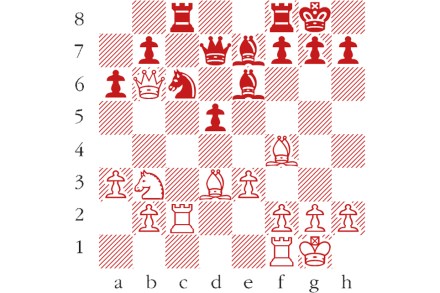
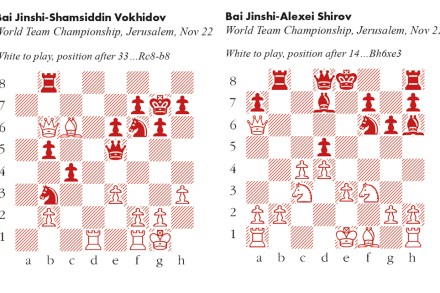
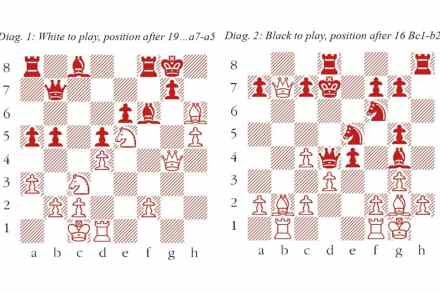
Chess players tend to fidget while they think. They crack their knuckles, stir their coffee, and bounce their legs. I have watched Boris Gelfand and Daniil Dubov twiddling a captured pawn in their fingers, with notable dexterity, despite being deep in thought. It’s a common tic, so when Sam Sevian reached out to pick up a piece while contemplating the position shown in the first diagram, I presume the motion was entirely unconscious. But it was odd for several reasons. First, it wasn’t Sam’s move, and the unwritten etiquette is to refrain from fiddling while the opponent is thinking. Stranger still, his outstretched hand didn’t settle on a stray pawn.

Awestruck

‘I can comprehend Alekhine’s combinations well enough; but where he gets his attacking chances from and how he infuses such life into the very opening – that is beyond me. Give me the positions he obtains, and I should seldom falter. Yet I continually get drawn games, even out of the King’s Gambit!’ Those words of admiration for the fourth world champion are usually attributed to Rudolf Spielmann, a strong contemporary of his in the interwar period. I am struck by the same sense of awe when I watch Shakhriyar Mamedyarov play. The grandmaster from Azerbaijan was at his sparkling best in the early rounds of the Aimchess Rapid, the latest online event in the Meltwater Champions Chess Tour.

Switchback

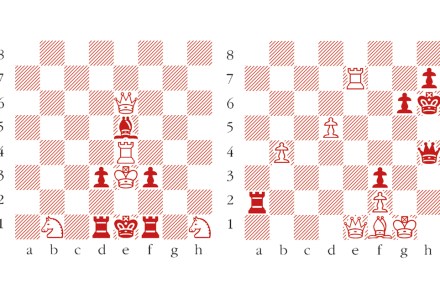
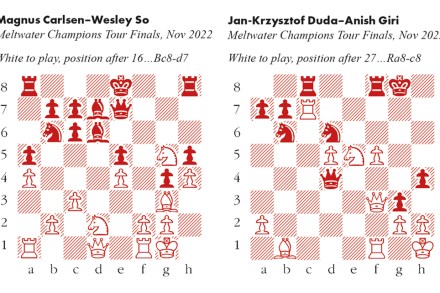
Vishy Anand’s eyes lit up as he described a beautiful variation from his game with Shakriyar Mamedyarov, played at the European Club Cup in Mayrhofen, Austria this month. The first diagram shows a variation which could arise if Mamedyarov had tried 33…Bg5!? 34 Rxc4 Bxe3+. (See left game) 35 Kf1 is tempting, since 35…Bxc4 36 Qa4!, threatens to capture the Bc4 and put Black in check at the same time. But 35 Kf1 d2! is a powerful spoiler, since after 36 Ra1 Bxc4+ the mighty pawn and bishop pair are a match for the queen. Placing the king on g2 or h1 leaves it vulnerable to a check from d5. Anand had planned to play 35 Kh2! Then, after 35…Bxc4 36 Qa4! disrupts Black’s coordination. He saw that Black might try 36…Bf4+ 37 Kg1 Be3+. But then 38 Kf1!

Girls compete

Judit Polgar, the strongest female player of all time, conducted an enchanting interview in the commentary room during the Chennai Olympiad. Her interviewee was Charvi Anilkumar, an eight-year-old girl from Bangalore. Asked about her dreams and ambitions, she announced confidently, ‘I need to play in men’s section and I need to be a grandmaster, and world champion!’ Polgar was evidently delighted and expressed her hope to one day see Charvi playing alongside men in the Open section of a future Olympiad. When she was an active player, Polgar was the top-ranked woman in the world from the age of 12, but she avoided women’s tournaments. Her pursuit of stronger opposition saw her peak at no. 8 on the international rating list.

The Generation game.

The latest flashpoint in the Carlsen-Niemann saga took place in the sixth round of the preliminaries at the Julius Baer Generation Cup, one of the online events in the Meltwater Champions Chess Tour. Ten days earlier, 19-year-old Hans Niemann had beaten Magnus Carlsen over the board at the Sinquefield Cup. Carlsen’s shock withdrawal from that event got the rumour mill spinning, which only accelerated after Niemann’s admission that he had cheated online at ages 12 and 16, although he insisted that those incidents are behind him. In the Generation Cup, Carlsen made just one move against Niemann before resigning, clearly in protest.

Royal’s success

The London Mindsports Centre in Hammersmith opened its doors in 2021, after it was converted from a Salvation Army building. The centre now hosts lectures and tournaments in Chess, Go and Bridge, besides other events. The Mindsports Masters all-play-all events, held earlier this month, were designed with title aspirants in mind. Among them was 13-year-old Shreyas Royal, one of England’s brightest prospects. His international rating has already crossed the 2400 threshold required for an international master title, and at Hammersmith he earned a ‘norm’ – one of three tournament results he will need to qualify for the title. He scored an important win against a grandmaster in the third round.

Pique or cheat?

In the third round of the Sinquefield Cup in St Louis, Magnus Carlsen was beaten by 19-year old Hans Niemann, the lowest seeded player in the event. The result was surprising, particularly since Niemann played Black, but certainly not inconceivable. The next day, Carlsen announced his withdrawal from the tournament on Twitter, appending a short clip of José Mourinho saying: ‘If I speak I am in big trouble.’ It was widely taken to mean that Carlsen suspected foul play, but was wary of making a direct accusation. So far, he has made no further statement, leaving pundits to fill in the gaps. But the patchwork of evidence remains threadbare.

Chess speaks for itself

‘Plug the fucking laptop in!’ Hans Niemann, the lively 19-year-old from the US, was left fuming – understandably – after his loss to Jan-Krzysztof Duda at the FTX Crypto Cup in Miami. The organisers set up the equipment, but Duda’s laptop ran out of juice at a tense moment when both players had about a minute remaining. By the time it was resolved, Duda had gained several minutes to think and found an accurate continuation, posing difficult problems in the endgame. An exasperated Niemann lost the game, and collapsed in the next two as well, losing a clean 3-0 sweep in the four-game match. The technical mishap was all the more absurd since the players were all at the same venue in Miami, and could just as well have played mano a mano.

Match of the half-century

They called it the Match of the Century. A full 50 years has passed since Bobby Fischer defeated Boris Spassky in Reykjavik, thereby becoming the 11th world champion. On 1 September 1972, Fischer won game 21 to win the match by 12.5-8.5. I enjoyed the perspective of a new book, The Match of All Time by Gudmundur G. Thorarinsson. (New in Chess, 2022, though first published in Iceland in 2020). Indeed, it is hard to imagine that the exceptional dramatic backdrop – an American against a Soviet in the midst of the Cold War – will ever be equalled. In 1972, Thorarinsson was president of the Icelandic Chess Federation, and one of the key figures in the organisation of the match, which was so nearly derailed many times over.

A week in Torquay

Hats off to Harry Grieve, who took clear first place at the Chessable British Championships which concluded in Torquay last Sunday. I am in awe of the courage he showed in the final round game, against the international master Matthew Wadsworth. Grieve set the tone in the opening, sacrificing rook for bishop, but gaining long-term compensation. Wadsworth reacted well, but let his advantage slip, whereupon Grieve doubled up his investment. After several hours’ play, they reached the murky position shown below. Matthew Wadsworth–Harry Grieve Chessable British Championship, Torquay 2022 50...Qb7 The mate threat on b1 forces White’s hand. 51 Rxd3 cxd3 52 Qc3 Qa6 53 Qb3 Ke4! This move looks right, when I see it, but it takes real guts to play it.

The first Olympiad

Everyone remembers their first Olympiad. As I boarded the flight to Chennai last month, it struck me that two full decades have passed since my Olympiad debut in Bled, 2002. Respectable in the seniority stakes, though one of the charms of this biennial team event is that you can count on meeting someone excited to reminisce about Dubai 1986, or perhaps Lugano 1968, and who hasn’t missed one since. This year, teams from around 200 nations – perhaps 2,000 players in all – made the trip to India. The event was moved from Moscow with just a few months’ notice, but any fears about the hasty organisation were quickly allayed.

India’s young stars

At the Chennai Olympiad, the Indian team began as second seeds, even with former World Champion Vishy Anand absent from the lineup. But it is the host country’s privilege to field more than one team, and India used its second team to showcase the next generation of talent. This team, which included three 16-year-olds, even won bronze, narrowly ahead of the first team. The gold medals went to another team of exceptionally talented youngsters from Uzbekistan, while Armenia took silver. Dommaraju Gukesh, who was born in Chennai, produced an astonishing performance on board 1 for the second team. He began with eight consecutive victories, including a victory over former World Championship challenger Fabiano Caruana.

A lucky escape

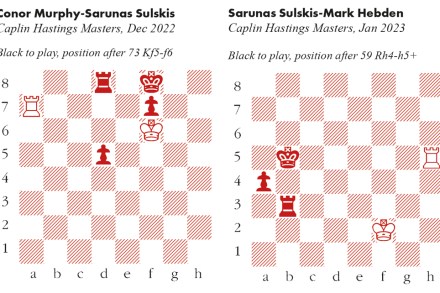
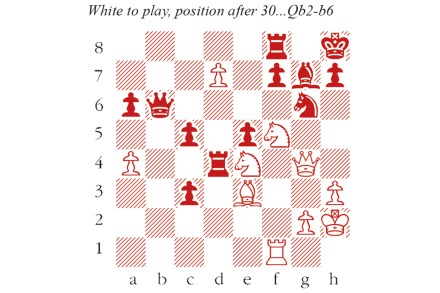
I chatted to a spectator after one of my games at the Sparkassen Chess Trophy in Dortmund. ‘A close shave today, wasn’t it?’ he began. ‘Yes, I can’t believe my opponent escaped with a draw.’ ‘No, I think you were losing.’ ‘Oh, but didn’t you see my beautiful mating idea with b5?’ ‘There’s a fly in the ointment – have another look,’ he said. [The penny drops, eventually.] ‘Oops. Ah well, better lucky than good!’ Fortunately, my opponent shared my delusion during the game. And doubly so, in that my misplaced confidence spared me the need to conduct an arduous defence. My opponent has just snatched a pawn on a3. After 39 Rf4 Re8 40 Rff7 Rb8 my rooks would hit a brick wall.

Heavy is the head

On International Chess Day, 20 July, Magnus Carlsen announced that he will not defend his world championship title next year. The Norwegian won the title in 2013 by beating Viswanathan Anand in Chennai, and went on to defend his title against Anand once more, then Sergey Karjakin, Fabiano Caruana and most recently Ian Nepomniachtchi. Carlsen stressed that he has no intention of retiring. In fact, his stated goal is to keep improving, unencumbered by the grind of preparing for a new world championship match. (Each one might easily demand six months of preparation.) Reaching an international rating of 2900 is still a target he has in mind, though that Everest remains a long way off.

Wetware

Modern chess computers, like the program ‘Stockfish’, are treated as oracles. Plug in a position, start the engine, and within a fraction of a second it will identify the best move and its numerical evaluation (+1.27 pawns!). So it is a natural misconception that an ambitious player must commit to endless clicking and memorising. On that theory, grandmasters are simply the ones who have set upon this treadmill with unusual fervour. I have done my share of gawping at the screen, but in wiser moments, I remember that when Stockfish is running, my brain goes to sleep. The firehose of answers is unmemorable if you don’t articulate any questions.

Silver and gold

The ‘English chess explosion’ that began in the 1970s produced a bumper crop of grandmasters, which meant that by the late 1980s, England was second only to the Soviet Union in international team events. Those days are behind us, but the march of time means that England is now a force to be reckoned with in senior team events. The World Senior Team Championship took place last month in Acqui Terme, Italy. England’s over-50s team got a boost from the addition of Michael Adams, who reached that milestone last year. With Nigel Short, Mark Hebden, John Emms and Keith Arkell, they began the event as top seeds. In the fourth round, they saw off a serious challenge from the second seeded USA, with its team of emigrants from the former USSR.

Nepo’s playbook

Ian Nepomniachtchi is back for more. The former world championship challenger left his rivals in the dust at the Candidates tournament in Madrid, seizing victory with a round to spare. So he will once again challenge Magnus Carlsen, in a world championship match slated for 2023. Or will he? A few weeks after beating Nepomniachtchi the first time around (in Dubai 2021), Carlsen stoked some intrigue when he stated: ‘It is unlikely that I will play another match unless maybe if the next challenger represents the next generation.’ ‘Nepo’ does not fit the bill; at 31, he is the same age as Carlsen.

Maximum mischief

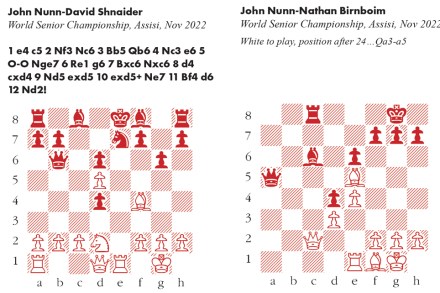
Forbidden things have a secret charm – that delicious paradox applies to the chessboard just as it does in life. Moves which appear to be unthinkable (for example, when the piece in question can be readily captured) can create a strong aesthetic effect. Composers of chess problems often make great play of this fact – so much so that it is a useful rule of thumb for a solver. If you spot a move which appears to be prevented for several reasons, there’s a good chance you have your solution. Once in a while, this pursuit of maximum mischief proves its worth in practical play as well.