Chess

Question of sport

Is chess a sport? Naively, I once considered that to be a philosophical question. Physical strength or dexterity – nope. Feeling of exertion and elevated heart rate – yes, at least if you’re doing it with soul. Global competition and recognition – yes, emphatically. It was no accident that Louis Vuitton’s ad campaign last year pictured Messi and Ronaldo playing chess. A better question would be ‘Does chess deserve government funding?’ For a game with obvious cognitive, educational and cultural benefits, the answer ought to be an unequivocal yes, and in a great many countries, including within western Europe, the game does indeed receive meaningful government support. Alas, in the UK chess is left to fend for itself.

World championship

The forthcoming world championship match, which begins in Astana on 9 April, was described by Garry Kasparov as an ‘amputated event’. The abdication of Magnus Carlsen, who remains the world’s strongest player, is of course a disappointment. But the 14 game match between the world number 2 and 3, respectively Ian Nepomniachtchi from Russian and Ding Liren from China, remains a gripping prospect. Nepomniachtchi is the more aggressive and ambitious player, but his results are more volatile. In an interview in January, Carlsen stated that he considers Ding Liren to be ‘a little bit better’. In my view, Ding stands out for his capacity to endure tension for longer than his opponents, a quality which manifests in subtle ways.

The American Cup

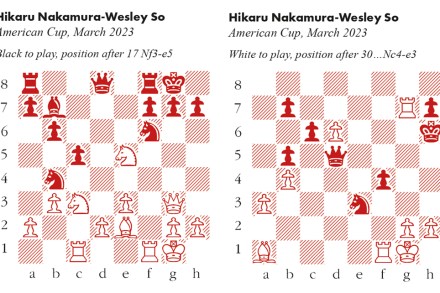
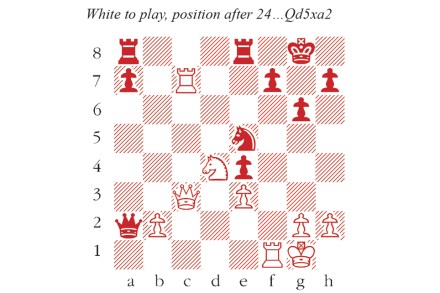
An uncharacteristic blunder from Wesley So handed tournament victory to Hikaru Nakamura at the American Cup, which finished at the St Louis Chess Club last weekend. The event was held with an unusual ‘double elimination knockout’ format, in which players who lost a match would continue playing in the ‘elimination bracket’, and only a second loss would see them exit the tournament. Nakamura won their first encounter, which shunted So into the elimination bracket. But since So triumphed in the elimination bracket, he was resurrected to face Nakamura in the final, where he took his revenge. Each player having lost one match, they were left to fight it out one more time.

Redrawing the map

In the world of chess politics, the map has been redrawn. Russia is now officially in Asia, and no longer in Europe. The move was formalised at the end of February, when the Asian Chess Federation voted to admit the Russian Chess Federation by an overwhelming margin. Russia’s pivot to Asia was in the pipeline for some time, since the European Chess Union (ECU) suspended the federations of Russia and Belarus just a couple of weeks after Russia invaded Ukraine. The international federation Fide followed suit soon after, so those teams were absent from the Fide Olympiad in Chennai last year. In Europe, the impact was lessened by the fact that the ECU’s biennial European Team Championship, is not due until November 2023 in Montenegro.

Varsity match

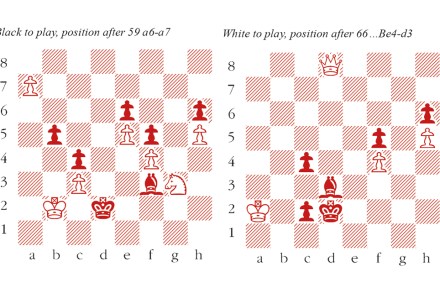
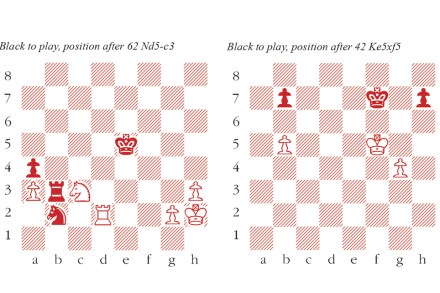
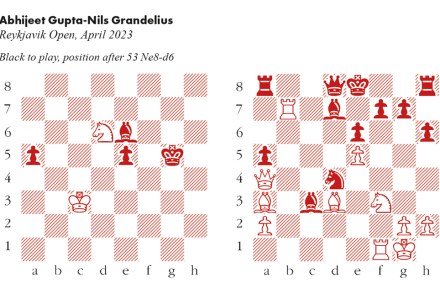
The great tradition of the Varsity match rolls on, ringing in the 141st edition earlier this month at the Royal Automobile Club in Pall Mall, London. Oxford were slight favourites, but the match finished on a knife edge. The game on board 2 was particularly hard-fought, with both sides having winning chances at different stages. This diagram shows the position after the advance 56 f4-f5, with Jan Petr (Cambridge) playing White. Striving to win the game, he has advanced his pawn to f5 instead of capturing the pawn on d3 (which led to a straightforward draw). Jan Petr (Cambridge)-Emil Powierski (Oxford) Varsity Chess Match, March 2023(See left diagram) White’s move would be justified by 56…a3 57 fxe6 a2 58 e7 a1=Q 59 e8=Q, with an easy win with the extra knight.

Blood in the water

‘The greatest pleasure? When you break his ego.’ So said Bobby Fischer on the Dick Cavett Show in 1971. He was right, of course – experienced players can sense that moment of mental despair in the opponent, which may arrive well before the outstretched hand of resignation. In fact, getting an accurate read on the opponent’s mood can be valuable at any stage of the game. Body language clues are the most obvious, but there’s plenty to be gleaned from the moves alone. Perhaps the game reaches an obvious junction, where the opponent can choose between a safe, solid option, and something more adventurous. The choice itself speaks volumes, and the time spent on the decision can be no less significant.

Bot moves

Can ChatGPT play chess? A few weeks ago, when the AI chatbot was making headlines, someone had the cute idea of getting it to play a game against the popular chess engine Stockfish. At the start, it followed a standard line of the Ruy Lopez opening. But soon the illegal moves began – ChatGPT tried to castle before its bishop was out of the way. Later, it added pieces to the board from nowhere, queens jumped over knights, and rooks teleported magically around the board. I repeated this experiment myself, with similar phantasmagorical results, all while the bot supplied nonsensical explanations for its moves. Indeed, ChatGPT cannot play chess, and it was fun to watch its collapsing facade of cogency. Teehee, silly computer!

Cambridge International Open

The Cambridge International Open, held last week in fine surroundings at the University Arms Hotel in the city centre, is a valuable addition to the UK tournament scene. Organised by the English Chess Federation, demand for this debut event was strong and registrations had to close early at around 120 participants, when the capacity of the playing hall was reached. Nine grandmasters took part in the open tournament, including England’s top player Michael Adams. Despite being a huge favourite in his first round game, he drifted into serious trouble in the early middlegame. Seeing the storm clouds gathering, he wisely ventured a draw offer, which was accepted – that being a tremendous achievement for his teenage opponent and namesake Henry Adams.

Bidding one’s time

If a series of chess games is drawn, how do you split the tie? One answer is to play two more games (one of each colour) at a faster time limit, to boost the odds of a decisive result. But that might take a while. When the games get too brisk, the tiebreak feels divorced from the original contest. The drawbacks of playing just one game are obvious – the white player get an unfair edge, and the game might end up drawn anyway. So the Armageddon game was invented – the chess equivalent of a penalty shoot-out. In this, a drawn game results in a win for the black player. On its own, that’s a chunky advantage, so a time handicap is used to even out the chances. What time handicap yields a fair contest?

Chequered history

I picture a medieval priest, hunched over a desk with bells clanging in his ears. He is on a deadline – tomorrow is Sunday and his congregation have heard enough sermons about the spiritual value of threshing. The leatherbound book in front of him, Summa collationum, sive communiloquium, is his source of inspiration. It’s a recent edition of a book written some 200 years earlier by a Franciscan monk, John of Wales (Johannes Gallensis), who died c. 1285. One section, known as ‘The Innocent Morality’, presents chess as an extended allegory for life. The priest pores over the Latin: ‘The world resembles a chessboard, which is chequered white and black on account of the twofold state of life and death, of grace and sin.’ A stirring thought.

Tata Steel Masters

Two rounds before the end of this year’s Tata Steel Masters, Jorden Van Foreest, the Dutch no. 2, declared himself ‘excited to play the role of spoiler’. Van Foreest was placed near the bottom of the leaderboard, but had yet to face two of the leaders. His opponent in the penultimate round was Anish Giri. True to his word, Van Foreest attacked him with abandon, and had his compatriot on the ropes, but their game was finally drawn after more than six hours of play. In the final round, Van Foreest faced tournament debutant Nodirbek Abdusattorov, hitherto the star of the event. The 18-year-old from Uzbekistan had led almost from the start, beating Magnus Carlsen along the way.

The next world championship

Fide’s clock was ticking, and their position looked difficult. But at last they have made their move, announcing that the next world championship match will take place in Astana, Kazakhstan with a €2 million prize fund, beginning on 7 April. Two factors explain the delay. One was Magnus Carlsen’s abdication, announced in July last year. Ding Liren and Ian Nepomniachtchi, who qualified to contest the match, are first-rate players, but obviously less marketable than the Norwegian. The second snag was that Nepomniachtchi is Russian.

Emory Tate

Internet bogeyman Andrew Tate, recently detained in Romania on trafficking and rape charges, is a chess fan. Disciples who visit his ‘The Real World’ website in search of the influencer’s insight will encounter a logo featuring a cobra entwined with a chess knight. ‘King Cobra’, as he was known during his days as a professional kickboxer, is a competent chess player, as he showed during a recent interview on Piers Morgan Uncensored. Their verbal sparring concluded with a game of chess, in which Morgan left his queen hanging and Tate didn’t hesitate to capitalise. Afterwards, Tate praised chess as a game which fosters absolute self-reliance, a lesson he learned from his father.

Staying the course

After a pause during the pandemic, the Hastings Chess Congress returned for its 96th edition in the days after Christmas, with renewed support from software company Caplin. A newly published book, The Chess Battles of Hastings by Jürgen Brustkern and Norbert Wallet (New in Chess, 2022), offers an enjoyable chronicle of the event’s rich history. Among the vignettes of congress luminaries, one anecdote caught my eye. One year in the 1980s, heavy snowfall caused the heating in the playing hall to fail, to which most players responded with an early draw offer. But grandmaster Murray Chandler persevered for five hours, he and his opponent ‘like two Eskimos, in woollen hats and winter coats’, and became joint winner thanks to his victory.

Triple crown for Carlsen

Doing your job, and not a jot more – ‘quiet quitting’ – became one of the buzzphrases of 2022. In The Spectator, Stephen Daisley lauded this as the philosophy of the clear-eyed pragmatist, not the layabout, and wondered when more young employees would cotton on. Was Magnus Carlsen thinking along the same lines? For the time being, he remains the world champion in classical chess, and many believe that his job, his grand duty, is to defend the title at all costs. So there was much consternation when he announced in July his intention to abdicate, leaving the title to be contested between Ian Nepomniachtchi and Ding Liren later in 2023. It seems to me that Carlsen sees his job differently.

Twelve questions for Christmas

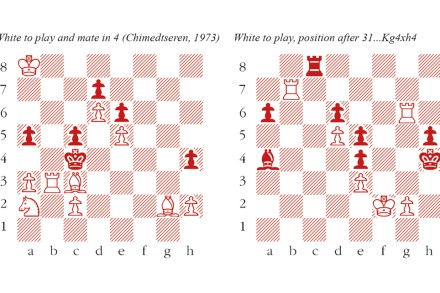
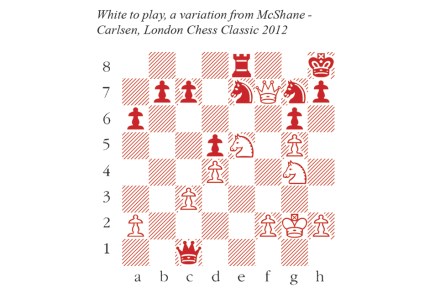
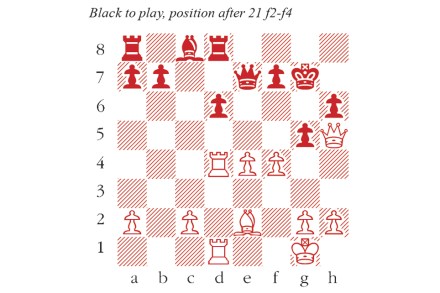
1. Who tweeted, in answer to the question ‘Do you still play chess?’: ‘I did as a child, but found it to be too simple to be useful in real life: a mere 8 by 8 grid, no fog of war, no technology tree, no random map or spawn position, only 2 players, both sides exact same pieces, etc. Polytopia addresses these limitations.’ 2. Who was handed a six-month ban by the Fide Ethics commission for his cheerleading of the invasion of Ukraine, ruling out his participation in this year’s Candidates tournament? 3. Who came second behind Ian Nepomniachtchi, and will challenge ‘Nepo’ for the world title in 2023, in light of Magnus Carlsen’s abdication? 4. White to play and mate in two moves (diagram above left).

World Senior Championship

English grandmaster John Nunn was the top seed in the over-65 section at the World Senior Championship, held in Italy last month. A series of crisp attacking games put him in the lead with 6.5/7. But an uncharacteristic miscalculation in round eight saw him lose a miniature against Danish grandmaster Jens Kristiansen. Going into the 11th and final round, Nunn still trailed by half a point, so his fate was no longer in his hands. As the games unfolded, Kristiansen had the draw well within reach, but succumbed to a neat endgame zugzwang against Jose Luis Fernandez Garcia. Meanwhile, against Valentin Bogdanov, Nunn spun a slim advantage into gold with a leisurely king manoeuvre from the h-file to the b-file. Nunn took the title with 9/11, ahead of a quartet on 8.5/11.

World Team Championship

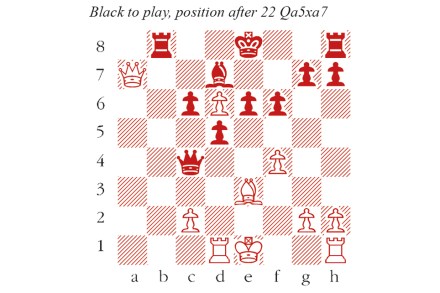
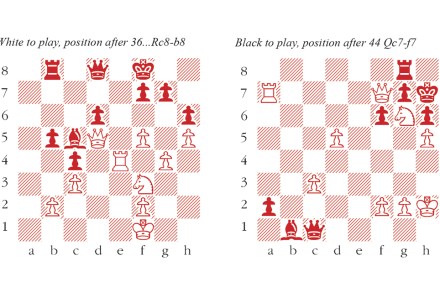
The young team from Uzbekistan, who took gold medals at the Olympiad in Chennai, came close to repeating that achievement at the World Team Championship in Jerusalem last month. They cruised through the group stage, quarters and semis, and met China in the final, who got there despite fielding none of their elite players, such as world No. 2 Ding Liren. The match promised to be close, and it was China who triumphed. Their star player was Jinshi Bai, who scored 8.5/11, including this crucial win from the final. Bai Jinshi-Shamsiddin Vokhidov World Team Championship, Jerusalem, Nov 22 In the diagram position, 34 Qa7 Rc8 is balanced, but Bai found a clever counterblow. 34 f4! The point is that 34…Rxb6 35 fxe5 Rxc6 36 exf6+ Kh6 37 Rd7 wins. But 35…Ng4!

Meltwater Champions Tour

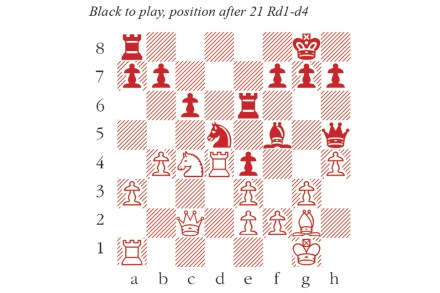
When Magnus Carlsen renounced his world championship title earlier this year, one of his stated goals was to focus on other events, without bearing the burden of preparation for a regular title match. The Meltwater Champions Tour is an important battleground for the Norwegian, and he showed devastating form at the Tour Finals in San Francisco earlier this month. Initiated by Carlsen during the pandemic, the elite series of rapid tournaments is mostly played online, although four out of eight players travelled to San Francisco for the finals. This was the only decisive game from Carlsen’s first-round mini-match against the runner-up.

Lengthy Correspondence

‘In fact it is now conceded by all experts that by proper play on both sides the legitimate issue of a game ought to be a draw…’ Those words were written by Wilhelm Steinitz, who became the first world champion after beating Johannes Zukertort in 1886. But their 20-game match saw 75 per cent decisive games, a quantity of bloodshed that would be unimaginable in the 21st century. By comparison, Magnus Carlsen has played five world championship matches, in which less than 25 per cent of the classical (slow) games were decisive. It is not a matter of style, but rather of skill – the fact is that modern players make far fewer mistakes.