Any other business

Free at last: the next web revolution

Edie G. Lush explains why we’re rarely asked to pay for online news and entertainment these days Amid the shockwaves caused by Rupert Murdoch’s acquisition of Dow Jones, publisher of the Wall Street Journal, one significant policy shift attracted relatively little attention. When the ink finally dries on the deal, one of Murdoch’s first moves will be to remove the ‘pay wall’ from the Journal’s website. The news that WSJ.com will henceforth be free may come as a pleasant surprise to its many loyal users, but it isn’t so great for other entrepreneurs who are trying to make money via online subscriptions.

Is that an iceberg ahead? Make mine a jereboam and put it on my credit card

First there was the news of passengers rescued from lifeboats in Antarctica as their cruise ship went down after hitting an iceberg. Then Tim Price, our guest Investment columnist this week, reminded me of ex-Citigroup chief Chuck Prince’s observation about dancing as long as the music keeps playing. Then at a wedding on Saturday, a Welsh male voice choir sang the Celine Dion hit My Heart Will Go On: a charming sentiment, I agree, but also the theme song from a certain epic disaster film — and you must have guessed by now which way my thoughts have been moving. As I stagger from one glittering pre-Christmas social event to the next, I can’t help wondering whether we’re all now dancing in the first-class saloon of the Titanic.

Northern Rock’s blonde knight?

Is it time for a reassessment of Sir Richard Branson? Chosen by the Treasury as the ‘preferred bidder’ for Northern Rock, he’s back where he craves to be and so often manages to put himself: in the headlines. And like every time he grabs the nation’s attention, two quite different caricatures of him have been projected.   On the one hand, there is the tirelessly creative, totally unconventional adventurer-entrepreneur whose brand image can sell anything and whose two-fingers-to-stuffy-old-corporate-capitalism has such powerful appeal to consumers even after many of them have had rotten experiences of his trains and his mobile phone service.

Shock and ore: the fight for the world’s mineral riches

Marius Kloppers is a man who has clearly learnt that business is like warfare in at least one respect: if you’re planning an attack, it might as well be done quickly. On 1 October this year, the 45-year-old South African was installed as chief executive of the Australian mining conglomerate BHP Billiton. Within less than a month, he’d pressed the button on an audacious £67 billion bid for BHP’s mighty British-based rival Rio Tinto. The prize: a £170 billion conglomerate that would be far and away the world leader in its sector, with mines everywhere from Brazil to Australia and control of vast reserves of mineral riches.

Half a million rooms to choose from

Most hotel-group bosses like to be at the opening of each new property in their chain. Some claim to have slept in all of their establishments or even to have spent a night in every room. Not Andrew Cosslett. His company is the biggest hotel group in the world. It has 572,000 rooms in more than 3,800 properties and is opening a new hotel every day of the year. Cosslett, the 52-year-old chief executive of InterContinental Hotels, has not yet visited all of his existing estate. ‘I couldn’t even keep up with the ones we’re opening,’ he admits. And the task will get harder. ‘We’re opening one a day and signing up two for the pipeline.’ There are now 1,400 hotels in that pipeline, being planned and built.

How Prince lost the plot — and why the next episode may be Sachs and the Citi

I hazarded here in February that it would probably be a good idea if the world’s largest bank were to be run, every now and again, by a banker. At last the board of Citigroup has come round to my point of view, though it might have saved shareholders a few billion dollars by doing so sooner. Charles Prince has gone as chairman and chief executive after announcing a loss of perhaps $11 billion on mortgage-backed securities that turned out to be neither backed nor secure. Robert Rubin has been left holding the fort as chairman and Sir Win Bischoff as chief executive, pending the arrival of somebody new with a head for figures.

In salons for writers, beware giving a black eye to literature

Students of words enjoy the way in which adjectives normally used to describe reprehensible actions are whitewashed to become terms of praise. One instance, which has caught my eye recently, is ‘aggressive’. In the past few days I have seen a firm’s brochure praising its ‘aggressive approach to the worldwide sale of megayachts’, a reference to a writer of semi-pornographic novels as ‘skilfully and slyly aggressive’ and a rising politician as ‘charming Congress with his verbal aggression’. Such usage is not all that new. ‘Aggressive’ can be defined (OED meaning 2c) as self-assertive, pushful, energetic and enterprising.

Don’t bank on it

With Alistair Darling coming under increasing pressure after the loss of the personal data of twenty-five million people by Her Majesty’s Revenue and Customs, Martin Vander Weyer reviews how Darling and Gordon Brown have also moved into the firing line in the whole Northern Rock debacle. They along with its employees and shareholders now have the most to fear from the crisis. No one seriously argued, ab initio, that the Northern Rock fiasco was the government’s fault.

Darling is out of his depth

For a man who has been Chancellor of the Exchequer for just over four months, Alistair Darling has certainly made some powerful enemies. In fact, it’s hard to think of anybody important with whom he hasn’t fallen out. Sir Ronald Cohen, the private equity king who is one of Labour’s most prominent business supporters, has criticised Darling’s proposed increase in capital gains tax. Cohen is not alone: Darling has managed the unprecedented feat of uniting all of Britain’s business lobby groups against this destructive, ill-thought-out measure. He has been chided by Mervyn King of the Bank of England over his mishandling of Northern Rock. And there is no love lost between Darling and Baroness Vadera, the Prime Minister’s most trusted adviser.

The price of valour and the value of money

Our gallant armed forces who face the daily horrors of Iraq and Afghanistan are often said to be undervalued by the public. But at least in the narrow financial sense, that cannot be said of historic acts of bravery and devotion to duty and the medals that commemorate them. Have you ever looked to see whether you have any medals lurking in your attic, perhaps won by a grandparent or ancestor for action in the field?

Let’s not go to Angola: a glimpse of the costs and benefits of prison reform

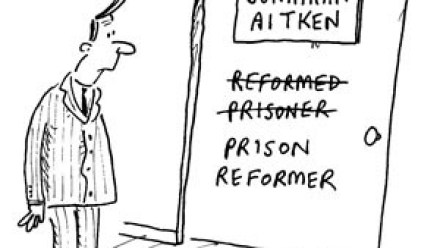
Is prison reform an economic issue, as well as a moral and social one? Well, if it’s uppermost in my mind and this column, then it must be — and it holds both of those positions this week not so much in response to the news that ex-jailbird Jonathan Aitken is to head a Tory ‘taskforce’ on the subject, but because I too have recently spent time inside. In fact I spent last Saturday morning in HM Prison Kirklevington Grange in Cleveland — where I was startled to find half the inmates had gone out for the day. Kirklevington is a Category C closed prison, which means it has a high fence and locked gates, but it is also one of only three specialist resettlement prisons in England.

Celebrating St Pancras Day

I like to think I was the first (indeed I may have been the only) journalist to have been invited to climb the scaffolding under the clock at St Pancras station. That was back at the beginning of May, when the refurbishment of what is, from today, London’s Eurostar terminus still had a little over six months to go. The whole place was a mighty confusion of construction activity, large-scale and small, high-tech and low: I remember watching a man pouring what looked like hot tar for the floor surface of the main entrance out of the corner of a battered old wheelbarrow.

A magic moment in the gruesome history of portrait sculpture

The relationship between a great artist and his sitters is a poignant one. But what they say to each other during the long periods of concentrated stillness, on the one hand, and frenzied search for a likeness, on the other, is seldom recorded. We do not know what Leonardo said to the Mona Lisa to evoke her Giaconda Smile. Or what Vermeer, a shadowy figure at all times, told the girl with the pearl earring, to fix her mood of heart-catching, pensive beauty. One feels that Vermeer was as gentle as the touch of his brush, and spoke in barely audible whispers. He was, I think, nervous and easily upset in his work, one reason why he never painted children, though he had 14 of his own (and left them badly provided for, alas).

Forty years on, we’re still confused

Next weekend is the 40th anniversary of Harold Wilson slashing sterling’s official value from $2.80 to $2.40 and telling us the pound in our pocket had not been devalued. It was a disaster, Wilson later confessed in his memoirs: a national shame that interrupted the Swinging Sixties. And now the pound has risen above $2 to its highest level for more than quarter of a century and we rejoice at sterling’s strength, gloating over the dollar’s misfortunes. That $2 is ‘high’ when Wilson devalued the pound to a then record low of $2.40 shows not only that today’s rate is a blip in a long-term slide from the pre-war rate of above $5; it reflects Britain’s perpetually confused attitude to exchange rates.

Here’s an oxymoron: green private jets

This year’s must-have Christmas present is a small rectangle of plastic, the size of a credit card. It costs E129,000, or a little short of £100,000 at current rates of exchange. Well, actually, it was last year’s must-have for those who consider themselves really up with the zeitgeist, but a NetJets card is still a pretty cool accessory to flash around and impress your friends. It says you can whizz around the globe at short notice in one of the company’s fleet of small planes; the E129,000 ‘entry level’ card, a sort of base-metal Barclaycard, buys you 25 flying hours, enough to flip across the Atlantic and back, and have something left over to take her to Paris.

The bishop of Hope Street offers an organic remedy for no-hope ghettoes

This should have been Boris’s gig, of course. Our former editor’s perilous journey into the heart of the Scouse soul was a penance of sorts for that notorious Spectator editorial. But amid the media scrum, he didn’t have much chance to do anything but murmur a few defensive sorrys, hair flapping in the angry breeze. Closure wasn’t achieved. A Liverpool City Life from the great man’s pen might have made things better — or worse — but his thoughts have turned to London and good luck to him. Liverpool, meanwhile, has moved on too and I’m delighted to report that The Spectator remains substantially less loathed here than the Sun, which is still reviled for its critical take on the Hillsborough disaster 18 years ago.

Are famous writers accident-prone? Some are

I don’t want to know too much about writers. The endless revelations about Sylvia Plath and Ted Hughes have put me off their poetry. Nothing can shake my love of Keats’s Odes but I don’t have any desire to see his full medical records. Nor do I care to learn anything more about Byron’s club foot (though I am fascinated by the fact that the painter John Glover, who founded the Australian school of art, and whose masterpiece ‘Dovedale at Dawn’ I possess, had two club feet). We know quite enough about Shakespeare personally, and I am happy he is still surrounded by mysteries. Of course, if his diaries were suddenly to appear, or autographed letters, that would be another matter. The truth is, an author and his works are best kept separate.