Books & Arts

Books and Arts

Inside A Table for Fortune, William T. Vollmann’s magnum opus

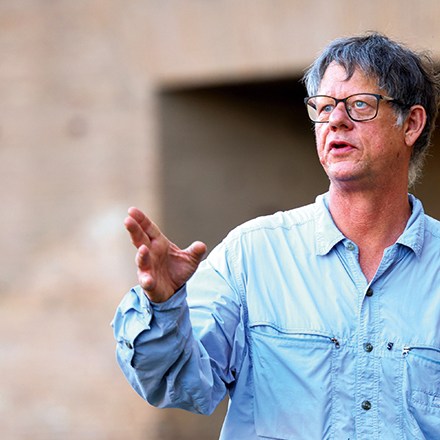
William T. Vollmann’s subject is 9/11. Always is, always was. Even before the attacks happened, they were somehow his thing. An Afghanistan Picture Show, Vollmann’s debut, was advertised as a Cold War memoir of a 22-year-old’s adventure battling the Soviets with the mujahideen. But it was really an inadvertent introduction to people and a place that were destined to become the enemies of America. Vollmann has spent his career writing around that day in 2001 – the first and main event of the 21st century – dissecting with retractor and forceps the American empire built before 9/11 and the country that the attacks created. Now, in his new novel, Vollmann faces the subject straight on. “A Table for Fortune is about September eleventh,” he writes to the reader at the start.
How the Ramones redefined punk rock

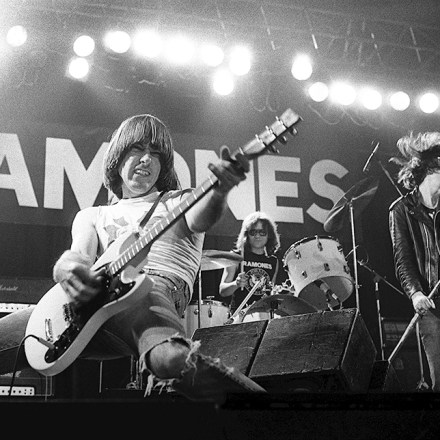
Is popular music truly an art form? This question has never met a straightforward answer, either from the musicians themselves or the public, and it hangs over the exhibitions currently commemorating the 50th anniversary of punk rock. Among others, there’s the Outsiders, Outcasts, Rebels + Weirdos show on at the Skirball Center in Los Angeles, while the Rock and Roll Hall of Fame in Cleveland is hosting its own celebration under the name Hey! Ho! Let’s Go! Punk at 50. Somehow I’m put in mind of the quote attributed to Jean Cocteau about “Ameri-cans being a funny people – first you shock them, then they put you in a museum.

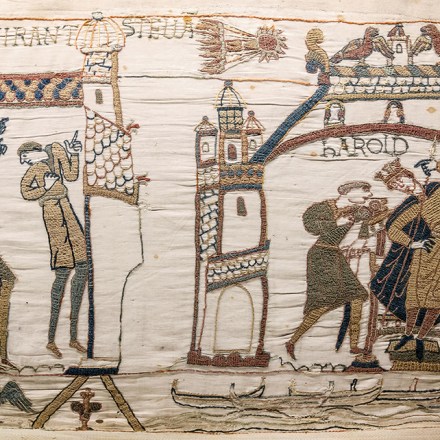
Shagger, chancer and oath-breaker – Harold Godwinson had a touch of the Viking about him

Oh Harold. So near and yet so far. So close and yet no cigar. In January 1066, the world (well, England) was at his feet. Two hundred and eighty-two days later he was battle meat. On day one he became the richest ruler Anglo-Saxon England had ever known. In late September, he defeated the hardest bastard in Europe (Harald Hardrada). In mid-October, England was changed forever, but not by him. He had, of course, no right whatsoever to be king. Sure, he was Edward the Confessor’s brother-in-law, but under the sacred rules of hereditary power that gets you zip. He claimed that Edward had promised him the throne (he hadn’t), but, again, that ain’t how the royal circus rolls.

type

How a young inventor with no printing experience revolutionized the newspaper world

Here’s a quiz for you. On the third floor of the New York Public Library is a vast mural painted by Edward Laning in the 1930s. It’s called “The Story of the Recorded Word” and it’s divided into four scenes, each one a pivotal stage in the development of writing. Can you guess what they are? I daresay you managed to picture something resembling the third scene: a bearded Johannes Gutenberg showing off a page of type from his new invention, the printing press. I think you might have got the second one, too: a medieval monk, with quills and inkpot, copying out a manuscript in his scriptorium. Perhaps, if you’re religiously inclined, you even guessed the first: Moses receiving the Ten Commandments carved into stone. But what about the fourth scene?

What’s in a kiss? A millennium of mixed messages

Kissing is a tricky subject. It has a complex, baffling history. The kiss of a baby is one thing; the kiss of lust something quite else. Kings, generals and prelates used to kiss, as did mafiosi – often before killing. The kiss has many meanings, all of which are explored in this informative, if sometimes wearing, book. Finally, a warning: if you’re queasy about arse-kissing, don’t read it. But then you would be missing a lot. Katie Barclay, a diligent Australian academic, has written an “overview of the world of the kiss in Europe from medieval times to the present.” Her opening words begin listing the startling variety of the kissing involved: “Smooch, snog, pash, smack, peck, canoodle...

The intrepid volunteers who risk all to preserve Ukraine’s cultural heritage

“The nonsense was over at last,” wrote the Lithuanian-Polish poet Czesław Miłosz in 1939, as a period of uncertainty gave way to the horrors of World War Two. Charlotte Higgins quotes these words at the beginning of Ukrainian Lessons, describing the outbreak of full-scale war in Ukraine after eight years of “local” warfare in the Donbas and the annexation of Crimea. From the first pages of this profound study of the impact of war on culture, replete with life stories, the author places the Russo-Ukrainian conflict within the context of global cultural history and geopolitics. References to Rwanda in 1994 and the bloody events in Londonderry in 1972 are in no way out of place.

The man who – inadvertently – invented the 1970s

Style, self-evidently among those who pursue an interest in such affairs, is, according to the Comte de Buffon, the man himself – the essence, the heart, the bowel, the Bovril. While, among the much greater majority who pursue an ignorance in such affairs, it is an assumed gamut of off-the-peg tics, props, accent – style is something bolted on to a being’s chassis and core in the hope that it will hold. We can be certain which of these two nugatory classifications better suits the late Christopher Gibbs (1938-2018) who in the course of his long, more or less antiquarian life encountered Everyone, absolutely Everyone.

The Shards is easily the best drama on TV

My father once drove down the King’s Road with Marianne Faithfull and Terence Stamp in a paisley-painted Mini to buy a velvet suit from Granny Takes A Trip while high on acid. No, not really. I was always very disappointed with my parents’ “what it was really like in the 1960s” anecdotes because basically they didn’t have any. Now my own children are having similar problems with my anecdotes about the legendary 1980s. Yes, it’s true that I did go to see Duran Duran at the height of their fame, but only to keep my little sister company in a football stadium smelling of chips and fizzy pop and filled with screaming 12-year-old girls. Yes, I did wear eyeliner and white lipstick once, but I looked a prat.

Why does anyone take Ai Weiwei seriously?

When Ai Weiwei (b.1957) arrived in Europe in 2015, fresh from state-imposed house arrest, he was greeted as a hero. Museums and galleries fell over themselves to host exhibitions devoted to the West’s new favorite dissident – even while he continued, mysteriously, to participate in Chinese art fairs. Nobody dared say it at the time, but his actual art – vast, chaotic installations and whimsical sculptures that drew on Chinese folklore – was even then just a bit dull. Soon enough, the artist was positioning himself as the voice of the global dispossessed, in the process (to borrow someone else’s phrase) morphing into a kind of Chinese Banksy. His work became self-aggrandizing in tone and ever more naff in form, in the process losing any trace of subtlety.

wagner apple music

Apple Music has redeemed itself

Just two weeks ago I was ready to cancel my subscription to Apple Music. I’d stumbled across its “Composer Essentials” – a list of 100 composers so significant that they merit their own curated playlists. It includes Bonds, Boyle, Caccini, Dawson, Dett, Perry, Poldowski, Sohy, Strohl and Walker. If those names don’t ring a bell, how about the composers who are missing? Albéniz, C.P.E. Bach, Bellini, Berg, Bizet, Borodin, Chabrier, Kodály, Martinu, Messiaen, Mussorgsky, Nielsen, Poulenc, Schoenberg, Walton, Weber and Webern. See what I mean? The “Essentials” list is stuffed with DEI hires. Which – an analogy to Cambridge University comes to mind – does no favors to the black and female composers who deservedly feature in it, such as Joplin and Beach.

A much-deserved revival of John McCabe, a formidable British composer

Grade: B+ “Cheltenham Symphonies”, they used to call them – a catch-all term for the kind of large-scale, traditionally inclined postwar works that found a natural home at the Cheltenham Music Festival. But it was also a sneer: a dig at the supposedly parochial nature of British music in the 1960s and 1970s. Over in Europe, the avant-garde was doing whizzy things with Marxism and electronics. British music, went the narrative, was suburban, outdated and drab. Now listen to John McCabe’s Third Symphony of 1978. McCabe’s orchestration is as gorgeous as a bird of paradise; it shimmers like the colors on the surface of a bubble. Not that there’s anything fragile about McCabe’s musical engineering.

mccabe