Is popular music truly an art form? This question has never met a straightforward answer, either from the musicians themselves or the public, and it hangs over the exhibitions currently commemorating the 50th anniversary of punk rock. Among others, there’s the Outsiders, Outcasts, Rebels + Weirdos show on at the Skirball Center in Los Angeles, while the Rock and Roll Hall of Fame in Cleveland is hosting its own celebration under the name Hey! Ho! Let’s Go! Punk at 50.
Somehow I’m put in mind of the quote attributed to Jean Cocteau about “Ameri-cans being a funny people – first you shock them, then they put you in a museum.” Up here in Seattle, the Museum of Pop Culture (MOPOP) has gotten in on the act with its artfully arranged display of smashed guitars and ripped T-shirts to salute both punk and its generational heir, grunge. With all its rollercoaster contortions and polished steel lumps, the MOPOP building itself perhaps offers the strongest argument for a distinctive rock-music art form.
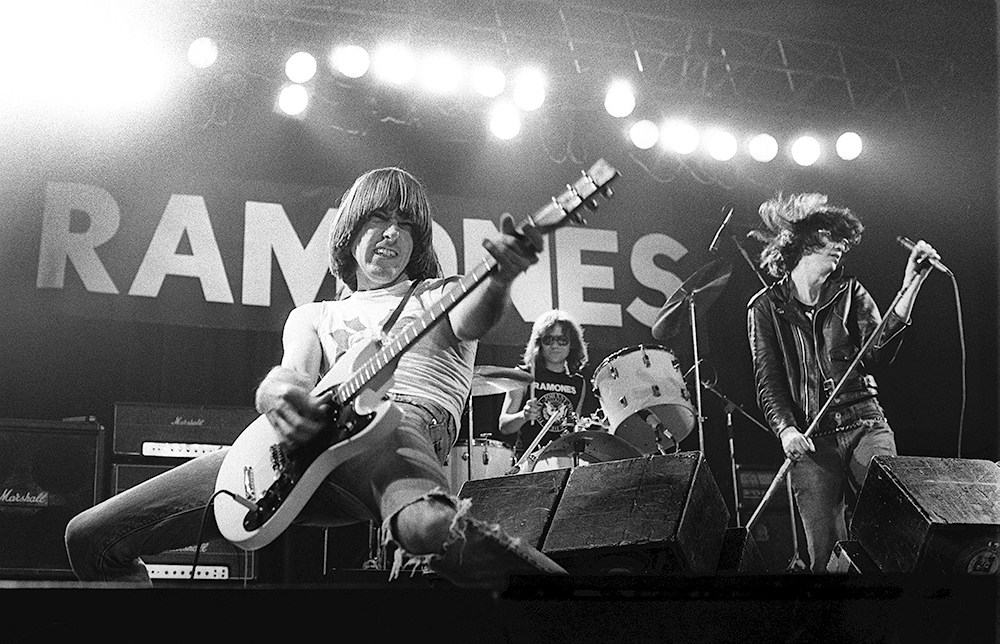
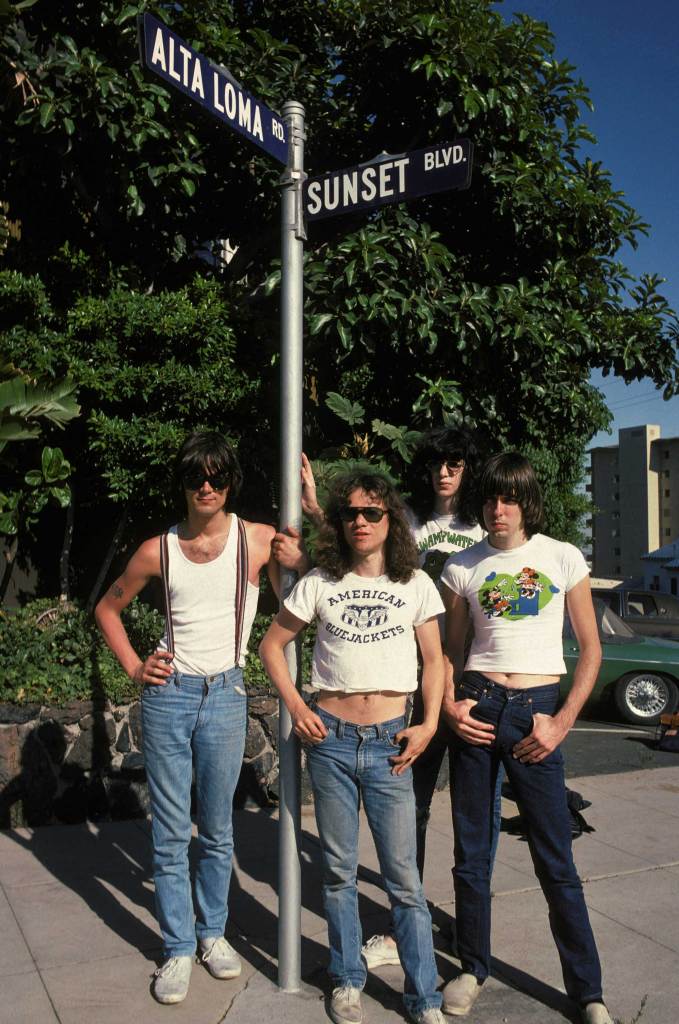
The big-bang name that lies at the heart of these various tributes is that of the sadly defunct New York quartet the Ramones. If you were to distill the Ramones’ music into a sentence, you could say that it was very loud, very fast and very simple. They also made a striking visual impact with their pudding-bowl haircuts and group ensemble of torn jeans, leather jackets and shades. None of the original band members – Joey (vocals), Johnny (guitar), Tommy (drums) and Dee Dee (bass) – were related, and none of them were actually called Ramone. They adopted the last name in honor of Paul McCartney, who occasionally used the alias Paul Ramon when his own band was still calling itself the Silver Beetles.
In May 1976, the Ramones released their debut album, Ramones. It was a 29-minute song cycle of yelped vocals and buzzsaw guitars that seemed to get ever faster and more furious as it progressed. Titles such as “Blitzkrieg Bop,” “Judy Is a Punk” and “Now I Wanna Sniff Some Glue” gave further evidence that the record might be something other than traditional family entertainment. Even so, there was something endearingly old-fashioned about the Ramones’ core message. Their devotees saw them less as the shock troops of a cultural revolution than as four good-time boys out for some fun – “a combination of everything we were into: television reruns, drinking beer, getting laid, cheeseburgers, and B-grade movies,” as Punk magazine’s Legs McNeil put it.
‘Punk rock is down to the Ramones. Bands were just playing in a calypso groove until then’
Some observers could similarly make out their debut album’s classic pop roots. The Ramones were all unashamed fans of early British Invasion bands such as the Dave Clark Five and Herman’s Hermits, and at one time had wanted to record their album in the Beatles’ home at Abbey Road.
In the end a production budget of just $6,400 didn’t allow for any flights to London, although the band did place frequent transatlantic phone calls to the Beatles’ producer George Martin to ask for advice. I’m told that Martin was characteristically charming, but that his references to such esoterica as the responsorial backing vocals to the Fab Four’s 1965 song “You’re Going to Lose That Girl,” or the matter of the microtonal key shifts of the band’s “Strawberry Fields Forever” may have elicited some head-scratching back in the studio in New York.
In their private lives, too, at least some of the Ramones were less about a licentious walk on the wild side and more about championing American – and, even more shockingly, capitalist – values. In 1987, Johnny Ramone told me with a straight face that he admired the presidency of Ronald Reagan, whom he called “the greatest man of my lifetime,” before revealing that he and his fellow band members had secretly had a five-year plan when starting out. “It was never meant to last,” he said. “The idea was to release so many hit records that we could all retire, buy houses and do something else with our lives.”
Alas, that didn’t happen. The Ramones’ debut album sold just 6,000 copies in the US during its first year of release, which was roughly 1,994,000 fewer than Frampton Comes Alive! managed in the same period. One critic dismissed the record as “the sound of 10,000 toilets flushing.” The band’s debut single “Blitzkrieg Bop” similarly avoided major sales on a chart dominated by the likes of the Carpenters, Barry Manilow and the briefly inescapable Bay City Rollers. You could have got long odds in 1976 that the song’s introductory chant – “Hey! Ho! Let’s go!” – would one day constitute the title of a major exhibition at an American museum.
Despite constant touring, the Ramones were never in danger of filling the world’s largest concert arenas. They did, however, attract a fanatically devoted audience, drawn to the short, sharp shock of experiencing the band up close. In general, the Ramones’ shows were fast, urgent and thrilling on a gut level, just as all good rock music should be. At a time when certain mainstream groups played three-hour concerts, adorned with fog machines and lasers, the average Ramones show lasted just 35 minutes.
The band’s preference for a direct approach to their music, both on stage and record, would later be tested by their collaboration with the famously exacting producer Phil Spector on their fifth album, End of the Century. This was a case of two opposite creative schools working together. Johnny Ramone would long remember the time Spector insisted that he perform 87 separate takes of a brief instrumental passage, which, as the guitarist himself genially told me, “was 86 more than I personally was used to.”
In a reverse British Invasion, the Ramones became hugely popular across the Atlantic. Their stripped-down approach to their craft provided an early blueprint not only for the likes of the Sex Pistols and the Clash, but even for successor bands such as U2. Bono himself would remember that “everyone’s music, including ours, seemed to double in speed” after the Ramones’ first album began to change hands. Tony James of the band Generation X adds: “Everybody went up three gears the day they got that album. Punk rock is totally down to the Ramones. Bands were just playing in a calypso groove until then.”
Among the Ramones’ hardcore fans were the Sex Pistols, a band that still remained a minority interest in 1976. In June that year, the Pistols made two appearances in the assembly room attached to Manchester’s Lesser Free Trade Hall. There were probably only 150 customers present for both concerts combined – although they would have needed a rather larger venue to accommodate everyone who later claimed to have been there. The shows represented the birth-cry of the punk rock movement in the UK.
Like the Ramones before them, the Sex Pistols redefined the nature of what constituted an acceptable form of public entertainment. There were generally three or four ad hoc bouncers, sometimes adorned with swastika armbands, at a typical Pistols concert. As the show progressed, the bouncers would shout at people not to climb up and join the band members on stage, while the musicians themselves frequently shouted exactly the opposite: this produced predictably chaotic results. Many of those who remained on the floor contented themselves with pogoing up and down in a series of malign hops, using their point of maximum elevation to spit lustily at the band in what appeared to be a spirit of comradeship and respect, rather than critical reserve. Either way, it was a compelling slice of immersive, mutually confrontational theater.
It’s rock music at its most primal, with songs reduced to their unadorned essence
Anyone who’s paid attention to pop music’s biggest hits over recent years will have noticed how the game is now played. Today’s successful artist will as often as not be only the visible face of a small army of composers, producers and arrangers who work together to furnish the star with the necessary material. This process perhaps reached its apogee with Beyoncé’s 2022 hit “Alien Superstar” which credits no fewer than 24 writers. One might reasonably ask if the results of such forms of collaboration have added to pop music’s original mission to entertain and uplift with a raw energy that was distinctly its own. I recently sat on the deck of a waterfront Seattle restaurant and, because it was a Monday and quieter than usual inside, I could actually hear the selection of modern pop being played over the PA system. I couldn’t differentiate between one song and another, which in itself may be the point of today’s hitmaking formula: step forward, Jack Antonoff and friends.
Compare that to the Ramones’ debut album: 13 self-penned songs and a spirited cover of the 1962 hit “Let’s Dance.” No assembly line of professional composers-for-hire or studio technicians hunched over their computer keyboards. It’s rock music at its most primal, with songs reduced to their unadorned essence: a count-in, a riff, a verse, a chorus. None of them clock in at any longer than two-and-a-half minutes, and most are considerably shorter.
The critics – and to some extent the record-buying public – have taken up the Ramones in recent years, but it has come too late for the four original band members. After a tumultuous 22 years they called it quits in 1996 and, like their music, sadly none of them lingered – at 65, Tommy was the oldest Ramone at the time of his death in July 2014. The band’s debut album was certified gold that same summer, 38 years after its original release.





Comments