When Ai Weiwei (b.1957) arrived in Europe in 2015, fresh from state-imposed house arrest, he was greeted as a hero. Museums and galleries fell over themselves to host exhibitions devoted to the West’s new favorite dissident – even while he continued, mysteriously, to participate in Chinese art fairs. Nobody dared say it at the time, but his actual art – vast, chaotic installations and whimsical sculptures that drew on Chinese folklore – was even then just a bit dull.
Soon enough, the artist was positioning himself as the voice of the global dispossessed, in the process (to borrow someone else’s phrase) morphing into a kind of Chinese Banksy. His work became self-aggrandizing in tone and ever more naff in form, in the process losing any trace of subtlety. A particular low came when the artist lay down on a Greek beach and posed as the drowned Syrian refugee Aylan Kurdi, an “awareness-raising” stunt as ill-judged as it was risible.
I’m honestly not sure I can remember seeing a show quite so objectively, impressively wretched
That picture doesn’t figure in his current retrospective in Manchester, but if it did, it wouldn’t be anywhere near the stupidest exhibit in the show. Everything here is crap; it’s also massive, for somewhere down the line, it seems that the artist has mistaken monumentalism for profundity. The Zeppelin-hangar space is rammed with outsized exhibits, accompanied by patronizing captions that assume that no Mancunian has ever been to an art exhibition.
The major attraction here is a giant black dinghy hanging from the ceiling, its sides weighed down by 258 anonymous, scaled-up mannequins in lifejackets. This tells us that, firstly, Ai cares about the migration crisis; second, that whatever talent he once possessed has long since evaporated.
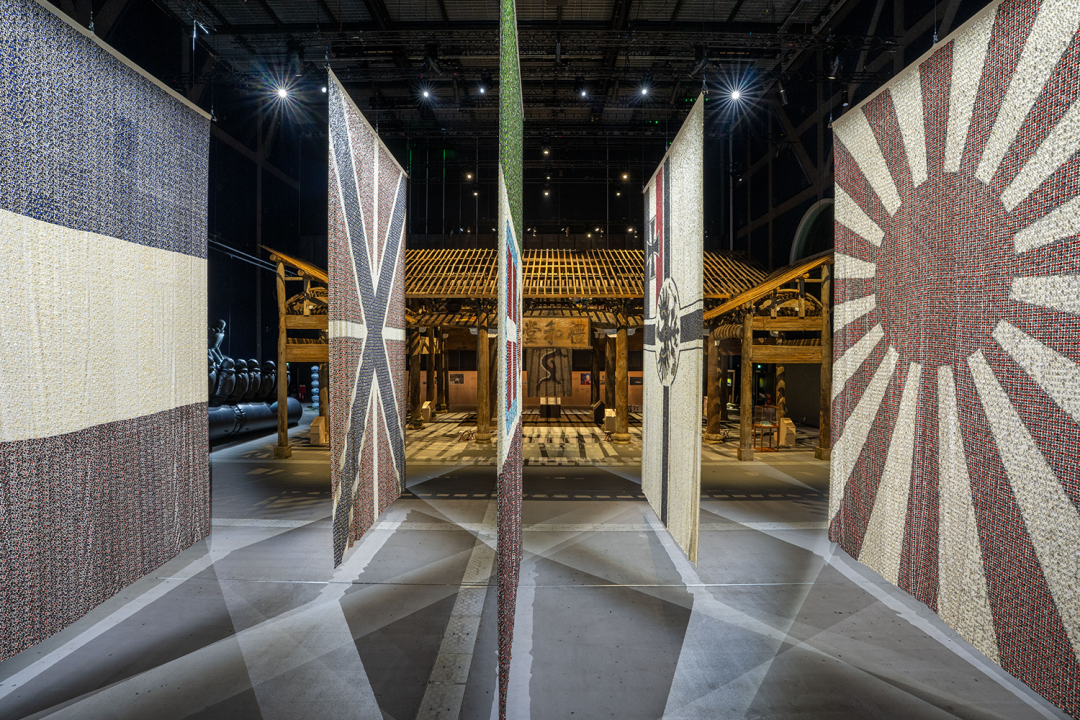
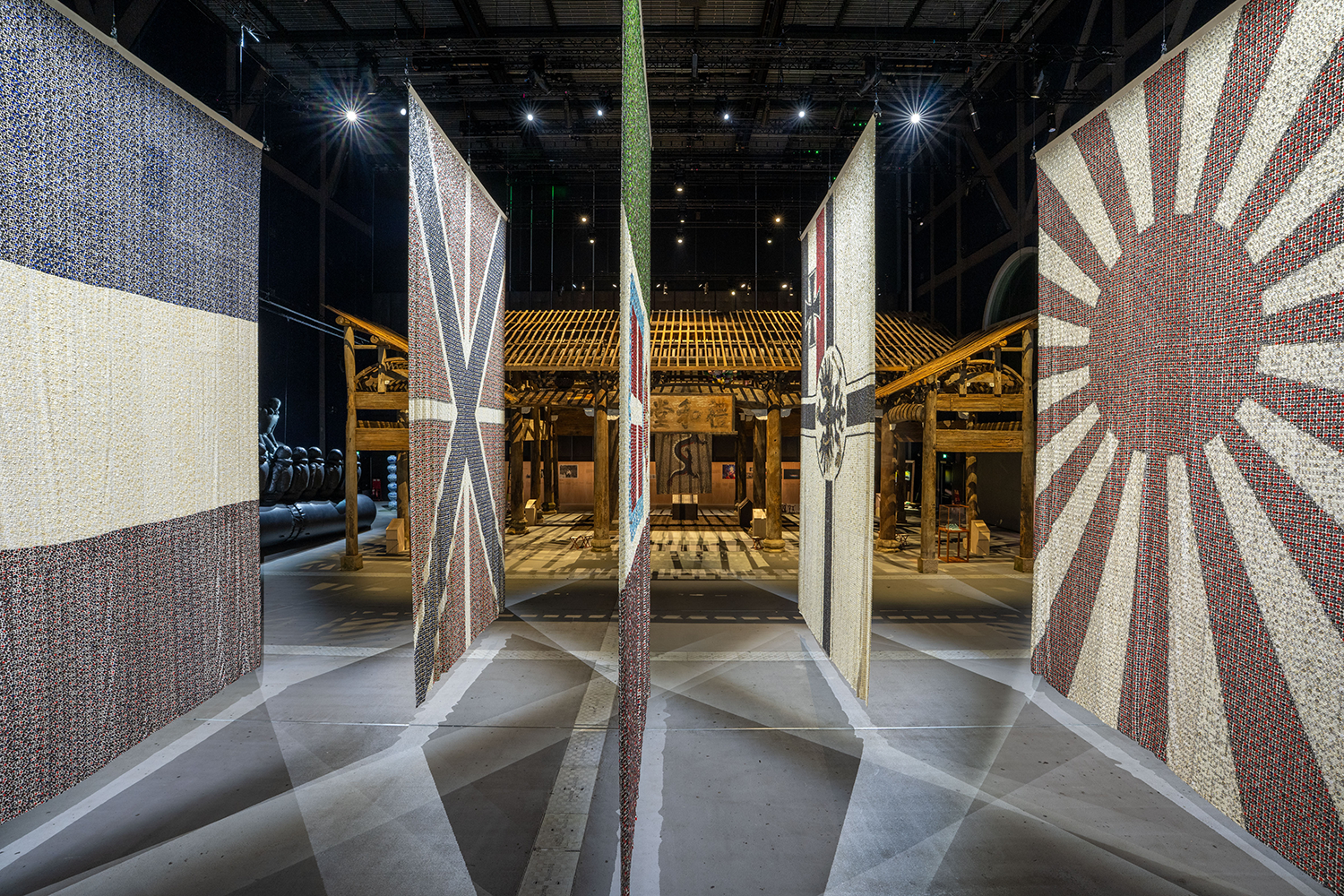
It’s heroically awful: there’s a billboard-sized chart depicting the history of bombs; an upturned, crochet recreation of Jacques-Louis David’s “Napoleon Crossing the Alps,” which – colonial-studies alert! – replaces the Emperor’s horse with a zebra; massive banners displaying the flags of the erstwhile “Great Powers.” Empires and police states are bad, Ai tells us, and we all bear the burden of guilt.
He’s probably right, but this stuff is pure finger-wagging junk, less an art exhibition than a really tawdry theme park. I’m honestly not sure I can remember seeing a show quite so objectively, impressively wretched.
Not that there’s much going on in London. The best exhibitions – Donald Locke at Camden Art Centre, or Ana Mendieta at Tate Modern – commemorate dead artists. A notable exception comes with Jasper Marsalis’s show at the Chisenhale Gallery – a flawed display that nonetheless manages to be miles more interesting than any other contemporary art you’re likely to see this summer.
Marsalis (b.1995) is the son of jazz musician Wynton and he is charismatic in the extreme. His eloquence doesn’t always translate into what he makes, but there’s nonetheless something wild to his practice. The mise-en-scène here involves a multiplex-scale screen broadcasting live imagery from webcams positioned in beauty spots around the globe. Meanwhile, massive speakers blast atonal FM frequencies, creating a near-symphonic continuum of white noise.
We thus get weird, grainy and gorgeous 30-second livestreams of the Sussex Downs, unidentifiable night skies, a view of a beach in (I think) Socotra and whatever else, set to an undetermined jumble of radio signals, the music they carry wiped from the equation. No matter that all we’re likely to see in motion are rippling waves on Alpine lakes and perhaps the occasional, speck-like passing car. The potluck roll of images introduces an element of jeopardy to the proceedings: you could, potentially, catch someone dumping a corpse in a bush.
Marsalis says he’s trying to make us reconsider our appreciation of landscape, and alert us to the hidden means via which we receive live information. I’m not sure he succeeds, but I was seduced all the same – and before I knew it, I’d spent more than an hour in the show. Whatever the artist’s intention: it draws you in, it feels new, and most important, it looks ravishing. In August, in London, I could settle for less.


Comments