Technology

The peril of playing with viruses

If a military team made a mistake during a nuclear war preparedness exercise and accidentally obliterated millions of people, you would not expect to find some of the very same people merrily admitting a couple of years later that they have carried out the very same kind of exercise with different live nukes and slightly fewer safeguards. Would you? That is roughly what I recently found out has apparently been going on in China. The Wuhan laboratory that conducted risky experiments on bat viruses at inadequate biosafety levels and almost certainly caused the pandemic has now revealed that it has done the same kind of risky experiments on another lot of horseshoe-bat viruses at low biosafety levels. Is accidentally killing millions not enough to give them pause?

looksmaxxing

The terrible logic of looksmaxxing

For years, I’ve had a fantasy of destroying my own life by following every piece of extreme self-improvement advice the internet offers. Not the wholesome stuff. I mean the industrial-strength protocols: starvation diets, rhinoplasty, Invisalign followed by double-jaw surgery, chemical peels that promise an entirely new layer of skin. Whatever surfaces in the algorithmic swamp. The appeal is the same as another, more respectable fantasy: the one where a doctor scans your chart, finds The Problem and hands you a pill. You swallow it and everything clicks. Your suffering had a single, nameable, diagnosable cause. The cure might give you rashes or IBS, but who cares? You finally know what’s wrong, and what’s wrong can be treated. The uncertainty is over.

Did the Democrats kill Roomba?

Allow me to add an additional downer note to this grimmest of news days: iRobot, the company that manufactures Roombas, has declared bankruptcy. iRobot said it will continue to update and provide technical support for the devices, so there will be no “bricking.” They will continue to function, just like ghosts continue to haunt the homes in which they once lived. But there’s definitely a brick in the hearts today of the customers who’ve loved their robot vacuums since the 1990s, not to mention the cats who loved to ride them, the dogs that loved to chase them around the house, and the people who loved to watch videos of animals doing those things. In many ways, the world has passed by the Roomba.

Roomba

Our brave new world

In 1961, just two years before he died in Los Angeles, the polymath, philosopher and novelist Aldous Huxley gave humanity a warning. Much of his prophecy about society in Brave New World had come to pass, he said, which made him even more certain that the standout problem of the future would be our inability to resist becoming enslaved to our own technology. Now, more than 60 years after his death – and with an entire generation of children frying their brains with smartphones and nobody able or willing to do anything to stop them – it is hard to deny that he was onto something. The man was destined to be a prophet for our gadget-addled age.

Technology

The dismantling of Lambda School

In 2017, Zoom finally achieved what Skype never could: hosting video calls that didn’t freeze. It was a golden moment to take education online. Enter Lambda School, a Silicon Valley startup founded by Austen Allred with the aim of disrupting higher education. Allred’s idea was simple: people wanted to learn to code but often couldn’t pay $20,000 upfront. His solution? You’d pay nothing until you landed a job earning more than $50,000 a year. At that point, a share of your income would go back to Lambda. But never more than $30,000, and never with interest. The technical term for this is an income share agreement, or ISA, an equity-like stake in a few years of a person’s future income. If you got a good job, the school was repaid. If you didn’t, the school took the loss.

startup

The world needs more copper, but there’s a catch

Copper has a nickname in the commodities market. It’s known as “Doctor Copper” because it’s so deeply integrated into the physical fabric of our lives and all the technology we depend on that its price reflects the health of the economy. “Gold is money, everything else is credit,” said J.P. Morgan more than a century ago. But copper is more than money. It’s modern human life. It is used in every corner of our technology, from houses to windfarms to warehouses. Which is why I think, while everyone’s still obsessing about gold, it’s worth taking a look at copper. Since the global financial crisis in 2008, stock markets may have reached new highs but the physical world of construction, infrastructure and manufacturing has never quite regained its old growth rate.

copper

Talk to your dead grandmother thanks to AI

Doing the rounds on social media is the most disturbing ad I’ve ever seen. And I’m telling you about it because you need to be forewarned, just in case this Christmas a child or a grandchild happens to mention that it might be an idea to record a video for posterity, and opens the 2wai app. 2wai is the company responsible for the ad, and the service it offers is the creation of AI versions of family members so that relatives can talk to them after they’re dead. Catch ’em while they’re still alive, says 2wai; film a three-minute interview and Bob’s your AI uncle. “Loved ones we’ve lost can be part of our future.” That’s its catchphrase. The 2wai ad is about “Baby Charlie,” and it goes like this.

granny AI

Are we becoming post-literate?

Everybody is suddenly recognizing, almost in unison, that many major of the cultural shifts in recent years were accelerated, if not explicitly caused, by Covid lockdowns. In confinement we went online and when we spent more time in cyberspace than in meatspace, our brains began to change. The most significant shift is that we have turned away from books and reading, and as a result our attention spans are collapsing. The screen is eclipsing the page. In the US, reading for pleasure has crumbled; in Britain, a third of adults no longer read books at all. The “reading revolution” that expanded consciousness in the 18th century is in retreat. But what’s emerging is not illiteracy: it’s post-literacy. We are becoming post-literate.

post-literate

What the Amish can teach us about tech

As new technology, AI and the internet take over 21st-century life, I suggest looking to the Amish for guidance. Far from being the Luddites most folk assume, the Amish undertake a guided policy of technological discernment. When a new practice or device emerges into the world, the elders often gather to test it out over a set period of time. The entire process rests upon this deceptively simple inquiry – “What is this tool for and what does it make us become?” All potential effects on family unity, social cohesion and self-reliance are soon revealed by this one question. Diesel and solar generators pass the test and are often adopted, while social media is largely shunned.

amish

Marijuana legalization has been a disaster

On the day the Marihuana Regulation & Taxation Act (MRTA) was signed into law in 2021, the man who was to become mayor of New York City, Zohran Mamdani, made the following statement: “I’m proud to be here today to debate the adult use of marijuana – also known as loud, Sour D, herb, Mary Jane, kush, green, pot, weed, zaza, a jazz cigarette and marijuana. In the course of this debate I’ve heard many of our colleagues from across the aisle discuss that smoking or ingesting marijuana is an indication of lawlessness and a deteriorating quality of life, makes one lazy and a burden to society, serves as a gateway drug.

marijuana

Why the comet 3I/Atlas still fascinates

Our latest visitor from interstellar space is leaving us. It reached its closest point to the Sun on October 29 and is now heading back toward the stars at great speed, having spent a few months traversing our region of space. This visitor – a comet called 3I/Atlas – scared some, fascinated astronomers and thrilled us all as we marveled at its strange journey. 3I/Atlas, which Michael P. Gibson introduced Spectator readers to in the last issue of this magazine, got its name because it is the third object ever found to have entered our solar system from interstellar space – and Atlas is the name of the sky survey that found it as a point of light moving against the distant stars.

universe 3I

3I, the interstellar object that’s baffling astronomers

Science began in the skies. Just after sunset, to be exact, on the evening of November 11, 1572 when a young Danish nobleman, Tycho Brahe, raised his eyes to the night sky. There, above his head, a star was shining brighter than all the rest – a new star that should not have been. Brahe thought he was mistaken, that his eyes were playing tricks on him, but others confirmed what he saw. And yet, according to the reigning theory, derived from Aristotle, there could be no change in the eternal heavens. Surely then this object could not be a star. It must be an anomaly in the upper atmosphere, closer to the Earth, within terrestrial realms. But Brahe got to work. Using trigonometry and observations, he found that the impossible had indeed occurred.

3I

Live-translation AirPods are the future

I have arrived in Naples, Italy, after an arduous flight from a chaotic London Gatwick Airport. I’m settled in a glamorous top floor apartment in the Quartieri Spagnoli – the romantic old “Spanish Quarter” – where Vespas fizz over cobbles and laundry hangs across alleys like flags of endless surrender. Most importantly, I’m clutching my Apple AirPods3 in their shiny new capsule. Because I’ve come here to do a grand, futuristic experiment using their much-heralded “live translate” function. Does it really work as smoothly as Apple says? Can I actually slot them in my ears and have them translate the Italian speaker in front of me, in real time? Is it really like the sci-fi Babel Fish from The Hitchhiker’s Guide to the Galaxy?

islam

What Islam can teach us about AI

In Islamic cosmology there are three orders of intelligent beings. Angels, made of light, have no choice but obedience. Humans, formed from clay, carry the burden of free will. Between them live the djinn, created from “the smokeless flame of fire.” The djinn are, in many ways, like people, but they categorically are not people – from their constitution to their morality. Like the Good Neighbors of British and Celtic tradition, the djinn exist in parallel to us. They think and decide, marry and worship, and are fallible, just as we are. The Qur’an describes some as believers and others as not: “And among us are Muslims [in submission to Allah], and among us arethe unjust.

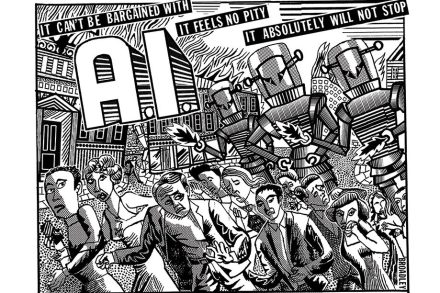
Has the AI jobs bloodbath finally arrived?

There has been much wallowing over news that Amazon and UPS have each just cut 14,000 jobs. Some Amazon employees report of being fired with all the heartlessness you might expect in a world where tech has taken over: by automated email. Maybe it was even AI which handpicked them to be de-emphasized, to use that dreaded 1990s expression. This, then, seems to be the future: where an elite of AI entrepreneurs grow rich while the rest of us slop off into idleness and unemployment. So much for those who have been gleefully predicting the implosion of the AI boom. Nvidia has just been revealed to be the world’s first $5 trillion company, with a market capitalization greater than the whole of Germany.

ai artificial intelligence

Did the billionaire Binance bro pay for his pardon?

“Better to ask forgiveness than permission.” Those were the words of Changpeng Zhao – the billionaire founder of Binance, the world’s largest crypto exchange – when dismissing the need for anti–money laundering safeguards. This week, his strategy proved both vatic and effective. Zhao, better known as “CZ,” received a presidential pardon for the money laundering charge to which he pleaded guilty in 2023.Just a year ago, CZ was sentenced to four months in prison and Binance issued a colossal $4.3 billion fine after U.S. authorities found the exchange guilty of financial malpractice on a global scale. Yet its founder’s contrition was short-lived. “No felon would mind a pardon,” Zhao wrote on X back in March, noting he was the only person in U.S.

Changpeng Zhao

Welcome to the Chinese century

Competition between the US and China will shape the 21st century, but have the Chinese already leap-frogged the Americans? It looks as if they might have done. Since China opened itself up to trade and market economics under Deng Xiaoping almost 50 years ago, it has been furiously chasing the US in terms of economic and technological development – and it’s been catching up, fast. We can prove just how fast by measuring its innovation and output per capita. The US has about a quarter of China’s population, so if both countries were at a similar level of economic and technological development, one would expect China to produce roughly four times the number of scientific breakthroughs as America, four times the number of physicists and AI engineers and so on.

China
Land

In conversation with Nick Land, the ‘father of accelerationism’

Within Silicon Valley, Nick Land is seen almost as a mythic figure. Tech pioneer Marc Andreessen, an official advisor to the White House, lists him as a “patron saint” of his thinking. You may have heard him described as a founding member of the “Dark Enlightenment,” a movement of online right-wingers skeptical of liberal democracy. Land’s name comes up in academic circles, online mythology and Valley folklore. For some, he’s a prophet; for others something more sinister. “He’s really into demons,” explained Conrad Flynn on a recent Tucker Carlson Show episode about the occult. “Land will talk about being in communication with Satan… the legend around Land is he had been possessed by at least three or four demons.

Microsoft

Can the US government escape the clutches of Microsoft?

The Trump administration and Republican leaders in Congress are beginning to look into Microsoft seriously. On August 28, Defense Secretary Pete Hegseth suspended a program which had Microsoft farming out Department of Defense cloud storage contracts to Chinese engineers. “If you’re thinking ‘America first,’ and common sense, this doesn’t pass either of those tests,” he said. Commenting on the project a few weeks later, Senator Tom Cotton and Representative Elise Stefanik wrote: “Microsoft’s role as a trusted contractor for our federal government means this is not a routine cyber vulnerability, but a direct threat to our national security.” It seems the techlash is coming for Microsoft – and not a moment too soon.

What folklore can teach us about our online lives

Irish folklore spoke of many worlds. There was the world of fields and hearths and then there were the hidden places where the non-material lived: the Sídhe mounds, the sea-realm of Manannán mac Lir, the land of youth called Tír na nÓg and, finally, the land of the dead. These worlds coexisted with ours. A woman might leave butter on the windowsill, lest the fairies sour the churn. A new mother would avoid complimenting her baby – at least, not too loudly – for fear he would be kidnapped by the Good Neighbors and replaced with a changeling. My first real boyfriend’s father blamed every family misfortune on their decision to cut down a hawthorn tree.

folklore