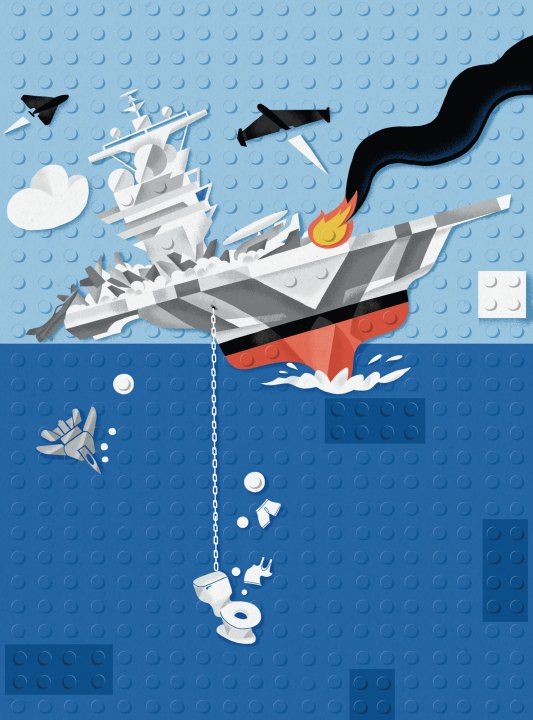
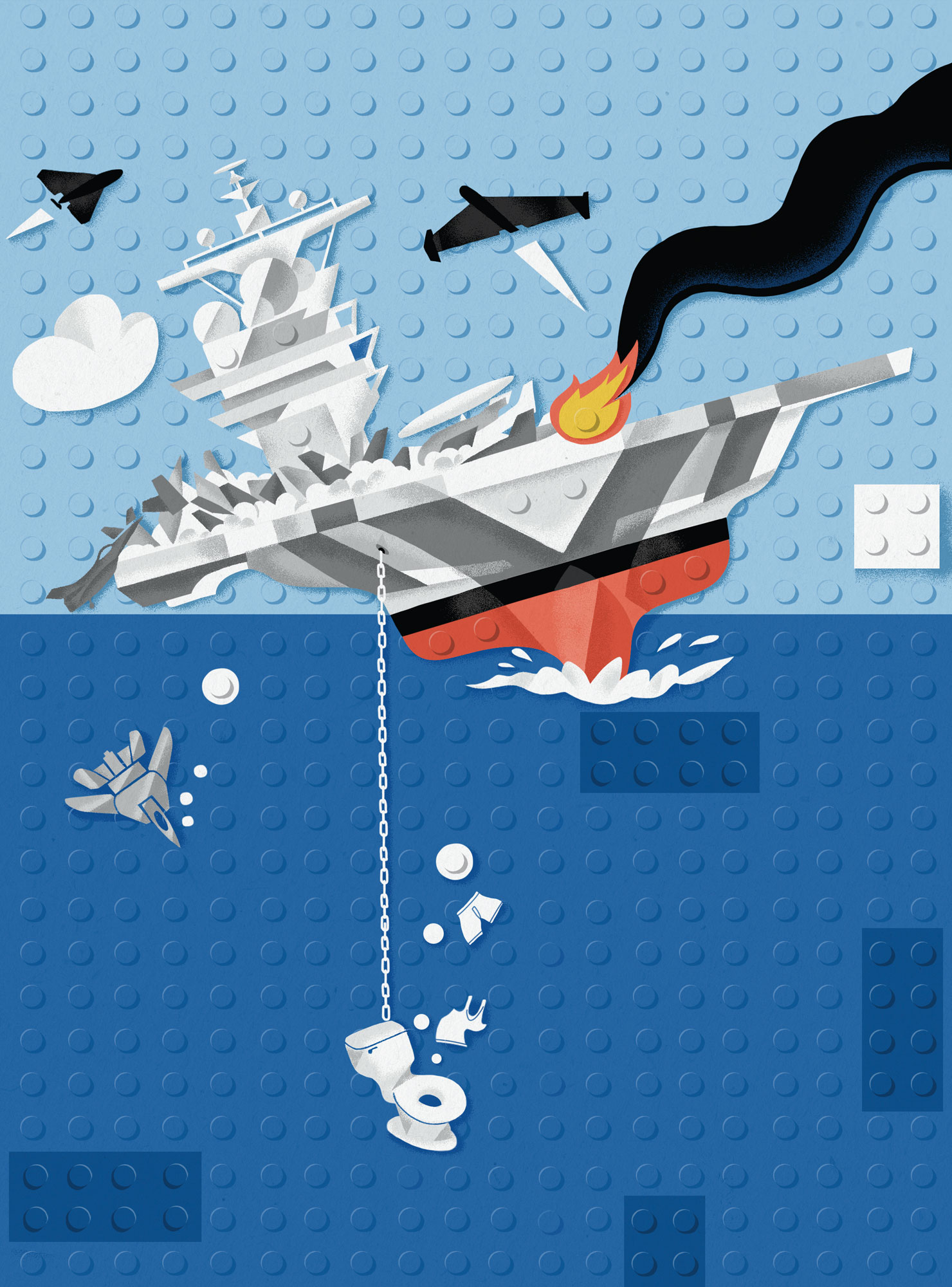
Ever since World War Two, America’s aircraft carrier fleets have served as imposing instruments of imperial power, roaming the oceans to cow recalcitrant nations into obedience. Favored by the Trump administration for this purpose, current experience indicates their day is done thanks to the proliferation of anti-ship missiles and the increasing ubiquity of drones.
In America’s last Middle Eastern war but two, against the Yemeni Houthis in 2025, the carrier USS Harry S.Truman, complete with its attendant escorts, was driven into retreat, leaving antagonists in control of the Red Sea. On one occasion, the carrier’s desperate maneuver to avoid a Houthi drone caused an $80 million Hornet jet fighter to slide off the deck and topple into the sea.
The Navy has gone to great lengths to defend its cherished ‘flattops,’ whose principal function appears to be defending themselves
Chronicling the buildup to the current war, media commentary paid excited attention to the progress of the USS Gerald R. Ford, customarily described as the “world’s largest aircraft carrier,” as it made its way to the war zone. Rarely did the Ford’s status as the most expensive warship ever built get a mention in the commentary, nor that key functions – such as its plane-launching catapult and the elevators that move aircraft to the flight deck – were deficient.
According to a report by Bloomberg defense correspondent Anthony Capaccio, the Navy did not know “how well the Ford – and other ships in its class, which have yet to be delivered – can detect, track or intercept enemy aircraft, anti-ship missiles or small attack aircraft. It’s also unclear how the aircraft carrier’s systems would perform under the wartime strain of continuous takeoffs and landings.” Equally unclear was the “reliability of several key systems, including its jet launch and recovery system, its radar, its ability to keep operating if hit by enemy fire and its elevators for moving weapons and munitions for warplanes from the hold to the flight deck.”
It cannot even launch the F-35C, the Navy’s newest fighter. Far from highlighting American military prowess, the Ford, years late, vastly over budget and replete with new and untested technologies, epitomizes much that is wrong with the US military. Three weeks into the Iran war, the huge vessel limped into a bay in Crete, driven from the battle by what appeared to be acts of sabotage by a mutinous crew exhausted and demoralized after nine months at sea and possibly eager to force a return to home by disabling key components. A poorly designed sewage system had largely broken down thanks to T-shirts, mops and other pipe-clogging items inserted – apparently deliberately – down many of the ship’s 650 toilets.
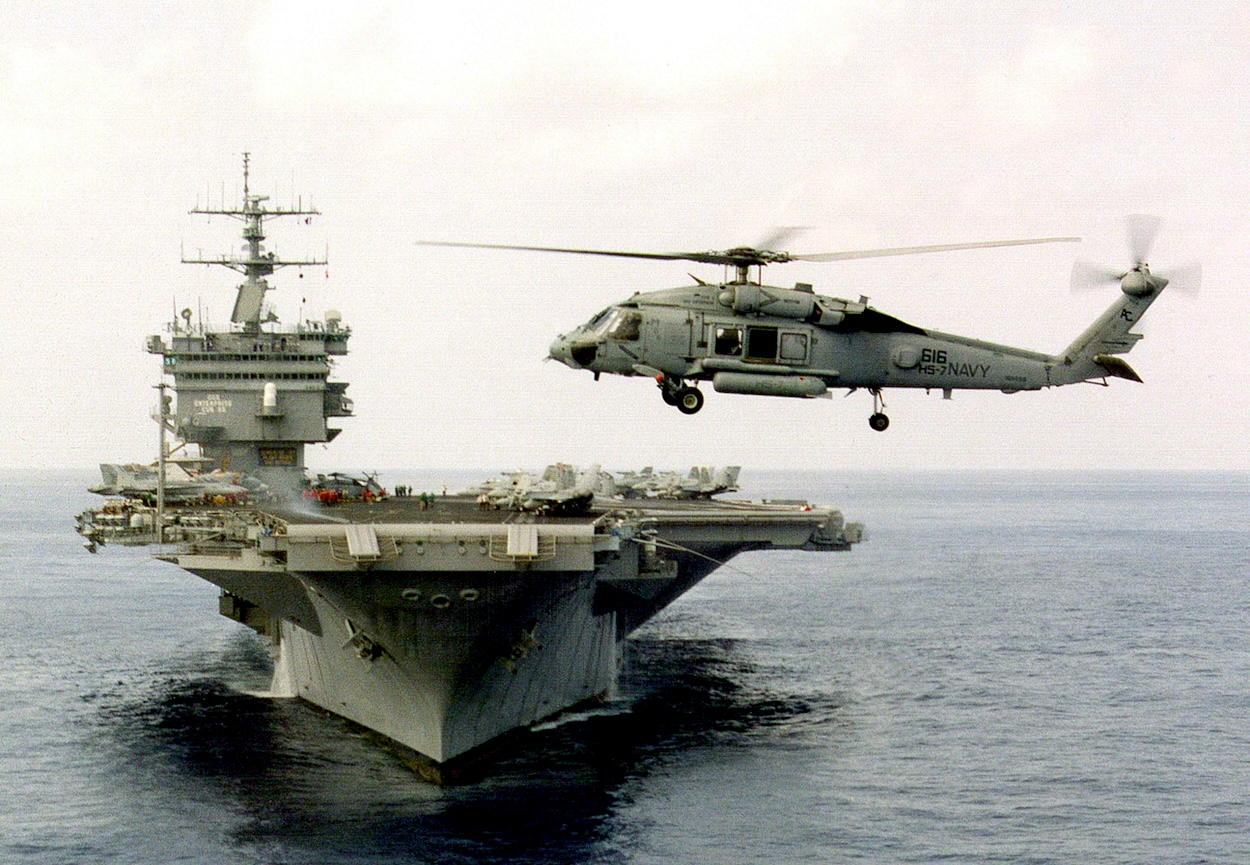
The consequent shortage of working facilities has meant that crew members frequently face a 45-minute wait in line to relieve themselves. A fire ignited by unknown causes in the laundry room, which took no less than 30 hours to extinguish, had burned through part of the Ford’s sleeping quarters, leaving several hundred crew members to bed down on tables or the hard deck. The ship will reportedly be out of action for at least a year. Another carrier currently deployed against Iran, the USS Abraham Lincoln has been ordered to move 1,000 kilometers away from Iran, following an attack by ballistic missiles. The last US aircraft carrier to be lost in wartime was the USS Bismarck Sea, sunk off Iwo Jima in February 1944 with the loss of 318 crew after devastating kamikaze attacks by the Japanese – threats more lethal than clogged toilets. Since then, the Navy has gone to great lengths to defend its cherished “flattops,” whose principal function appears to be defending themselves. Armed with an array of defensive missiles and guns, they move only when enveloped in a screen of cruisers, destroyers and submarines tasked with providing a so-called “area of immunity.”

Even so, critics cite the growing lethality of modern anti-ship missiles, such as the Chinese Dong Feng 21, not to mention drones, as evidence of their vulnerability. Diesel-electric submarines, a venerable technology spurned by US admirals, have on several occasions successfully penetrated the anti-submarine defenses and “sunk” carriers in NATO exercises. Still, it seems less than likely that carriers will ever lose their place at the center of US naval strategy, in the Navy budget, which must be constantly defended against encroachment by rivals in the other services.
In 1949, partisans of the newly independent US Air Force in the Pentagon leadership forced the cancellation, on grounds of cost, of a planned “supercarrier” on which the admirals had set their hearts. A secret naval intelligence unit, tasked with uncovering dirt on the air force, concocted and distributed a document charging that the air force’s nuclear bomber program, which had gotten the carrier money, was rife with fraud and corruption. The so-called “revolt of the admirals” ended in defeat, and many of the high command were forced into retirement by a vengeful Truman administration.
Nevertheless, the notion that the Navy should have its own air force, the rationale for carriers, survived, assisted by the outbreak of the Korean war in 1950, when carrier-based planes were heavily engaged, playing a similar role in the subsequent Vietnam war. The vast expense and questionable utility of these gigantic vessels has not deterred other navies from attempting to create their own carrier forces. Britain has strained its finances to build two carriers, HMS Queen Elizabeth and HMS Prince of Wales, which have so far had a sorry record of malfunctioning propeller shafts, engine room floods and plumbing breakdowns, thereby spending long periods out of service. The one French and two Italian carriers are similarly beset by mechanical problems, crippling cost and reliance on the high maintenance F-35B vertical-takeoff fighter.
The Russian Admiral Kuznetsov presents an even sorrier tale of breakdowns and fires, and has spent many years in dock. China, meanwhile, has stirred the hearts of carrier enthusiasts by embarking on an ambitious program. The Fujian, commissioned in 2025, appears to have drawn inspiration from the Ford. There is little reason to suppose that Beijing’s entry into the carrier club will escape the problems of vulnerability, cost and maintenance faced by its peers. But at least the toilets might work.






Comments