Politics

Read about the latest political news, views and analysis

Why I’m backing the Brexit deal

What are committed Brexiteers to make of Boris Johnson’s deal? It’s said that some Tories are cheering a compromise out of blind party loyalty – but I’m not sure I can be accused of that. I have devoted the last five years in pursuit of Brexit, and stood against the Tories in the last European election. But the political part is over. We now have a deal, and the question is whether it’s the real deal. I’d like to do two things: point out the many problems with this deal – problems that other Brexiteers are quiet about. But I’d also like to explain why, nonetheless, the deal is worthy of support. Even celebration. As Ursula Von Der Leyen said, it certainly has been a long and winding road - for me especially.
A UK-India trade deal is needed now more than ever

Within a year of being elected leader of the Conservative party, David Cameron made clear the importance with which he viewed Anglo-Indian relations: “I attach the highest priority to Britain’s relationship with India. For too long, the politics of this country has been obsessed with Europe and America.” That he meant business was underscored by the 2010 Tory general election manifesto which promised a “new special relationship with India”. The British head of state Queen Elizabeth ratified an “enhanced partnership” with India in her speech at the opening of parliament. Cameron, now prime minister, rushed to Delhi, where India endorsed the idea, but did not really execute it.

The problem with Johnson’s Brexit deal

Boris Johnson has delivered a deal that I must admit is miles better than I had anticipated. Mind you, I had feared the worst. But this Brexit deal still does not justify the plaudits it is receiving. Let’s start with the good bits. Great Britain (as opposed to the UK) will, on 1 January, be out of the Single Market, largely free of the European Court of Justice and able to make its own laws. We will be able to trade in goods with the EU free of tariffs and quotas. Yet without wishing to detract from the importance of these achievements, there is very little else that is good in the agreement and which could not otherwise be achieved. The Trade and Cooperation agreement (TCA) does not in any way unpick the pernicious Northern Irish Protocol.

Most-read 2020: Why Dominic Cummings had to go

We're closing 2020 by republishing our ten most-read articles of the year. Here's No. 3: Alex Massie's article from May on the Cummings' imbroglio Most aspects of this present emergency are complex and resist easy solutions. Only a handful are elementary but one of these, and quite obviously so, is the Dominic Cummings affair. He must go and he must go now. There is no alternative, no other way out, no means by which this ship can be saved. The only question is the number of casualties Cummings will take with him. Judged by the cabinet’s performance on social media this weekend, the answer to that question is also simple: all of them. It cannot be stressed too often that the government’s authority during this crisis is moral much more than it is legal.

Ministers plan to push recess back

As ministers consider placing more areas under Tier 4 restrictions in the upcoming tier review, there are a growing number of Tory MPs keen to get back to parliament and scrutinise the government's plans. However, they will likely have to wait. Coffee House understands that plans are afoot to push back recess dates by a week.  When the Commons sits on Wednesday to vote on Boris Johnson's Brexit deal, MPs will also be asked to vote to extend recess until 11 January. It had been due to end 7 January. MPs have been told the reason for the change of plan is concerns over Covid rates – and that MPs travelling from various parts of the country could fuel further spread of the virus.

The trouble with Erasmus is not just the cost

It was curious to see the explosion of outrage over the UK no longer participating in the Erasmus scheme. We were told it broadened young people’s horizons by sending British undergraduates to study at a European university. We were told our young people are being deprived of this opportunity. But having spent my pre-politics career working with young people, Erasmus and deprivation are not things I’ve ever associated with one another. The outrage is largely coming from a collection of the firmly middle class and affluent anti-Brexit folk – TV broadcasters and QCs among them.

A Priti poem: an ode to the Home Secretary

Priti Patel, Ms Priti Patel, Burnished by sunshine of far Israel,  How we all cheered when on Marr you did smirk, And as he got rattled, we yelled ‘O, good work!’ – Love-thirty, love-forty, oh weakness of joy, With the speed of a swallow you mangled the goy,  With carefullest carelessness, gaily you played Marr,  And like a Hindu princess you cheeked and you slayed Marr. – Priti Patel, Ms Priti Patel, Mandarins you mangle, and at police chiefs you yell, Illegals you find where others have missed ’em, But you’re no xenophobe with your lovely points system.

Putin is finally waking up to Russia’s climate change problem

The snow is falling in Moscow, but that is after the warmest autumn there on record. Meanwhile, perhaps reflecting that with the arrival of vaccines, there is at least the prospect of an end to the Covid-19 crisis, the climate change debate is rekindling – and with a particular geopolitical angle. Much of the conventional wisdom is that it is a perverse boon to Russia. Representative of this perspective, for example, has been a recent study that led the New York Times to predict that Moscow will ‘win the climate crisis’ – while its partner, ProPublica, warned that ‘Russia could dominate a warming world.’ Stirring stuff, and no doubt music to Vladimir Putin’s ears.

The small print of Boris’s Brexit deal makes for reassuring reading

The new UK/EU Treaty is needlessly long and turgid in its prose: this document was not drafted by people who think the law should be understood by all. Close inspection of the small print reveals that none of the details undermine sovereignty. It has been restored and the UK has the power to control its own laws. To understand what’s happened, consider the last two big treaties. Under the Maastricht Treaty the EU’s ability to control UK law was extended on what came before but was confined to specific areas only. That was called 'spheres of competence'. The 2007 Lisbon Treaty vastly expanded the EU’s power and the idea of restricting EU writ to areas of its competence fell away.

Is a high-spending, high-debt economy the new normal?

35 min listen

After a year battling coronavirus, the UK's debt now totals more than £2 trillion. In an effort to keep the economy afloat, the Treasury has paid wages, given tax relief, and even paid for people to eat out. As recently as five years ago, Conservatives would have thought this spending unsustainable. But with Boris Johnson's government being elected on a promise to 'level up' the country, will this high-spending, high-debt economy become the new normal?With Paul Abberley, CEO of Charles Stanley Wealth Managers; Jake Berry, Conservative MP and chair of the Northern Research Group; and David Miles, an economist at Imperial College London and former member of the Monetary Policy Committee. Presented by Kate Andrews. Sponsored by Charles Stanley Wealth Managers.

Most-read 2020: Six questions for Neil Ferguson

We're closing 2020 by republishing our ten most-read articles of the year. Here's No. 5: Steerpike's questions from April for Neil Ferguson. It was a tale of two interviews on the Today programme this morning. First up on the show was Neil Ferguson, professor of mathematical biology at Imperial College London, who has been instrumental in forming the UK government’s response to the coronavirus crisis, and whose virus modelling led to the current lockdown being put in place. On the show, the professor received an almost deferential line of questioning from Sarah Smith with his views seemingly taken as near-Gospel as he declared that a 'significant level' of social distancing could have to be maintained indefinitely until a vaccine becomes available.

Boris Johnson’s Christmas reading

Boris Johnson will be hoping for at the very least a brief break after securing a Brexit deal on Christmas eve. So, how will the Prime Minister choose to unwind? Perhaps a clue can be found in a photo recently uploaded to Flickr by 10 Downing Street official photographer Andrew Parsons.  There has been much amusement online over the new photos by Parsons which document the fateful hours leading up to Johnson securing a deal with the EU. In a range of pictures, the Prime Minister is photographed deep in conversation with his closest aides as well as swigging from a can of beer and near a bag filled with Five Guys burgers.

How the Brexit deal demonstrates Boris Johnson’s genius

I have never cared for Boris Johnson as a politician. Despite that, I voted for him twice as London mayor. That actually says a lot about Boris for me. I can point to the fact that what I really did in 2008 and 2012 was vote against Ken Livingstone. Boris was just the lucky recipient – he was in the right place at the right time. Yet when a politician is always in the right place at the right time, there comes a moment when you have to stop putting it down to simply luck. Getting the trade agreement with the EU completed this week is nothing short of political genius on the part of Boris Johnson. If Dominic Cummings were still working for him, a lot of political journalists would right now be crediting him for getting this over the line; but no, it was down to Boris.

Why Brexiteers should support this deal

When Britain voted on whether to leave the EU or remain within it there were valid arguments on both sides. But on one thing most leavers and remainers could surely have agreed: the Brexit would be a pointless and wasteful exercise unless Britain would retrieve the powers that voters wanted. A deal that left us under EU rules – as outlined by Theresa May’s Chequers proposal – would mean all of the pain but minimal gain. Boris Johnson’s test was whether he could do better. This is what has made the past four and a half years so agonising. For much of that time we seemed destined for a halfway house which nobody really wanted – a state of limbo in which we would be forever bound to follow EU rules and policies yet have no say in the making of those rules.

Is the SNP’s Brexit strategy paying off?

Ursula von der Leyen quoted TS Eliot’s poem ‘Little Gidding’ in her press conference today: ‘What we call the beginning is often the end. And to make an end, is to make a beginning.’ The free trade deal between the UK and the EU marks beginnings (new arrangements on commerce, fishing and security cooperation) and ends (the single market, free movement, Erasmus), but what we can’t yet be sure of is which category Scottish independence falls into. We might glean the answer from the 2,000-page agreement when the text is published but it is more likely that the question will remain open for some time.

Will Boris’s Brexit deal sail through the Commons?

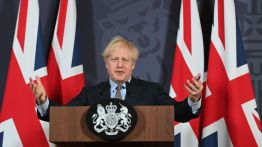
After Boris Johnson waxed lyrical about his Brexit deal in today's Downing Street press conference, it's now over to MPs to give their verdict. During the press conference announcing the terms of the deal agreed between the UK and EU, the Prime Minister confirmed that the government plans to put the deal to a vote on 30 December. MPs have already voiced concerns about the lack of time for proper scrutiny – and the text of the full deal (500 pages plus another 1,000 in annexes) is still to be published. But, despite this, the initial signs are promising for the government. Prior to finalising the deal this afternoon, the Prime Minister had conversations over the phone with several Brexiteer MPs to brief them on the outline of the deal.

France couldn’t care less about Boris’s Brexit deal

The reaction of the French commentariat to the Brexit partnership agreement will be largely one of extreme irritation that the traditional Christmas Eve dinner was so crudely interrupted. Any initial response to the deal has been rather abbreviated. Nobody has read the fine print. The usual pundits are out of town. Brexit has never been a subject central to French political discourse and since Covid it has shrunk further as a preoccupation of the country. The news channels with their skeleton holiday crews have been unable to mount a full-blown orgy of live remotes from Europe’s capitals and have resorted to more marginal regional figures, focusing on the fishing ports. Conspicuously absent in these remotes is much passion. It doesn’t look like a cod war is imminent.

Boris’s Brexit gamble faces its next challenge

This country will end the Brexit transition period with a zero tariff, zero quota deal with the EU. Four and a half years after the Brexit vote, the issue that has so convulsed British politics is settled. We are still awaiting the text of the deal. But from what both sides have said it is clear that this is a pretty full fat Brexit: Britain leaves the single market and the customs union and there’ll be no dynamic alignment with EU rules in the future. On the three key tests of money, borders and laws – it looks like the deal passes The two sides will be able to put tariffs on each other if they feel that they have raised their standards and the others refusal to follow suit puts them at a trading disadvantage.