Music and Opera

Our curation of music and opera reviews

Fionn Regan has gone method Worzel Gummidge

Watching the Mercury Music Prize on television last week, I remembered that Fionn Regan’s debut album, The End Of History, was nominated for the award back in 2007. Proof were it needed that the prize is rarely a shortcut to superstardom for most of those it spotlights. The Irish singer-songwriter has never quite replicated the mainstream acclaim he gained for his debut – when, for a solid five minutes, he was the latest in a long line of ‘new Bob Dylans’. He has, however, carved out an interesting and worthwhile career across five further albums, expanding his core skill set of folk guitar and knottily poetic wordplay with experimental touches


A great comedy about a terrible sport

I’m trying to think of things I’m less interested in than American football. The plant-based food section? Taking up my GP’s offer of a free Covid booster? Ed Miliband’s nostril depilation regime? No, apart from maybe baseball, I can’t think of anything so soul-crushingly tedious as a rigged game where men in shoulder pads and portcullised helmets shout numbers, bash into one another, then wait half an hour while the referee decides whether or not they’re allowed to throw a spinny ball and maybe one day end up being Taylor Swift’s latest boyfriend. So you’ll never guess what the subject is of my favourite new American comedy series, Chad Powers…

Why I love blowing up worms

Grade: B+ War, as we all know, is hell. But if it involves small squeaky annelids blowing each-other up with bazookas, it is also hella fun. And so to the newest installment in the long-running turn-based strategy series Worms. Can it be a coincidence that Worms Across Worlds arrives on Apple Arcade just in time for the release of Philip Pullman’s final His Dark Materials book? Yes, it absolutely can. Nevertheless the latest Worms, like Pullman’s work, is set in a multiverse in which intrepid heroes travel through portals between worlds. The world of Worms, like the world of His Dark Materials, mingles science and experimental theology: you can see

In defence of Mick Hucknall

Before Simply Red came on stage at the Greenwich peninsula’s enormodome, the screens showed a clip of a very young Mick Hucknall being interviewed. What he wanted, he said, was to be a great singer. Usually, that’s the cue for a gag about fate having other plans. Not this time. He’s 65 now, and he truly is a great singer as he showed for the best part of two hours. He knows it, too. A couple of songs in, he benignly told his audience at the first of two nights at the O2 that he liked it when they sang along with the choruses, but maybe leave the verses to

Very pretty and pretty gruesome: Ballad of a Small Player reviewed

Ballad of a Small Player opens with Lord Doyle, played by Colin Farrell, hiding from security in his trashed casino suite in Macau. After they’re gone, he slips into the corridor and sees a trolley holding a bouquet of flowers and a knife. I kept my eyes on the knife, expecting the jittery, paranoid gambling addict to grab the weapon. Instead he places a white rose in his green velvet lapel. Director Edward Berger (All Quiet on the Western Front, Conclave) enjoys playing these games of misdirection. It feels appropriate. Casinos – with their chandeliers, gaudy frescoes and croupiers in black tie – are contradictory places. Opulence in these temples

Handel was derided in his own time – particularly by us, for which belated apologies

Here’s a patriotic thought for you: baroque opera, as we now know it, was made in Britain. Sure, there are your Vivaldis and Cavallis; there’s always someone (usually French) trying to make Rameau stick and a few years back Opera North – bless them – even tried to exhume an opera by Reinhard Keiser. But realistically, if you’re going to see a pre-Mozart opera from a major company anywhere in the world, and it’s not by Monteverdi, it’s overwhelmingly likely to be by Purcell or Handel. And Handel wrote practically all of his surviving operas in London, for British audiences and British taste. So it’s only right that UK opera

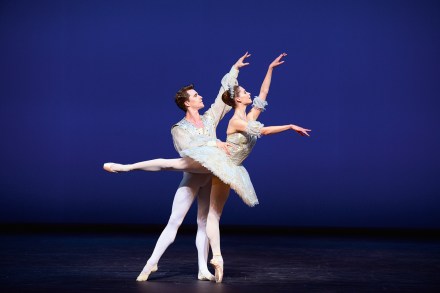
I could watch Balanchine's Theme and Variations on repeat

R:Evolution is a pun, presumably intended to suggest that tradition is not static and the obvious truth that change always grows out of what has come before. A useful idea, of course, even if it’s one that the four short works selected under this title by English National Ballet doesn’t smoothly illustrate. The management is, however, due a pat on the back for trying; budget cuts and the power of the grey men in marketing means that such programming is becoming increasingly rare, victim of the regressive fashion for full-length narratives and fairy tales. ENB starts by juxtaposing two works conceived in 1947. Balanchine’s Theme and Variations is one of

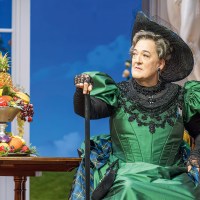
Stephen Fry is the perfect Lady Bracknell

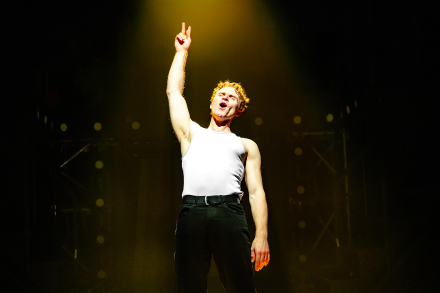
Hamlet at the National opens like a John Lewis Christmas advert. Elegant celebrations are in progress. The stage is full of dining tables draped in white linen and adorned with flowers and beautiful glassware sparkling in the candlelight. Elsinore is reimagined as the home of a multicultural royal family. Claudius, resplendent in a dark dinner jacket, toasts his Asian bride, Gertrude, who wears a banana-yellow sari. Enter Hamlet, hunched and mutinous, in a snaky black suit like a moody star at a film première. He cheers up when he reaches his first soliloquy which he delivers to the crowd like a larky routine at a comedy club. Hiran Abeysekera (Hamlet)

The mind-bendingly creative works of Louis Couperin

The French lutenist Charles Fleury, Sieur de Blancrocher, is one of those unfortunate historical figures who are chiefly remembered because of how they died. He was climbing the stairs to his apartment near the Louvre after a court dinner in November 1652 when he slipped, fell head over heels and was dead a few hours later. We don’t know, though people have wondered, whether the wine was to blame. Only one piece of music by him survives, and he would probably be forgotten if he hadn’t been memorialised in several tombeaux – slow memorial dances – by royal composers, one of whom was a young harpsichordist whose genius is only

Has Taylor Swift been reading The Spectator?

The Last Dinner Party received quite the critical backlash when they arrived amid much fanfare in 2023. Posh, precocious and theatrical, armed with lofty ideas that matched their station as four young women who had benefited from very expensive educations, the band encountered widespread suspicion that they were industry ‘plants’, or had somehow bought their way to instant recognition. Happily, their debut album, Prelude To Ecstasy, proved sufficiently accomplished to repel these waves of hostility (strange how the success of privileged young women tends to attract far greater opprobrium than that of privileged young men). In any case, the excellence of the follow-up should settle the matter. Rougher around the

Excruciating: Netflix's House of Guinness reviewed

First the surprising news: not a single one of the four Guinness siblings in 1868 Dublin is black; and only 25 per cent of them – surely a record for Netflix – is gay. Now the bad: despite these oversights, House of Guinness remains very recognisably the work of Steven Knight, the Peaky Blinders screenwriter who once set a drama in 1919 Birmingham and said to himself: ‘I know just what this period needs to make it more echt: a cameo appearance by dub poet Benjamin Zephaniah.’ As a Brummie (more or less), I loathed Peaky Blinders. I hated the accents (some were OK, but too many were a melange

An album that proves Martinu was one of the great quartet composers

Grade: A Bohuslav Martinu was a patchy composer; worse, he was also a prolific one, meaning that if you dip into his music at random you never quite know if you’re going to have your day made, or just half an hour wasted. Ideally, you need someone to do the choosing for you, and praise be, here’s one of today’s brightest and best chamber ensembles doing exactly that. Seriously: listen to one of the big-name string quartets of the CD era – the Alban Berg Quartet, say, or the Emersons – and ask yourself, hand on heart, whether the Pavel Haas Quartet doesn’t play the socks off them. The vitality,

A dazzling musical celebration of the 1970s

Clarkston is an American-backed production featuring a Netflix star, Joe Locke. He plays a young graduate with a terminal illness, Jake, who works at a Costco warehouse in a failing midwest town. Jake is a brainbox with an IQ of 140 who takes a scholarly interest in early American history. On his first day at work, he befriends a bookish intellectual, Chris, who loves literature and wants to dazzle the world with his fiction. The entry requirements for this branch of Costco seem to be tougherthan Harvard’s. The romance between the two boys is impeded by Jake’s clingy mum, Trisha, who feeds her meth habit by stealing his money and

Pure feelgood: ENO's Cinderella reviewed

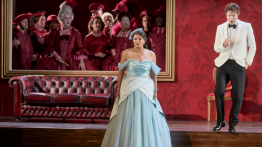
‘Goodness Triumphant’ is the alternative title of Rossini’s La Cenerentola, and you’d better believe he meant it. Possibly my reaction was coloured by last week’s experience with the weapons-grade cynicism of Stephen Sondheim’s Follies, but honestly – it’s just so sweet. A gentle, put-upon girl gets her fairy-tale ending in the face of stepsisters and a stepfather who are basically buffoons rather than outright villains. We’re in the realm of panto, or children’s TV: nothing really dark can happen here and the only sorcery is worked by Rossini, whose fountain of laughing, crystal-bright invention is as life-affirming as Haydn, if he’d been born 50 years later and in Italy. Pure

Propulsive, funny – and what a car chase: One Battle After Another reviewed

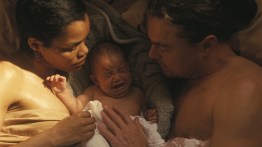
Is Paul Thomas Anderson’s latest as good as everyone is saying? That it has a run time of nearly three hours and I didn’t drop off, and didn’t have to fight dropping off, may say it all. But if you want more, I can also vouch that One Battle After Another is funny and fantastically propulsive, and it also, I should add, reinvents the car chase – which I don’t believe any of us expected to see in our lifetimes. So while you can search for a deeper meaning if you want (many have), you can also simply enjoy it. (I give you permission.) The car chase at the end?

Like Gabor Mate set to club beats: Lady Gaga, at the O2, reviewed

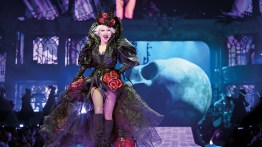
Lady Gaga’s show was to begin at 7.30  prompt, we were told. No opening act. And at 7.30 something did happen: the big screen over the stage started showing a film of Ms Gaga, clad in scarlet finery, writing on a scroll with a peacock-feather quill, while the PA played opera’s greatest hits. For more than an hour the film ran, an impassive Gaga doing nothing but writing. An hour. It was nearly as dull as a Paul Thomas Anderson film, and it’s a miracle it took 45 minutes for the handclaps to start ringing around the arena. Was she about to do a Madonna – who had to keep

Northern Ireland Opera have a hit: Follies reviewed

Never judge a musical by its score alone. Even more than with opera, the music is only ever half the story and if you judge a classic show from the cast recording, you might get a shock when you see it staged. Leonard Bernstein’s Candide is generally reckoned to be one of the fizziest, funniest Broadway scores ever composed. But in the theatre, the storyline is so intractable that the combined efforts of Richard Wilbur, Lillian Hellman, Stephen Sondheim and even (it’s said) Dorothy Parker haven’t succeeded in establishing a definitive, stageable version.  No such problem with Sondheim’s own Follies: you’d be hard put to find a smarter piece of

Kate Moss's new Bowie podcast is far too safe 

In January, it will be ten years since David Bowie died. I remember Bowie songs playing out of every London orifice that day. People who only knew ‘Life on Mars’ went down to the Brixton mural and cried. And then, for a whole year afterwards, the BBC’s arts coverage consisted entirely of salt-and-pepper fatties sitting in studios, in the mandatory uniform of T-shirt and blazer, all of them finding different ways to wheeze: ‘Day-vid Bow-ie chay-nged everyfing.’ As we approach the anniversary, the BBC is having another go – except this time with Kate Moss. ‘This is David Bowie Changeling’, Moss purrs, inaugurating a nine-parter on BBC Sounds and Radio

Michael Keegan-Dolan's How to be a Dancer is worthy of Flann O'Brien

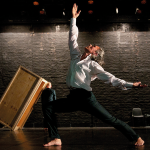
Michael Keegan-Dolan’s show doesn’t even pretend to live up to the arresting proposition in its title – anyone hoping to glean a few useful tips on becoming a dancer would come away bitterly disappointed. What the Irish choreographer offers instead is a witty and touching exercise in autobiography in which he is ably abetted and illustrated by his resourceful wife, Rachel Poirier.  Born into a large and unlettered working-class family in north Dublin, Keegan-Dolan grew up jiving to Talking Heads and emulating Gene Kelly. Pigeon toes hobbled his four gruelling years in ballet training and as a performer he didn’t make it beyond the chorus line in West End musicals.