Culture

The good, the bad and the ugly in books, exhibitions, cinema, TV, dance, music, podcasts and theatre.

John le Carré was boring and unpleasant

I have been having a John le Carré holiday. Five years after the great master of the spy thriller went to his final safe house in the sky, I spent chunks of the festive season watching two of his series on TV, and reading a slim volume called The Secret Life of John le Carré by his biographer Adam Sisman. Amazon Prime’s big New Year drama offering is The Night Manager, a sequel series to one of le Carré’s later stories, and simultaneously the BBC has been re-running le Carré’s 1970s masterpiece, the seven-part mole hunt Tinker, Tailor, Soldier, Spy, starring the late, great Alec Guinness as spymaster George Smiley. Sadly, on two successive nights I found myself falling asleep in front of the dramas.

john le carré

My father gave me the internet

My father went into the kitchen for a cookie, then disappeared into his home office for a phone call. He was arranging a surprise for my mother – hired waitstaff for Christmas Eve dinner, one of the biggest our family would have hosted. Then he died. It took 15 seconds. We found him within minutes. The waitstaff called back 11 times over the next two days. I thought they were debt collectors. Finally, I went into his office, where we had found him, picked up his phone, and yelled, “He’s gone! Stop calling!” That’s how I learned what he’d been doing. They were trying to confirm. And in the corner of my eye, on his bookshelf: Irish Folk and Fairy Tales by W.B. Yeats.

father internet

No sex please, we’re Gen Z

For many years now we have all been agonizing over the fertility crisis. Why aren’t the kids having kids? It’s become a sort of parlor game, the swapping of the various theories. Is it the cost of living? Microplastics? Eco-anxiety? Tight underwear, I heard the other day, and snorted with scorn even as I tipped my son’s stretch-cotton briefs into the bin. But now another, rather more fundamental explanation for the baby shortage has emerged. It’s not just that younger generations aren’t having babies – it turns out they aren’t really having sex at all. The Atlantic was first to properly examine this trend among young Americans, in a terrific piece which gave a name to the phenomenon: the Great Sex Recession.

The French obsession with Epstein

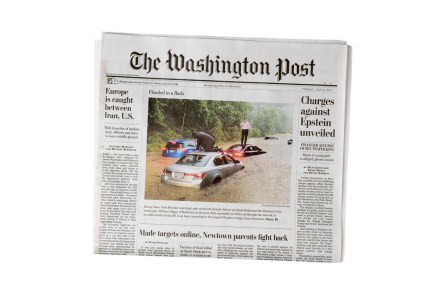
The ongoing revelations about the rich and famous who rubbed shoulders with Jeffrey Epstein are receiving extensive coverage in France. Print and broadcast media have pored over the details of the deceased sex offender and the famous names contained in the Epstein files, from princes to presidents to pop stars. There is a French connection to Epstein in model scout Jean-Luc Brunel, who was alleged to have trafficked girls for the pedophile financier. He was arrested at Charles de Gaulle Airport in 2020 and was found hanged in his prison cell two years later. But overwhelmingly what the French media have described as l’affaire Epstein is an Anglo-Saxon sex scandal. ‘Isn’t a certain tolerance for infidelity what the French have given the western world, along with great wine?

Every unhappy generation is unhappy in its own way

The Kids Are All Right was a 2010 movie that attempted to reassure audiences that the teenage children of a lesbian couple are psychologically just fine. The movie is largely forgotten but the title has lingered, often as a springboard for observers who say that today’s kids are not, in fact, all right. The diagnoses of what ails the current generation of young folk are many and various. They are the products of infantilization, feminization, iPhones, cancel culture, digitalization, narcissism, social-justice intoxication and nihilism – among other maladies.

Marla Maples’s divine purpose

The White House Christmas party really was beautiful this year. A very special festive night with beautiful friends and family. Don Jr. and Bettina got engaged at Camp David just before it and the party wasn’t supposed to be a celebration for them – but Donald decided to announce it to the world. I was so happy the official announcement was made while we were all there with them. It was a special night. Then the following night I attended the White House Hanukkah party because I believe we have to bring people of all religions together especially at difficult times. The cold and hustle of Washington, DC was a far cry from my normal routine.

invalid

If you’re ‘reaching out’, you sound deranged

“Why doesn’t anyone ever do what you ask them to?” inquired my husband, who is something of an expert on the question, I should have thought. He was referring specifically to a plea I made three years ago to people I’ve never met to stop sending emails that begin: “I am reaching out to you.” But it has grown worse. Using the expression makes it sound as though the emailer is deranged. Reach out has for more than a century meant “to offer sympathy, support or assistance” to people. Correlatively it can mean to seek those things. British Prime Minister Keir Starmer has acquired the habit of issuing a Christmas message. For 2025 he said: “At this time of the year, which celebrates love and abundance, loss or hardship can feel even more acute. Reach out.

Make mine a Moka pot

It’s strange the things that can trigger amity or affection. At the beginning of the capsule/pod coffee-maker craze, when George Clooney, with his come-to-bed eyes, was seducing the world with Nespresso machines, I bonded with my eldest daughter’s Italian boyfriend over the Bialetti Moka pot. Notwithstanding the expense and waste of the capsule coffee makers, I need at least three pods to get the lights on in my head in the morning. I’ve never had a good coffee from any of them. Contrast that with the cute, economical, environmentally friendly little Moka, the smallest of which – one cup – costs about $30 and, depending on the quality and freshness of the coffee used, makes a better cup than any café or restaurant.

AI porn will spawn a nation of addicts

If there is one safe prediction we can make about 2026, it is this: public debate and global news will be dominated by artificial intelligence and the anxieties that surround it. And near the top of that swelling list of worries will be “AI porn” – the fateful collision between ever more accomplished image-making machines and humanity’s eternal appetite for audiovisual sexual stimulation. The year has barely begun and already two loud tsunami sirens have sounded. The first is the latest Grok incident. For the uninitiated, Grok is Elon Musk’s AI, conceived a couple of years ago in a fit of pique after Musk’s spectacular falling-out with OpenAI.

The gender hydra is about technology, not ideology

I hope this is the year people fighting the gender hydra, with its proliferation of harms across society, finally recognize that this is not a culture war. It is a war against a rapidly expanding industry built on the deconstruction of sex and, like any profitable industry, it will continue growing until it is stopped. Calling it a medical scandal, misogyny, or social contagion will not create a sustainable resistance unless people understand it as an industry. At the heart of the matter is the fact that industries in capitalist systems must expand to survive. And once they do, once a market forms, they’re near-impossible to erase. They begin to multiply, as others see opportunity. Consider pornography: despite widespread harm, eliminating it has proven impossible, so far.

This Christmas, listen to Mary Did You Know?

A popular and poignant Christmas song, written late in the previous century for a church’s holiday program, incites passionate criticism from those who disagree with the way it phrases its message. Since first being recorded in 1991, “Mary, Did You Know?” has been performed by soloists and groups ranging from Carrie Underwood and Dolly Parton to Pentatonix, CeeLo Greene and Kathleen Battle. The lyrics are a series of questions to Mary, Jesus’s mother, asking whether she knew during his infancy about the profound impact he would make as an adult. Yet that powerful literary device annoys those who believe the song demeans its subject.

Does Spielberg’s new movie have real UFOs?

Steven Spielberg might be the most beloved and popular American director of the 20th century, but it is also unavoidably the case that, since 2005’s Munich, he has been on something of a disappointing run. While many of his films, not least The Fabelmans and West Side Story, have been critically acclaimed and Oscar-nominated, there is a growing sense that he has not made a really interesting or worthwhile picture in 20 years, with the partial exception of the enjoyable, quirky, Coen Brothers-scripted Bridge of Spies.

Slipshod: a short story by Sarah Perry

It was months before the difficulty with Marnie and Addison was talked about, or even alluded to. The sight of their names in emails circulated around the department was enough to cause a pall to settle on everything, like ash from fires only just put out. Besides, the nature of the difficulty (that was the word we all used) was both so opaque and so distressing we’d have had trouble talking about it, even if we’d wanted to. It fell to me to piece things together. My brief from Helen was simply to satisfy the university that nobody in the department was to blame. It fell to me because I am, she tells me, part of the furniture: unremarkable, functional, predictable.

slipshod
david mamet

The myth of human sacrifice

Most of us indulge in mild fortune-telling. We think "If the light changes before I count to five, I’ll get the job" or "If the solitaire hand comes out my tests will be negative’, and so on. We understand prophecy as the ability to foretell the future. But biblically, prophecy was not prediction but castigation. And prophets were those who were inspired by God to describe the present. Dr. King, Malcolm X and Charlie Kirk were modern prophets. Their lives and speech forced the populace to confront the unacceptable and obvious, which is why they were killed. Mass murderers and political assassins are incapable of facing the truth that their fury is not caused by "the other" but by their own mind.

Portrait of the year

January For three weeks wildfires raged around Los Angeles. Perhaps 30 people were killed but 200,000 were evacuated, 18,000 homes and structures destroyed and 57,529 acres burnt. Donald Trump was inaugurated as the 47th President. On his first day he issued about 1,500 pardons for people charged in connection with the attack on the Capitol in 2021; he created the Department of Government Efficiency (DoGE), led by Elon Musk; he signed executive orders on gender and immigration and withdrew the United States from the World Health Organization. The state funeral of Jimmy Carter, the 39th president, was held in Washington, DC. Israel and Hamas agreed to a ceasefire and the return of hostages held in Gaza.

The Sherlockians’ game

There is no better time to read a Sherlock Holmes story than a winter evening. As the rain lashes against the windows and the fog descends, we can imagine ourselves sitting companionably with the great detective and the good doctor around the Baker Street hearth, waiting for the step of a visitor upon the stair. Unfortunately, our 21st-century climate rarely cooperates. The rainstorm arrives when we’re far from a hearth, fighting with an umbrella that turns inside-out at the first breath of wind. And when were you last enveloped in a London fog? The savagery of the elements beating down on 221b seems to belong to another world. "It was a wild, tempestuous night, towards the close of November… Outside the wind howled down Baker Street" ("The Adventure of the Golden Pince-Nez").

Are angels real?

One day while out walking, William Blake saw angels sitting in the trees: “bright angelic wings bespangled every bough like stars.” He was eight years old. His fascination – some have called it an obsession – with angels lasted for the rest of his life. When he sat to have his portrait painted by Thomas Phillips, the two men began to argue about who painted a better angel, Michelangelo or Raphael. Phillips, not unreasonably, suggested that since Blake had never seen even an engraving by Michelangelo, he was not qualified to give an opinion on the matter. “But I speak from the opinion of a friend who could not be mistaken,” replied Blake. “And who may he be, I pray?” asked Phillips. “The Archangel Gabriel, sir.

What’s wrong with the West?

It is 25 years since Theodore Dalrymple published Life at the Bottom: The Worldview that Makes the Underclass. In this now famous set of essays, Dalrymple, who worked as a psychiatrist in British prisons, describes the damage done to the poorest in society by the West’s progressive middle-classes, who encourage criminals to see themselves as victims and cheer on the destruction of the traditions and norms that once guided working-class life. On the other side of the Atlantic – and the other side of the middle-class divide – the writer Rob Henderson came to the same conclusions as Dalrymple.