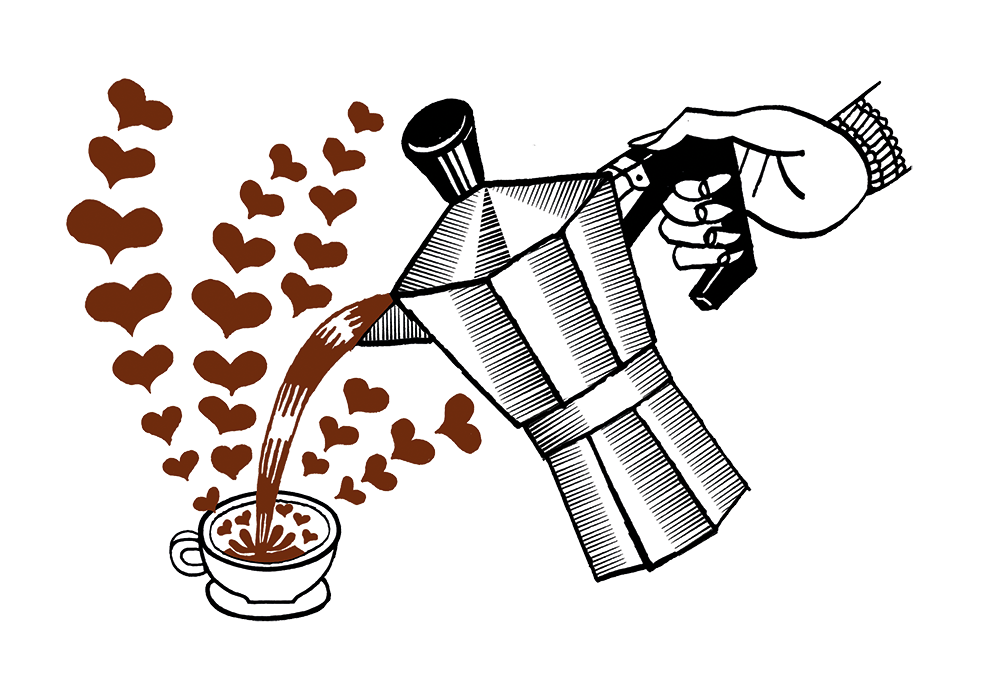
It’s strange the things that can trigger amity or affection. At the beginning of the capsule/pod coffee-maker craze, when George Clooney, with his come-to-bed eyes, was seducing the world with Nespresso machines, I bonded with my eldest daughter’s Italian boyfriend over the Bialetti Moka pot. Notwithstanding the expense and waste of the capsule coffee makers, I need at least three pods to get the lights on in my head in the morning. I’ve never had a good coffee from any of them. Contrast that with the cute, economical, environmentally friendly little Moka, the smallest of which – one cup – costs about $30 and, depending on the quality and freshness of the coffee used, makes a better cup than any café or restaurant.
The original aluminum stovetop coffee-maker – octagonal and art deco in style – was launched in 1933 by Alfonso Bialetti from premises in Crusinallo, Piedmont. The name Moka derives from Mokha in Yemen, one of the most famous coffee-producing areas in the world. Production and sales were slow at first. It wasn’t until Alfonso’s son Renato took over, after returning from two years in a German concentration camp, that the company began advertising and sales took off. In 1958, Paul Campani drew a cartoon logo for the company. Based on the by then corpulent and Moka-shaped Renato, the mustachioed man, who holds his right hand aloft in the action of ordering a coffee, is still used on all the brand’s products.
In the 1960s and 1970s, it was estimated that 90 percent of Italian households owned a Moka pot. But in recent decades, because of competition from newer brewing technology, big expensive bean-to-cup machines and the cheaper pod-based ones, sales of them have declined. Perhaps an aversion to coffee grounds in the sink, or the perceived difficulty of the Moka – you need to be in attendance to prevent the coffee becoming stewed – have contributed to its decreased popularity. An older American man who was staying in my little French Airbnb cave studio last summer pulled a face and said, “Looks a bit European…” when I showed him the Moka. Even when I set it up for him, he couldn’t get the hang of it. No plug, you see.
My daughter’s Italian boyfriend became her husband in 2017. He’s from Como. His parents were given a Bialetti Moka as a wedding present in 1980 and have used it every day since. I wonder how many Nespresso machines will still be functioning in 45 years. If you get used to the Moka’s funny ways – making sure no coffee grounds sneak into the thread where you screw the two component parts together, pack the coffee down sufficiently and don’t overfill the tank – you can’t go wrong. I set mine up the night before. There’s no glass jug to clean and the filter is easier to empty than a cafetière. Unlike big bean-to-cup machines, which can cost more than $1,300, it never breaks down.
The company is modernizing. While still keeping the familiar design in production, there’s the new sleek stainless steel Venus model, an induction version and an expensive collaboration with Dolce & Gabbana. As with most things, the parts are now made in China, and the pot is merely assembled and finished in Italy. But even allowing for that, given the choice between Clooney and the mustachioed man, I’d go for the squat Italian any day.
This article was originally published in The Spectator’s January 19, 2026 World edition.





Comments