Arts Reviews

The good, bad and ugly in arts and exhbitions

How crazy was Louis Wain?

Before Tom Kitten, before Felix the Cat, before Thomas ‘Tom’ Cat, Sylvester James Pussycat Sr, Top Cat and Fat Freddy’s Cat, there were the cats of Louis Wain. The Wain cat came in a variety of breeds and colours: black and white, tabby, marmalade, white and blue (sky blue rather than Persian). But it always had the same disconcerting look in its wide, glassy eyes with the dilated pupils. It looked bombed out of its tiny mind. The original Wain cat was a black-and-white kitten called Peter belonging to a young late-Victorian magazine illustrator and his sick wife. In 1884 the 24-year-old Louis Wain had married his sisters’ governess, Emily

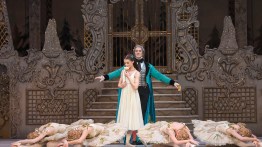
The Nutcracker wasn’t always considered quite such a box of delights

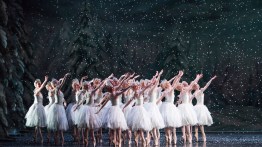
E.T.A. Hoffmann’s tale of a young man turned into a novelty kitchen gadget by an evil rodent isn’t obvious dance material, and yet here we are, up to our plastic tiaras in sugar plums. Four Nutcrackers in London alone and an average of 200 productions, amateur and professional, across the Atlantic. How? Why? Sharp pens greeted the 1892 St Petersburg première — ‘it’s a pity that so much fine music is expended on nonsense’ — and within two decades it was little more than a box of delights to be raided by directors and choreographers, blithely borrowing anything they fancied from Lev Ivanov’s choreography or Tchaikovsky’s ravishing, bittersweet score, regardless

The genius of Tchaikovsky’s Nutcracker score

By all accounts, Tchaikovsky struggled to compose The Nutcracker. It wasn’t his idea of an effective ballet scenario, and he was unimpressed with the choreographer Marius Petipa’s prettified storyline. Mid-composition, he learned of the death of his younger sister Alexandra. ‘Even more than yesterday, I feel absolutely incapable of depicting the Kingdom of Sweets in music,’ he wrote. But inspiration can be counterintuitive. On a good day, Tchaikovsky could write as fluently as any Victorian serial novelist, churning out forgettable piano pieces (as he put it) ‘like batches of pancakes’. Projects like The Nutcracker put him through purgatory but the result, with hindsight, was nothing less than the sound of

The art of the Christmas card

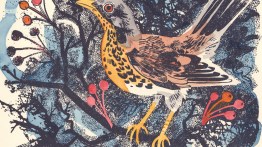
It’s the thin end of the wedge, the slippery slope, the beginning of the end of a civilised Christmas. It is the first week of December and I still haven’t started my cards. My friend Charlotte was at it in October. She signed up for a lino-cutting class, cut holly boughs and robin redbreasts and printed her own cards. She sent me photos of the fruits (berries?) of her labours and very merry they were, too. Usually, I am a Charlotte. By November, I have made cards, addressed envelopes, applied thumbs to 80 stamps. But after an illness in the autumn, I’m feeling as uncreative as a turkey. Could I

Truly godawful: Ed Sheeran’s =

 Grade: C= My wife’s ill with Covid and demanding inexhaustible libations and difficult meals, which she will leave uneaten. The dog thinks it deserves a walk in the filthy sleet. The kitchen is a tip and the bins need emptying. I have a headache, a runny nose and the ghost of a ticklish cough. Can things get worse? Yes, yes they can. It’s The Spectator on the phone. Can you please review Ed Sheeran’s new album? As in: look, you’re feeling rough and put upon at the moment. So can we come round and smash your spectacles and rub human excrement in your hair? And all this a few weeks

Entirely gripping: The Lost Daughter reviewed

The Lost Daughter is an adaptation of the Elena Ferrante novel about motherhood that says, quite ferociously: it’s complicated. And: mothers aren’t necessarily motherly, and can feel ambivalence. You’d think it was unfilmable, particularly as the central character describes herself as someone even she doesn’t understand but, directed by Maggie Gyllenhaal — it’s her directorial debut — and starring Olivia Colman, this film is entirely gripping. No ambivalence on that count. Colman could play a bedside table and somehow bring depth, feeling, an internal landscape It is carried by Colman who is tremendous, and is being tipped as a potential Oscar winner, if that matters. She is certainly now one

Tells us more about today than the early 1960s: BBC1’s A Very British Scandal reviewed

For people who like a good upper-class scandal (or ‘people’, as they’re also known), 1963 was definitely a vintage year. Even before the Profumo affair came along, the divorce of the Duke and Duchess of Argyll offered plenty to enjoy, with its courtroom tales of her 80-odd lovers and that famous Polaroid of her pleasuring a titillatingly anonymous man while still wearing her pearls. All of which presented something of a problem for BBC1’s three-part dramatisation, A Very British Scandal — and not just because it had to pretend not to be titillated itself. At a time when female blamelessness is such a dominant media theme, could it find a

In praise of seasonal chart fodder

Christmas: the most vulnerable time of the year. I heard ‘A Winter’s Tale’ by David Essex on the radio the other day and, oh boy. It was Noël Coward who wrote, in Private Lives, that smart little line about the strange potency of cheap music. It is a truism never more apparent than at Christmas, when we allow the gaudy and sentimental access to our hearts with only the most cursory of security checks. Songs that would never make it past the bouncers in May are whisked directly into the VIP area come December. A quick google confirms that ‘A Winter’s Tale’ was released in the run-up to Christmas 1982,

Clive Rowe is astonishing: Hackney Empire’s Jack and the Beanstalk reviewed

Jack and the Beanstalk is a big, sprawling family show that opens with a baffling gesture. A booming voiceover announces that Hackney is being menaced by some unseen threat. Enter an evil monster, Funella Fleshcreep, who wears facial moisturiser made from liquefied avocado. This green-cheeked ogre is challenged by the virtuous characters, Jack Trot and Simple Simon, who must defeat her and deliver Hackney from danger. The show starts to finds its way once Clive Rowe appears as the dairymaid, Dame Trot, who needs to milk a dysfunctional, dried-up cow. There are few performers in Britain who are as versatile as Rowe. He can do broad slapstick as well as

Radio 4’s Moominland Midwinter restores Moomintroll’s innocence

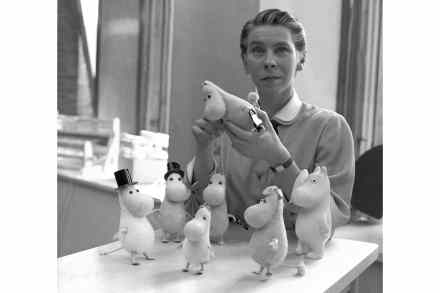
Moomins do not like winter. In one of Tove Jansson’s stories, Moomin’s Winter Follies, young Moomintroll bumps his head when the sea ‘goes hard’, prompting Moominmamma and Moominpappa to hurry the family into hibernation. They attempt to follow the tradition of their ancestors by scoffing pine needles and covering the furniture in dust sheets before bedding down on hay, but Moominpappa, for one, is troubled by the prickliness of all this: ‘Who said I must do like my ancestors?’ They briefly abandon the idea and postpone their sleep to try some winter sports, but Moomins are not really built for skiing. In Moominland Midwinter, which premières on Radio 4 on

Why? Spielberg’s remake of West Side Story reviewed

When you first hear that a remake of West Side Story is on the cards, it’s: God, why? Why would anyone look at West Side Story, which won ten Oscars in 1961, and think: that needs doing again? Who would do that? Steven Spielberg, that’s who, and as it had garnered mostly five-star reviews before I’d had a chance to watch, the question became: how? What wonders might he have brought to a film that was great and beautiful in the first instance? Not much. It is more authentic. The back stories are more substantial. The singing and dance numbers are bigger. There’s a part for Rita Moreno, which is

Modernism’s back, baby: Huddersfield Contemporary Music Festival reviewed

It’s not everyone’s idea of fun, a trip to Huddersfield in the depths of November. But as any veteran of Huddersfield Contemporary Music Festival knows, it usually pays off. Sure, none of the venues has a bar; the programming is as carefully curated as a b2b trade show, the main hall about as cosy as a care home. And true, calling all this a ‘festival’ sometimes feels like wishful thinking. And yes, you are in Huddersfield. (In November.) But HCMF remains one of the few places in this country where you can get a high-quality hit of musical modernism — and always freshly served piping hot straight from the continent’s

Even worse than the book: Amazon Prime’s The Wheel of Time reviewed

A couple of years ago, in that near-forgotten era when we could travel almost freely, I canvassed social media as to what should be my relaxing but involving holiday read during a fortnight in Greece. One suggestion — and this is why you should never trust the literary advice of random strangers — was Robert Jordan’s The Wheel of Time series. I started the first book full of bright hope. It would be my new Tolkien-meets-Game of Thrones. Besides the strong personal recommendation and the slew of five-star reviews on Amazon, what persuaded me was the fact that the late author had served two heavily decorated tours of duty as

‘I am not able to answer your question’: an irascible Paolo Sorrentino interviewed

Loving the films of the Italian auteur Paolo Sorrentino, I thought he’d be easy to chat to. But a maestro is a maestro, as I was reminded when I interviewed him in London last week. Masked and communicating through a translator, I semaphored my admiration for his new film The Hand of God, starting with its spectacular opening shot. Like a bird, the camera flies over the sea, then focuses on a vintage car tooling along the promenade, before panning over the city again. But he rejected my praise: ‘It’s not complicated. It’s a normal shot by helicopter.’ He’s right, of course, that his new classic coming-of-age story represents a

An amazing technical achievement: Life of Pi at Wyndham’s Theatre reviewed

Yann Martel’s novel Life of Pi is a complicated organism. The action starts in southern India where we meet a precocious teenager, Piscine, who tells his parents that he wants to be known as Pi. The family own a failing zoo and they buy a Bengal tiger to attract fresh customers. The new arrival promptly rips the head off Pi’s pet goat and eats it. Next they take a ship to Canada, with the zoo stowed in the luggage hold, but the vessel hits stormy weather. The beasts break out of their cages and start to eat each other. And when the ship sinks, Pi finds himself on a life

A show of ample and eerie majesty: British Museum’s Peru: A Journey in Time reviewed

Growing up on a farm outside Lima, I was aware that indigenous Peruvians did not understand time in the same way that their white countrymen did. On our visits to the highlands, we would encounter a very different mode of thinking. Ask an Andean villager where the next settlement was and you’d be told, ‘aquisito no más’ — just over here. Whether ‘aquisito’ meant around the next bend or four days’ schlep across the mountains was, for aboriginal people, a meaningless question. They were not ruled, as their European-descended neighbours were, by clocks. You’d sometimes see Quechua-speaking herdsmen sitting motionless for so long that they seemed to have switched off

Reprehensible – but fun: Orpheus Chamber Orchestra’s Complete DG Recordings reviewed

 Grade: B It must have been an interesting day in the Orpheus Chamber Orchestra’s press office when Blair Tindall’s memoir Mozart in the Jungle hit the bookshops in 2005. ‘He sat in the desk chair, pushed aside the first oboe part of Rossini’s Italian Girl in Algiers and tapped a pile of cocaine on the glass’ runs a typical anecdote. Even in 2005, it wasn’t really what anyone expected to hear from a former member of Orpheus — a youthful, conductor-less New York outfit who used to pose for album covers dressed in spotless white. For a brief moment during the 1980s CD boom, Orpheus was going to save classical

More mesmerising than it should be – Disney+’s The Beatles: Get Back reviewed

My late friend Alexander Nekrassov loathed the Beatles, which I used to think was a wantonly contrary position akin to hating kittens or blue skies or Christmas carols. What could there possibly be not to like, love and admire about the band that gave us ‘Eleanor Rigby’, ‘A Day In the Life’ and ‘Strawberry Fields Forever’? Since then I’ve encountered so many Beatles sceptics that it has given me pause for thought. Some think that the Beatles were just mediocre and not nearly as talented as, say, the Kinks; some even claim that they were as manufactured as the Monkees, that like their bad-guy opposites the Stones they were a