Arts Reviews

The good, bad and ugly in arts and exhbitions

Completely Gar-Gar

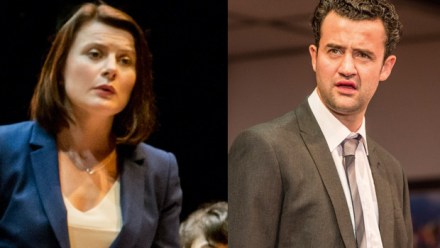
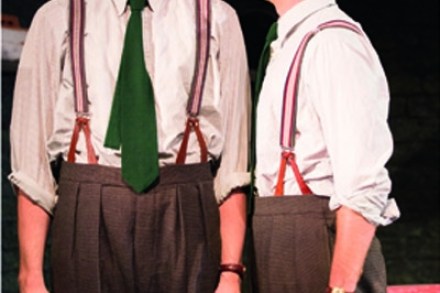
Irish playwright Brian Friel has built a formidable reputation out of very slender materials. A couple of international hits and a handful of Chekhov translations have won him a mountain of trophies. He’s still best known for his 1990 turbo-weepy Dancing at Lughnasa, which featured five mad Irish birds stuck in the bog with no hope of escape. His breakthrough play, Philadelphia, Here I Come, written in 1964, tackled the same themes of frustration and longing but in a brighter, lighter tone. Our hero is Gar and we meet him during his last night in Ballybeg (a cobbling-together of the Irish words for ‘small’ and ‘town’), just before he heads
Racking up the tension

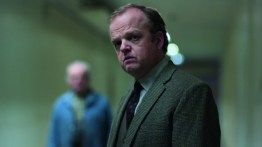
Berberian Sound Studio is a film about a man who can’t get his expenses repaid and hurts a lot of vegetables — don’t worry, the RSPCV is on to it — although I suspect there may be rather more to it than this. I suspect there are hidden meanings. I suspect there are references to those nasty Italian giallo films of the Sixties and Seventies. I suspect it is, at least in part, a love letter to old, analogue sound technology. This is, in short, one of those arthouse tarts, always winking and hitching its skirt to those in the know. Yes, annoying for those not in the know —

Money and the Flying Horses

Intriguing, the oaten seethe of thoroughbred horses in single stalls across a twilit cabin. Intimate, under the engines’ gale, a stamped hoof, a loose-lip sigh, like dawn sounds at track work. Pilots wearing the bat wings of intercontinental night cargo come out singly, to chat with or warn the company vet at his manifests: four to Dubai, ten from Shannon, Singapore, sixteen, sweating their nap. They breed in person, by our laws: halter-snibbed horses, radiating over the world. Under half-human names, they run in person. We dress for them, in turn. Our officer class fought both of its world wars in riding tog: Luftwaffe and Wehrmacht in their jodhpur pants.

Birds in the Blue Night

Not birds I know, dank-feathered, inky-eyed, spinning in a ring until one breaks free, flies in. And already I am out of bed and on the path to my father’s room, the whole house sleeping but for him, his old face stunned in the white light webbed on the wall and I say Dad, the bird in my room. Each time he rises, my shadow on the carpet follows where he passes, watches in the doorway as he softly coos and scoops the bird into his palms, strange trophy thrown out into the night again.

Martha Wainwright’s family affair

Martha Wainwright was keeping it in the family at the Union Chapel in Islington last week. Arcangelo, the singer-songwriter’s three-year-old son, joined her on stage and had the audience eating out of the palm of his tiny hand; the spectral presence of her mother, the folk legend Kate McGarrigle, was never far away; and the evening was peppered with references to intense sibling rivalry with her irritatingly talented brother Rufus. Wainwright stole the show, though. A gutsy set drew mostly on her recent album Come Home to Mama, a paean to motherhood written in the aftermath of her mother’s death and the scarily premature birth of her son. She effortlessly

A painful but brilliant film: Deborah Ross on Maisie’s betrayal

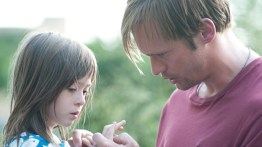
What Maisie Knew is an adaptation of the Henry James 1897 novel, updated to Manhattan in the now, and is described in the bumf I received as ‘heart-warming’, which is utterly strange, as it’s a child-caught-in-the-middle drama, and just so painful. It’s compelling. It’s exquisitely done. It’s brilliantly acted. (According to the most recent figures,  the chances of Julianne Moore turning in a duff performance are 0.00 per cent.) But it’s not a comfortable watch, which should not put you off, of course. There must be discomfort at the cinema just as there is discomfort in life, as Socrates might have said, if he had lived to experience film. (He

The problem with self-portraits: Ruth Borchard competition and Stranger reviewed

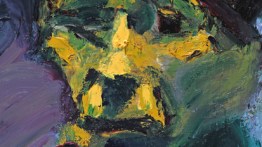
My wife says you can always tell a self-portrait by the quality of its self-regard. There’s something about the eyes and mouth (though not invariably flattering or admiring) or the set of the chin that give the artist away. Perhaps it’s simply that the artist is more interested in depicting the self than anyone else; or that the degree of self-awareness is inevitably deeper. Some of the great paintings have been self-portraits, from Rembrandt to van Gogh, and when they’re good they’re always worth looking at. So it was with optimism in my heart that I made my way to Kings Place to view the results of the second bi-annual

The best satire at the Edinburgh Festival Fringe

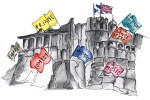
Politics is everywhere in Edinburgh. It’s embedded in the architecture of the streets. The New Town, built in the latter half of the 18th century, is a granite endorsement of the Act of Union, a stone pledge of loyalty to Britain’s new Germanic monarchy in London. The layout forms an oblong grid. The horizontals of George Street, Princes Street and Queen Street intersect at right angles with Charlotte Street and Hanover Street. This makes the approximate proportions of a flag. There are rumours that a scheme was proposed to dig two diagonal avenues, meeting in a central X, which would have turned the New Town into a colour-free Union Jack.

Tell me a story! Anne Fine, Amanda Mitichison, Terence Blacker and Keith Crossley-Holland on the joy – and importance – of reading aloud

A dark afternoon in December, aged about ten, I was in a class waiting for double geography. Mr Blake breezed in, told us to put our books away and, as a treat, he read us a story. It was ‘Oh, Whistle, and I’ll Come to You, My Lad’, the famous ghost story by M.R. James. Heads resting on our arms, we listened to this chilling tale of a scholar who takes a winter holiday at an English seaside town, finds a whistle buried in the sand engraved with the inscription of the story’s title, and makes the mistake of blowing it. An evil thing is summoned — a flapping, sheet-like,

Fish oil, exercise and no wild parties

My lifelong friend, dear heart, these days you’re losing the plot: you’re a fish in a bucket, open-mouthed, flopping about in a panic, bereft of your sheen, all confidence gone. Examined in action on a black and white screen, every movement recorded, you’re haplessly tethered, chaotically jumping, locked into a pulse of your own. Tracked by the inks on that turning drum we see what will come if that spidery record persists Slow down then, no coffee, resist the enticement of alcohol, not even a thimbleful and I will net you, my flailing fish, land you without a splash into calm waters, weaving upstream, steady and breathing. Till the hook’s

Only Evan Davies can keep his guests in order

It must have sounded like such a great idea. To gather a group of thinkers, agitators, experts, intellectuals and media people round a large table, mike them up, ply them with drink, choose a presenter from the radio hall of fame to act as monitor and shut the studio door. Then switch on the red light, and cross your fingers they’ll not run out of conversation before the hour’s up. Summer Nights was introduced as ‘a first’ for Radio 4 — ‘live’ late-night conversation on topics ranging from sex to politics via fracking and the fear of boredom. I was really looking forward to the two-week season. Could it be

Tippett’s Midsummer Marriage is an opera of exuberant genius — but forget about the text

Whenever Michael Tippett’s first opera, The Midsummer Marriage, is revived, there is a chorus of voices, including mine, complaining that it should be done much more often, for it is a work of exuberant genius, full of wonderful musical invention, and life-affirming in the way that Britten’s operas never are (with, I think, the exception of Albert Herring). Yet the Prom performance, semi-staged, it was claimed, but rather less than that, did make clear, while doing justice to Tippett’s score, why Marriage is always likely to be something of an outsider. For the text was provided complete in the programme book, and since the balance, at least where I sat,

The Email About Writing the Poem

I’ve been occupying myself trying to write a long-ish poem. It’s an odd sensation writing a poem. You’re trying to make something come out of nothing, and you have an idea of what it could be, of stray lines and thoughts, and it takes shape as you do it, and you have to somehow notice what you’ve done and see how it tells you what you are engaged in and what clue it gives on proceeding. Even then of course you have no guarantee of the finished thing being a ‘success’ or that anyone else will like it or get it; or, in fact, that it qualifies as finished. There

Kuma would shine at any time of the year

Mid-August is a hopeless time for films; so hopeless, useless and bleak, if I don’t use three words when one would have done, I am just never going to fill up this space. The assumption is people don’t wish to visit the cinema on summer evenings, or they are on holiday (I wish!), so the studios put out all their rubbish. This week sees the opening of Bachelorette (a Bridesmaids rip-off), Planes (a Disney film, originally intended for DVD only) and The Lone Ranger, which is said to be so lousy, terrible and awful the producer is going to be hung from a lamppost on Sunset Boulevard, as a warning

Big School left me po-faced

How did our comedies become so sad? BBC1’s new sitcom Big School (Fridays) opened with a scene that would probably tickle the ribs of many, but I, in my usual humourless way, found it depressing. Chemistry teacher Mr Church, played by David Walliams, hoped to excite his morbidly uninterested pupils about the effects of dunking a bottle of cold liquid nitrogen in warm water by using hundreds of table-tennis balls to dramatise the resultant explosion. But the bell rang, and his students filed out of class radiating boredom and contempt, leaving Mr Church gazing forlornly at a thousand ping-ponging shells. A similar sense of vulnerability permeated Boom Town, BBC3’s ‘structured

A masterclass in stage presence from the Bolshoi

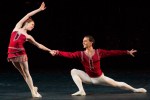
Jewels is everything a George Balanchine admirer could ask for. The sumptuous triptych, set to scores by Fauré, Stravinsky and Tchaikovsky, is a compendium of what Balanchine’s style is about; each part — Emeralds, Rubies and Diamonds — provides unique insights into the subtleties, signature features and inventiveness that inform the art of the Russian master who fathered American ballet. Yet on these shores Jewels is seldom a sell-out production. Unless, of course, it is danced by the Bolshoi Ballet. Comparisons are odious, but seasoned dance-goers could not help noticing that, on Monday, the Royal Opera House was packed to the brim. The lure of the exotic, the hype of

The next Joyce Grenfell at the Edinburgh Fringe

Strict bylaws in Edinburgh prevent you from buying off-licence booze after ten at night. You can, however, buy all the sauce you want from ten in the morning. (This may explain why alcoholism is so rare up here.) When midnight tolls, Festival revellers pour forth and fill the air with chanting and singing of variable aesthetic quality, and the only way to get any peace is to lapse into a Valium coma. By day I venture forth with sleepy eyes in search of great art. Lee Kern: Bitter Twitter (Gilded Balloon) wants to unmask the superficial malignity of Twitter. His tactic is to tweet silly questions to silly celebs and

Climb aboard the runaway train

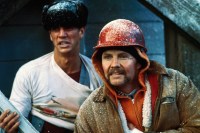
Brother, can you spare me a train? Or maybe just a Pullman carriage or two? There are so many brilliant films set on trains that I’d love to screen some of them in loco locomotive, as it were. Shanghai Express (1932), The Lady Vanishes (1938), The Narrow Margin (1950), Night Train (1959)… I’ll stop there. Just grab a ticket and scramble aboard. Andrey Konchalovsky’s 1985 film Runaway Train, which has just been released on Blu-ray and DVD, would certainly be included on the programme. It has the qualities of other rail-bound films: the heavy sense of momentum, the restrictiveness of the carriages, and so on. But it’s several times gruffer