Arts Reviews

The good, bad and ugly in arts and exhbitions

Doing time

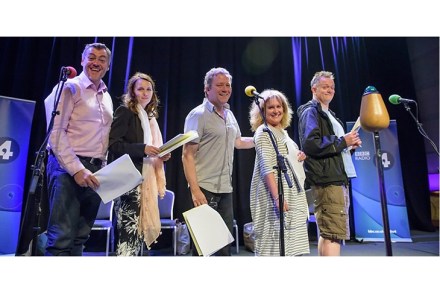
Nine on a Thursday morning is University Hour for those of us who don’t commute to an office every day. We time the clearing away of breakfast to coincide with Radio 4’s In Our Time. Melvyn Bragg, with his deadpan questioning, is our Thursday educator. Last week’s programme was a classic of the genre: about an obscure 17th-century physician I’d never heard of, Sir Thomas Browne — and here were three university professors who’d devoted their entire working lives to studying him. ‘With me to discuss…’, Melvyn said, introducing them all. These professors (one male and English, two female and American) would propel the nation’s knowledge-graph of Sir Thomas Browne

Stranger things

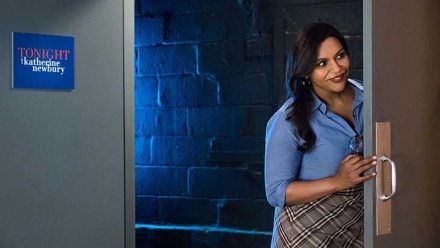
Usually, the return of Killing Eve would be pretty much guaranteed to provide the most unconventional, rule-busting TV programme of the week — where genres are mixed so thoroughly as to create a whole new one. This week, though, there were two new series that were even harder to classify. One was ITV’s Wild Bill: a show so bonkers that the fact it stars Rob Lowe as the recently appointed chief constable of East Lincolnshire mightn’t be the weirdest thing about it. When the resolutely American Bill Hixon (Lowe) first arrived in Boston, Lincs, it looked as if we’d be in for a standard fish-out-of-water comedy, with the traditional differences

Twitter: no country for old men

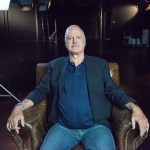
As I write these words, I regret to inform you, John Cleese is on his way to being cancelled. Now there’s a sentence that straddles a generation gap. Many people very familiar with John Cleese will have only the dimmest idea of what ‘cancelled’ means; while people who are all about cancelling celebrities will tend not to know what ‘John Cleese’ means. If anything saves him from cancellation, it will be the hope that he can snuggle down and hide in that gap until it’s all over. The cancellers won’t try too hard because they didn’t know who he was in the first place; others will register the row, furrow

Ring without the bling

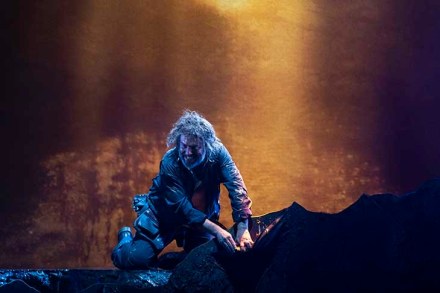
At Longborough Festival Opera, Richard Wagner is on the roof. Literally: his statue stands on top of the little pink opera house, surveying the Evenlode valley from beneath a stone beret. He’s not alone, mind. A figure of Mozart looks up indignantly. On the other side of the pediment stands Verdi, arms folded, glowering huffily at the floor. But Wagner is on top: a permanent reminder that this is the company that took on the greatest musical-dramatic challenge in the operatic universe, and in 2013 staged a full production of Der Ring des Nibelungen in a converted barn. And next week, they’re going to start all over again. The 2019

The possibilities of paint

‘The possibilities of paint,’ Frank Bowling has observed, ‘are endless.’ The superb career retrospective of his work at Tate Britain demonstrates as no words could that he is correct, and that the obituaries of this perennial medium — so often declared moribund or defunct — are completely wrong. This presents more than half a century’s virtuoso exploration of what pigment on canvas can achieve. After his first decade of work, Bowling (born 1934) became what is called an abstract artist. But that is a vague and unsatisfactory category. His early, figurative pictures such as ‘Cover Girl’ (1966) could be labelled ‘pop’. It features an image of a Japanese supermodel garnered

Sunny delight | 6 June 2019

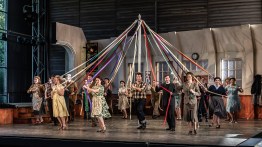
So it’s the start of the summer opera season at Wormsley and we’re sitting there in evening dress in the middle of the Getty estate, looking at a beautifully detailed replica of a rundown English village hall. It’s superbly done: the canvas chairs and austerity-drab paintwork in Paul Curran’s new production of The Bartered Bride could surely have been found in any number of church halls in this corner of the Chilterns, at least in the 1950s when this production seems to be set. And then, having gone to painstaking lengths to relocate this definitive Slav national opera to rural England, Garsington flips our expectations straight back at us and

She hasn’t stopped dancing yet

It’s not often you hear the voice of a 104-year-old on the radio. You’re even less likely to hear one so clear in thought, so spirited and full of enthusiasm for life. Eileen Kramer’s voice crackles with age, with the years she has lived, but from what she says, and the energetic way she says it, she could be at least 30 years younger. ‘I don’t know how long I will go on living,’ she says, but she’s still excited by the present: ‘There’s so much going on. I’m living in that period when a lot is being discovered about everything.’ Kramer is a dancer, artist, performer, famed in Australia

Poetic and profound

Kenneth Lonergan, who wrote the movie Manchester by the Sea, shapes his work from loss, disillusionment, small-mindedness, hesitation and superficiality, all the forgettable detritus of life. The Starry Messenger is about Mark, a disappointed astronomer aged 52, who gives public lectures at a city planetarium. He loves his subject even though it let him down and every week he tackles the daft questions of his pupils with superhuman patience. The same two pests always raise their hands. One is a burly misanthrope who disbelieves all experts, the other is a high-flying oddball who craves attention. Mark starts a slow-burn affair with Angela, a single mum who needs a role model

Blast from the past | 6 June 2019

How many people do you think died at Chernobyl? 10,000? 50,000? 300,000? The correct answer, according to the never knowingly understated World Health Organisation — in a thorough report released nearly 20 years after the 1986 explosion — was ‘fewer than 50’. Ah, but what about all the mutant babies who ended up with two heads and webbed feet? What about the inevitable epidemic of cancers? Well, yes, it’s true that 4,000 more cases of thyroid cancer were loosely attributable to Chernobyl, mainly in children and adolescents. But the survival rate was 99 per cent. Because I’ve long been familiar with these facts — mainly as an antidote to all

Our flexible friend

Plastics — even venerable, historically eloquent plastics — hardly draw the eye. As this show’s insightful accompanying publication (a snip at £3) would have it, ‘Plastics have no intrinsic form or texture, thus they are not materials that can be true to themselves.’ They exist within inverted commas. They can be shell-like, horn-like, stony, metallic — they do not really exist on their own behalf. Mind you, the first vitrine in Raw Materials: Plastics at the Nunnery Gallery in east London contains an object of rare beauty: a small, mottled, crazed, discoloured sphere that looks for all the world like the planet Venus, reduced to handy scale. It’s a billiard

Shooting star

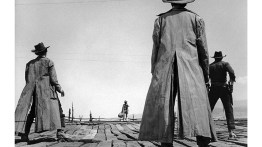
This is an edited extract from the Foreword to Christopher Frayling’s Once Upon a Time in the West: Shooting a Masterpiece (Reel Art Press), based on a long conversation between Frayling and Tarantino from January 2018.  The movie that made me consider filmmaking, the movie that showed me how a director does what he does, how a director can control a movie through his camera, is Once Upon a Time in the West. It was almost like a film school in a movie. It really illustrated how to make an impact as a filmmaker. How to give your work a signature. I found myself completely fascinated, thinking: ‘That’s how you do

Here comes the sun

When you see the opening caption ‘4.6 billion years ago’, it’s a pretty safe bet that you’re watching a programme presented by Professor Brian Cox. And so it proved again this week, as his latest exploration of the solar system began on BBC2, with an episode about Mercury and Venus. Being an officially designated ‘landmark’ series, The Planets (Tuesday) has many of the features you’d expect: lush music, an impressive CGI budget, a ten-minute behind-the-scenes segment at the end. More surprising is Cox’s willingness to anthropomorphise the planets — and to regard the ones that aren’t lucky enough to be Earth with a touching level of sympathy. After all, it’s

O brother, where are thou?

Sunset is French-Hungarian writer-director Laszlo Nemes’s follow-up to his astonishing Oscar-winning debut, Son of Saul. This time round the film is set as the Austro-Hungarian Empire is on the brink of collapse, and it is confounding, but not in a good way, as it’s as turgid as it is baffling. I’ve seen it twice now, and it was as turgid as it was baffling on both occasions. Disappointing, I know, but on the plus side the backdrop is a high-end millinery establishment, so the hats are fab. Truly. It opens seductively enough, in bustling Budapest in 1913. It opens as if this were a Dickens or Dostoyevsky, but it’s not

Serial genius

‘It’s no use at all,’ says Posy Simmonds in mock despair, holding up her hands. ‘I can’t tell my left from my right.’ She is ambidextrous. ‘This hand [her right] writes and draws; and this hand [her left] cuts out, sharpens pencils, throws balls, plays tennis… I can’t drive. I’ve never taken a test. I’m always on the wrong side of the road.’ Looking at these wonderful hands, elegant and almost limp, one would never suppose they had created, over the past 50 years, such a large volume of intensely enjoyable and astute drawings. Reliably funny and wise, her work ranges from Fred (1988), about the secret rock-star life of

Poetry in motion | 30 May 2019

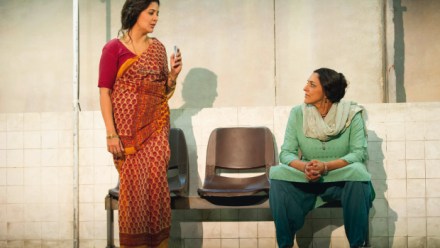
T.S. Eliot’s Four Quartets is full of music and movement. The players, such as they are, slip, slide, shake, tumble, wrestle, leap, kick, whirl, fold and kneel. There are lines like stage directions: ‘stillness’, ‘quick now’, ‘the dancers are all gone under the hill’. In her rendering of Four Quartets, the American choreographer Pam Tanowitz has denied reviewers the satisfaction of ‘Eliot in leotards’ jokes. Her dancers wear diaphanous ruched onesies. No Cats spandex here. In collaboration with the Finnish composer Kaija Saariaho and the New York artist Brice Marsden, Tanowitz’s Four Quartets is a remarkable recasting of Eliot’s ‘Burnt Norton’, ‘East Coker’, ‘The Dry Salvages’ and ‘Little Gidding’ —

Acts of settlement

‘Put yourself in their shoes,’ says Zahra Mackaoui, a British-Lebanese journalist who has been following the stories of refugees from Syria for five years, catching up with them as they move on restlessly, searching for a place to settle. ‘Ask yourself, what would I have done?’ That question echoed through her series of documentaries for the World Service as we heard from those who have been exiled by a war in which they have played no part except as victims. What would I have done? In Beyond Borders (produced by Craig Templeton Smith), the open, frank honesty of Hani, Ayesha, Doaa Al Zamel and Fewaz gave us an opportunity to