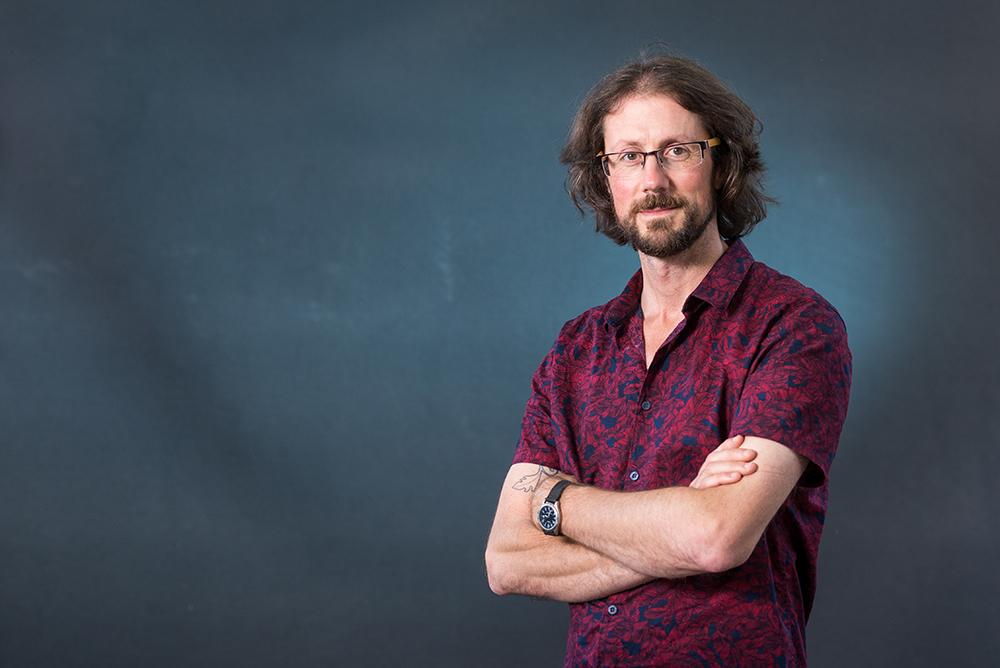
In the sphere of British environmentalism, Paul Kingsnorth is admired as a maverick in thought and deed. Starting out as a journalist with the Ecologist magazine, he co-founded the Dark Mountain Project, an online portal devoted to stories about the more-than-human world in a time of ecological collapse. On resigning from both, he retreated as a self-proclaimed ‘recovering environmentalist’ to an Irish smallholding, where he has embraced the Romanian Orthodox church.
Against the Machine, his tenth book, is billed as a summary of his intensifying disillusionment with events in the past 30 years. It is a serious work leavened with sardonic humour and is by turns rich in unsettling ideas and deeply pessimistic. It argues that there is a self-destructive dynamic at work in western civilisation which became irreversible once we embraced post-Cartesian science as our chief system of epistemology. With empirical evidence and inductive reasoning as the core preconditions for truth, an ideology Kingsnorth calls ‘scientism’, we dethroned the old gods and installed new ones: power, self and money.

With the invention of advanced capitalism and the launch of empire, we made this materialist ideology a planetary matter. The Earth’s biosphere, the collaborative foreground for all of our lives, has been relentlessly degraded until it is viewed either as an economic resource or private property. Humanity is now enmeshed in a modern spiral of globalisation, high-tech and increasingly massive wealth inequalities. Today, just 2,153 individuals own more than the poorest 4.6 billion people. To all of this Kingsnorth gives a name: ‘the Machine’.
Much of the book is taken up with a tour of western writers who share a similar sense of impending crisis. They include the American arch-critic of technology Lewis Mumford as well as the French philosopher and Sufi mystic René Guenon, who foresaw spiritual collapse in the 1920s. Kingsnorth locates further authority for his Weltanschauung in Oswald Spengler’s once influential The Decline of the West (1918). That some of their prophecies are more than a century old prompts questions of how long we must wait before the conclusions arrived at by Kingsnorth can be considered valid.
What these writers supply is a language for his anxieties, which he boils down to a foursome – the four horsemen perhaps in his private apocalypse: self, sex, science and screens. His essays on the latter duo are particularly troubling. Half of those working in Silicon Valley apparently think that the latest computing developments pose a significant risk to the future of humankind. The specialist Eliezer Yudkowsky, described as ‘a leader in the field of artificial general intelligence’, doesn’t just want a moratorium; he wants the whole field shut down. His latest book is titled If Anyone Builds It, Everyone Dies!
On a more cheerful note, Kingsnorth draws from a secondary suite of writers, including the French philosopher Simone Weil, to formulate a programme of resistance to the Machine. He calls it ‘reactionary radicalism’, which, depending on his underlying intentions, is either a sop or a red rag to his critics on the left and right. He distils his new philosophy into another four-point charter: people, place, prayer and past. The somewhat folksy formulation leads neatly towards his final conclusions: that the only answer to public chaos is private calm; the most radical challenge to a dysfunctional world is to stay at home.
What is curiously absent from any of these reflections is any real commentary on the matter which first exercised Kingsnorth as a professional: the living world of nature. His principle of ‘place’ may be assumed to embrace this theme, but he barely discusses it. The only detailed evaluation of the non-human world is a hostile demolition of the ideas of George Monbiot, who is arguably the most important political voice on our treatment of nature in the last three decades. Perhaps Kingsnorth ‘the recovering environmentalist’ has now fully recovered.
The true challenge of a book like this is applying its satellite’s view of planetary affairs to the rub of human interactions. It is nigh on impossible to fit the specific details of modern life into any binary moral schema. Take, as a rather banal example, the matter of how we heat domestic homes. You might assume that air-source heat pumps couldn’t be one of the forces destroying world peace, but Kingsnorth has a whole chapter on home heating. While woodfires are integral to place, people, past and prayer, air-source heat pumps are slung out into the darkness.



Comments