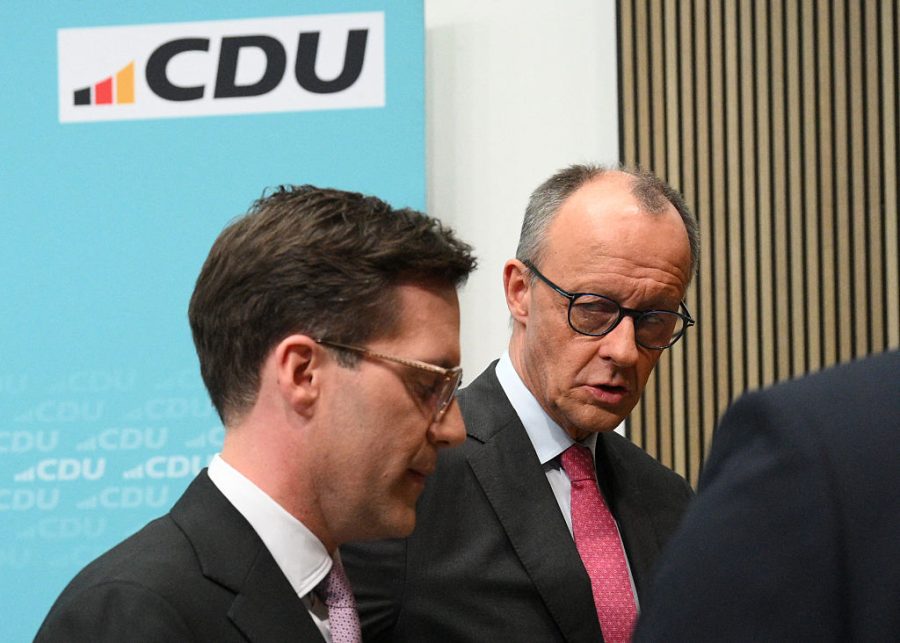
Amid growing uncertainty caused by the US-Israel offensive against Iran and surging gas prices, Germany had its first major election of the year yesterday, with the new state parliament of Baden-Württemberg elected. Forecasts indicate that the Greens, who have been governing the state for the past 15 years, will remain in control of the premier office in Stuttgart, while the Christian Democrats (the CDU) have come in as a close second.
Over the past couple of months, it appeared as if the Christian Democrats, with their leading candidate Manuel Hagel, could win the election. But negative vibes from Berlin impacted Hagel’s campaign, as promised reforms continue to stall and Friedrich Merz’s CDU-led government faces record low approval ratings.
Fascinatingly, both leading candidates in Baden-Württemberg, Hagel and the Green’s Cem Özdemir, were aware of the fact that they could suffer thanks to the weakness of their respective party leaderships in the lead-up to the election. Hagel clearly attempted to persuade conservative voters by running a quite region-centric campaign, hoping that Chancellor Merz’s unpopularity wouldn’t dampen his chances of beating Özdemir. Since coming into office last year, Merz has been forced to make plenty of concessions to the Social Democrats, his coalition partners in Berlin, making him less appealing to conservative voters.
Merz is increasingly operating from a position of weakness.
This was the first state election Merz has faced since taking office last May. He has certainly felt the pressure that his party needs to deliver in this year’s state elections in order to prevent internal party discontent with the Chancellor.
Baden-Württemberg is the third largest German state by size and population and one of the wealthiest alongside Bavaria. Home to Mercedes-Benz, Porsche and many companies in the automotive sector, the state, however, has been affected by the country’s crisis-gripped car industry and the recent recession.
Hagel, a 37-year-old banker, had a lot of steam under his campaign only a few months ago, but negative news about the federal government turned out to be disruptive to his efforts. Hagel – not a seasoned politician – was also trying too hard, playing the elder statesman in the vein of former Christian Democratic government leaders instead of sharpening his profile. A poll in late October said that only every third voter in Baden-Württemberg even knew who Hagel was.
While Baden-Württemberg was once a stronghold of the Christian Democrats, the Greens have ruled the state for quite some time, with the CDU serving as their junior partner in a government coalition since 2016. The outgoing premier, Winfried Kretschmann, chose not to run again and Özdemir, a well-known face of the Greens, was chosen to succeed him.
But throughout his campaign, Özdemir, a moderate former agriculture minister, clearly also tried to distance himself from his party leadership. Nationwide, the Greens are still suffering reputationally following their failed coalition with Social Democrats and Free Democrats under the leadership of Olaf Scholz, which collapsed in late 2024. The Social Democrats, themselves historically weak in Baden-Württemberg, only narrowly cleared the 5 percent threshold needed to enter parliament on Sunday.
Just like Kretschmann before him, Özdemir knew that the key to attracting voters in the southwest of Germany was to present himself as a local man of the people and emphasize policies that strengthen the economy rather than insist on climate-related regulations. Özdemir, the son of a Turkish migrant worker, even promoted more stringent immigration policies and did not oppose the softening of the planned ban of combustion engine cars by 2035, deviating from the agenda many of his party colleagues in Berlin pursue.
At times, Özdemir seemed closer to the conservatives in his state than his own party leadership. Hagel’s attempt to discredit Özdemir, arguing the Greens wouldn’t support his policies, failed to pay off. Özdemir staged a remarkable comeback in the last few weeks of campaigning and came out on top. While he won’t be a strong voice against Merz in the Bundesrat, his victory will put even more pressure on the Chancellor, as the next state election looms. Merz is increasingly operating from a position of weakness.
Voters in Rhineland-Palatinate are due to go to the ballot boxes on March 22, where the latest polls see a neck-and-neck race between the Christian Democrats and Social Democrats. In September, state elections will also be held in Berlin, Saxony-Anhalt and Mecklenburg-Vorpommern, with the latter two offering the right-wing Alternative for Germany a realistic chance of winning the most seats. Merz will be watching the results closely.





Comments