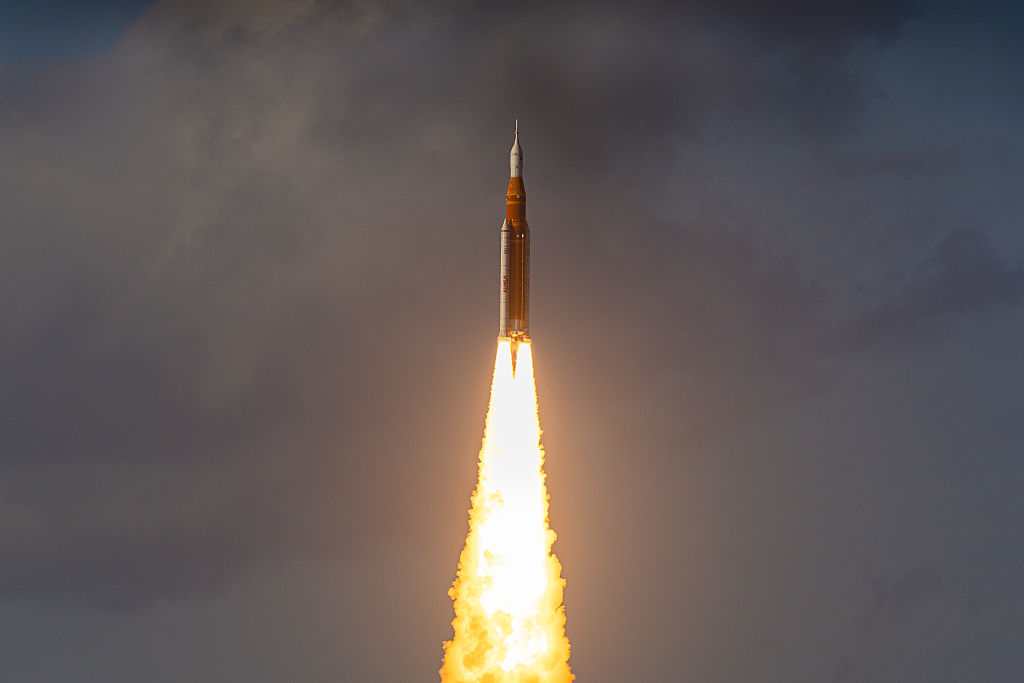
As the Artemis II mission thundered into the sky last night, a full moon rose above Cape Canaveral. It was no coincidence: the timing of the lift-off was ordained by lighting requirements and the mechanics of the Moon’s orbit. The mission set off not in the direction of the Moon, but towards where the Moon will be in five days’ time when the spacecraft swings around it in what is called a “free-return trajectory.” The crew of four are the first in almost 54 years to go to the Moon. In a way, things have not changed so much since then.
Over the ten-day Artemis II mission, when the crew sees sights no human ever has before, we might understand what we have been missing all these years
The first time we left what has been called the cradle of humanity – our Earth – was the Apollo 8 mission in December 1968. It was an audacious plan brought forward because of fears the Soviets were planning to upstage Apollo. They weren’t, but NASA didn’t know that. Those were troubled times not dissimilar to ours. The Vietnam war was raging, there were Poor People’s Campaign marches, riots at the GOP convention and Martin Luther King and Robert Kennedy were assassinated. But the Christmas reading of the Book of Genesis from Lunar orbit seemed to bring people together. Someone wrote to NASA saying: Thanks Apollo 8, you saved 1968.
I recall looking at the Moon when I was a boy, peering through a small telescope from the back garden of my home in England. It was July 1969, just a few days before the Apollo 11 mission. I remember thinking that soon the first footprints would change the Moon forever. But a few years later, the great adventure stopped when the politicians deemed it sufficient that the Soviets had been beaten to the Moon. And so, the great wait began.

In the Apollo era, 24 people went to the Moon and 12 walked upon it. Only 5 of them are still alive, all in their 90s. NASA’s Artemis program – its new plan to go to the Moon and build a base there – will be the task of future generations, not those of old men wondering why their dream evaporated. If all goes well – and there are formidable technical challenges to face in the next few years, not to mention the pressure of China putting its astronauts on the Moon first – we might all understand what that dream represented.
The Orion capsule, called Integrity for this mission, is the size of a camper van that leaves little room for privacy, although there is a door on the toilet. The life support systems, scientific instruments, radiation meters and communications have all to be checked. After that, getting to the Moon and back is the challenge – especially the high-speed re-entry into the Earth’s atmosphere. The crew is not only traveling further out into space than anyone else, but they will travel faster than anyone ever has when they return. When the uncrewed Artemis I mission came back down to Earth, the capsule’s heat shield suffered worse than expected damage. The heat shield on Artemis II is identical, but the re-entry trajectory has been adjusted and mission controllers are sure it won’t be a problem.
Look out for what happens one day and one hour into the flight. When the spacecraft has shed most of its boosters, the command will be given for TLI – Trans Lunar Insertion – and the crew will then be heading moonward. You can listen to the TLI command given to the crew of Apollo 8. There was no fuss, no dramatic words, just “Apollo 8, you are Go for TLI”. Astronaut Frank Borman acknowledged, “Roger, understand, we’re go for TLI.” This time it will be more of a PR moment.
Over the ten-day Artemis II mission, when the crew sees sights no human ever has before, we might understand what we have been missing all these years. Five thousand miles beyond the Moon, the crew will look back and see it – and the Earth – from a new viewpoint. The stories of astronomers, scientists, saints and explorers who have named the Moon’s craters are all waiting in the dark, and alongside them are broken space probes, abandoned landing craft and twelve sets of human footprints.
Artemis II is also about fulfilling the ambitions that the Space Shuttle couldn’t. Up and down it went, from the ground to low earth orbit, but while the Space Shuttle was always busy, it never seemed to have a destination. Some said it was a stepping stone into space, but others might say that stepping stones are boring. It’s what they lead to that’s important. At last, we are going somewhere.
In every civilization and every age, we have looked up at the Moon knowing that it has a strange influence on us that we could never quite describe. The Moon does not just watch over human life on Earth – it is more like an accomplice in the affairs of the night and the tides that move us. If Artemis succeeds – if we walk on the Moon’s surface again and build settlements and perhaps fortresses there – we will still not have conquered it. Neil Armstrong, the first man on the Moon, said: “There are secrets on the Moon, there are things to see beyond belief.”




Comments