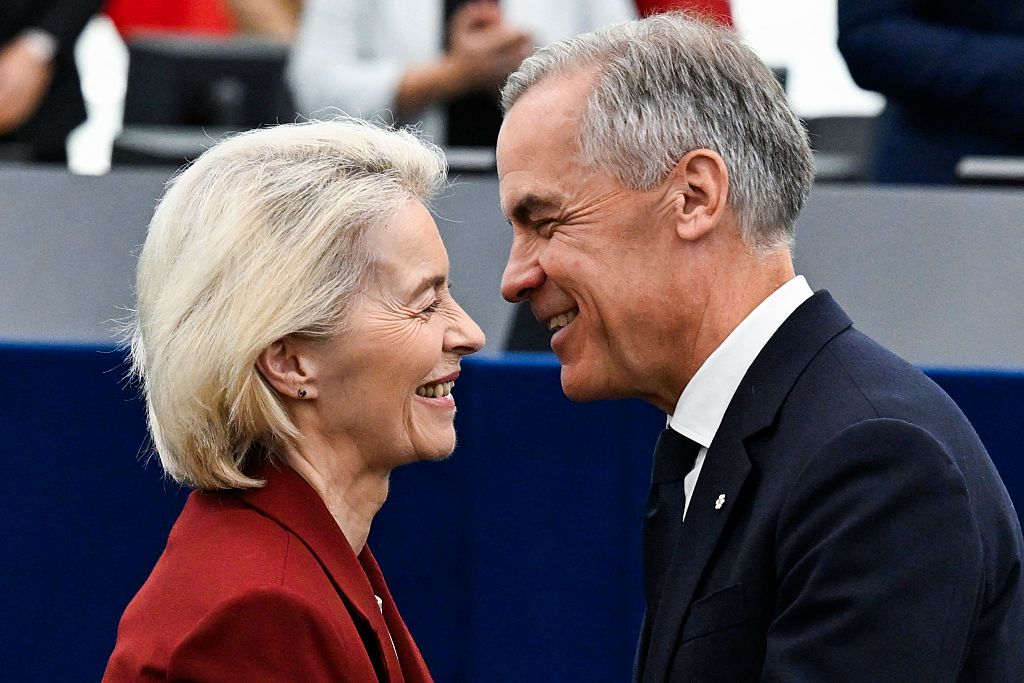


“Canada has what the world wants,” Mark Carney likes to tell people. But what does Canada want? The European Union, apparently. The bloc’s President, Ursula von der Leyen, has announced that Canada would become its first “associate member.” This is happening, she said, because “above all… Europe and Canada believe in democracy.”
Really? The EU spent years trying to block Brexit. And in 2015, when Greece voted to reject the conditions on EU loans, Brussels replied with even more stringent conditions. “There can be no democratic choice against the European treaties,” von der Leyen’s predecessor said at the time. But the rise of right-wing parties across Europe – most recently, the AfD’s election victory in the German state of Saxony-Anhalt – is proof many have lost confidence in the EU project.
Germany is the object lesson in the damage of mass migration, high taxes, extreme environmental policies and a self-inflicted energy crisis. Crime is rising and the economy is stagnant. German manufacturing, rebuilt so successfully after World War Two, is moving offshore – in part to China. Meanwhile, the country’s elite has tried to repress political opposition using dubious methods. The AfD has been under government investigation since 2019 for “right-wing extremism” (read: opposition to mass migration) and was formally classified as “extremist” by German intelligence forces in spring last year. This tactic has failed.
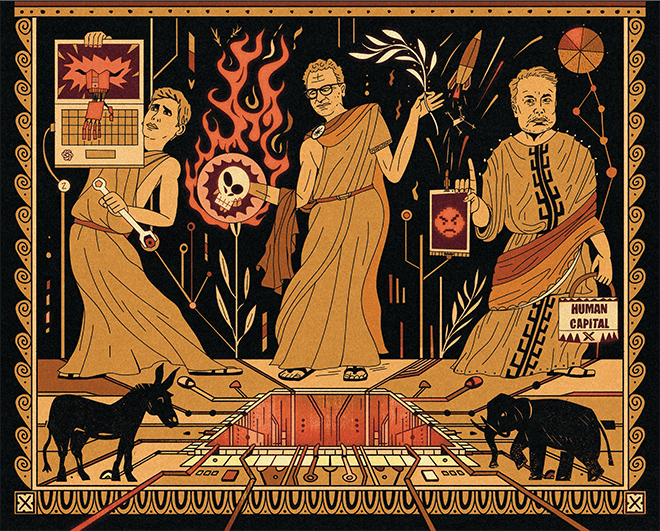
The anxiety among wider EU elites shows they fear this may be the beginning of the end. Fabian Zuleeg, CEO of the European Policy Centre, wrote in the Guardian that “a special status” is needed for Canada, one that is “so deep that the country could eventually become the equivalent of an EU member state in all but name.” But why should the EU want Canada to join it? Because, Zuleeg says, France and Germany may one day become discontented with the shackles of the EU. In such a case, Canada could serve as a “counterweight” and help “preserve collective action when consensus inside the EU becomes impossible.” In short, when people who live under EU governance become sick of it, naive Canadians can pick up the slack. Isn’t there a quote about bureaucracy always seeking first to preserve its own interests?
As for Carney, it’s clear he loves the EU. During his stint as Bank of England governor he was steadfastly anti-Brexit. Why? The answer is in his Davos speech, where he called for the “middle powers” to unite to counter the “great powers” that threaten “multilateral institutions on which the middle powers have relied – the WTO, the UN, the COP – the architecture, the very architecture of collective problem-solving.” Canada’s Prime Minister believes the “middle powers,” through coalitions and international organizations, can continue to solve “global problems.” That seems to be his political dream: being a global leader, running globalist organizations and participating in globalist groups such as the EU. Canada could be his ticket to the top.
But what about the country itself? Nearly the only concrete advantage mentioned so far is increased access to European markets. But the EU economy is fragile and set to increase by a measly 1.1 percent this year. The US is growing by as much as twice that rate. And the EU and Canada already have a free trade agreement. It was signed in 2016 and has only increased Canadian exports to Europe by a little more than 1 percent in ten years. Why should anyone expect a dramatic surge in trade due to a “deepened” relationship?
In return, Canada may have to accept wide-ranging EU legislation, never scrutinized or voted on by the Canadian parliament, totally unfamiliar to the Canadian people. Companies may be forced to comply with a new set of corporate and environmental laws, industrial standards and food safety and packaging requirements, all established on the other side of the ocean by people whose names Canadians don’t know. What was that about a shared belief in democracy?
Carney declined a US trade deal because he said it restricted Canada’s ability to make deals with third-party nations. But significant integration with the EU would surely have the same result. Will Brussels represent Canadian interests? That seems unlikely.
Another concern is the Eurozone’s open borders. The world has watched as unvetted migrants pour across the continent, creating deep instability. Will Canada, already struggling with transnational crime, arms- and drug-trafficking, open the door to the unvetted migrants of Europe?
When Carney says ‘European,’he means getting told by Brussels how to milk your cows
All this pro-Europe talk is giving Canadians cultural whiplash. Carney has said more than once that “Canada is the most European of non-European countries.” It’s a startling message to hear from a Liberal leader. Progressives have spent decades working to wean Canadians off European civilization and its Christian principles. Trudeau senior turned “multiculturalism” into official government policy. He established the Charter of Rights and Freedoms, a nebulous document susceptible to evolving interpretation, that overrode legal precedents and has been used to crush long-standing customs, moral beliefs and tradition.
Trudeau junior went further, claiming that Canada had no core identity. Diversity became our strength, Shakespeare and the “Song of Roland” were banished from the curriculum, and statues of John A. Macdonald, Samuel de Champlain and Queen Victoria were toppled. It was even claimed that the effort to provide western-style education to indigenous communities was “cultural genocide.” There were allegations of mass graves, but none were ever found. In repentance for schools founded on Christianity and western civilization, Liberals flew the Canadian flag over parliament at half-mast. A national day of collective guilt, Truth and Reconciliation Day, was assigned to September 30.
But Carney doesn’t mean “European” like the Book of Kells or Roman aqueducts. When he says “European,” he means net zero, high taxes, expensive energy and getting told by Brussels how to milk your cows.
“On the mountaintops we stand, all the world at our command/ For we have opened up the soil, with our teardrops and our toil,” sang Gordon Lightfoot in 1966. But even as he celebrated Canada’s natural wealth, the Liberal party under Pierre Trudeau was choking the nation’s potential. The EU is yet another Canadian elite folly. It’s a mistake we wish they would stop making.




Comments