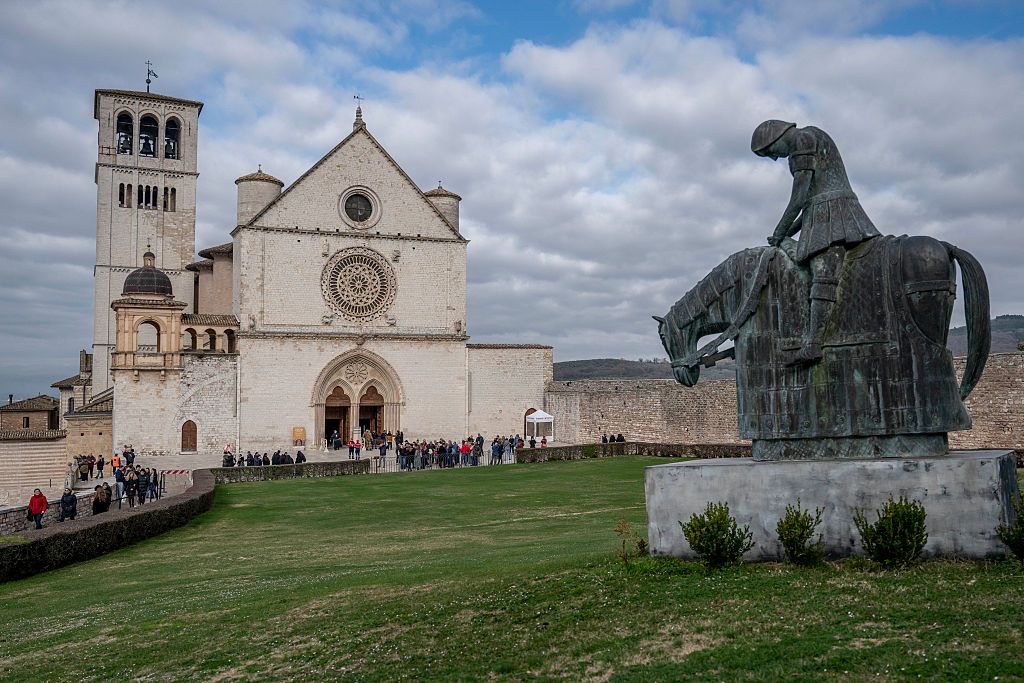


“Assisi – best spiritual vibrations anywhere I’ve been, along with India,” enthused the mustached British man next to me on the bus to Florence. Pleased to find a fellow anglophone, he chatted away happily, telling me how he’d retired, sold his house in London and moved to Assisi. He hadn’t yet learned Italian but could manage enough Sanskrit to read the Upanishads.
A spiritual dilettante. Wonderful. It was 7:30 a.m., I’d missed coffee, breakfast and a train, and my feet, after walking for eight days and 115 miles to commemorate the 800th anniversary of the death of St. Francis, hurt. Yet when my companion gave his verdict on how Francis had transformed his world, my cranky heart warmed to him. “I think when people met Francis, they looked at him and they thought, whatever he’s got, I want it. Just tell me what I have to do.”
St. Francis was the greatest religious genius Europe has ever produced, according to Kenneth Clark. But not everyone gets him. “He’s not my favorite saint,” a woman in Valfabbrica told me, handing me the keys to my lodgings. “I think he was trying to avoid responsibility.”
Our walk to Assisi began in the remote vastness of La Verna in Tuscany. When it comes to the life of St. Francis, La Verna is perhaps the hardest place to start. We can picture Francis singing to the sun and preaching to the birds. But what happened on this mountain is something profoundly challenging, even alien, to our 21st-century sensibilities.
On September 17, 1224, while praying, Francis saw a six-winged seraph fly down from the sky and take on the appearance of the crucified Christ. So great was the compassion in Francis’s soul that five wounds broke out on his hands, feet and side. “Knowest thou what I have done to thee?” Christ said to him. “I have given thee the stigmata which are the insignia of my Passion, that thou mayest be my standard-bearer…”
Trains don’t go to La Verna and neither does anyone else, so I had to catch a ride with fellow pilgrims. The August sun filtered through the beech leaves as we swung up the hairpin turns to meet Anthony, Raphaëlle and the others at the cliffside sanctuary.
Ten years ago, Anthony and Raphaëlle walked this route to celebrate their wedding anniversary. They fell in love with St. Francis and with the pilgrim life. Now, every summer, they walk an extended pilgrimage with their children, friends and families. I was lucky to be with them this year.
In La Verna you can find five of Andrea della Robbia’s finest altarpieces. Sometimes priceless artworks are hard to live with. They get main-character syndrome and take up all the oxygen. Not here. The overwhelming sensation is one of peace and airy freedom, with the blue-and-white reliefs like windows to the sky. Over the altar in the Chapel of the Stigmata is della Robbia’s Crucifixion. In front is the place where Francis received the five wounds. When I slipped inside, I found a surprising number of people. The silence was so complete you could feel it wrap around you.
The next morning, we were off down the paved road at a chipper gait, then a sharp left onto an increasingly narrow trail that headed straight up, up, up… and up. This was to be our pattern for the next few days: climb directly up the side of a mountain (or so it seemed), walk along the crest for a while, and then head back down again to the next one. It tested the limits of my lungs and I made the acquaintance of a number of previously unknown muscle groups and watched eight-year-olds breeze past me as I staggered along. But believe me when I tell you it was worth it. One afternoon we made the steep climb to an isolated hermitage where we were to spend the night, only to discover that the water was shut off in the entire area. No showers, and not too much drinking water, could be had. Some of us decided it was time to return, briefly, to the comforts of modern civilization.
The only hotel in the area happened to be Castello di Petroia, a medieval castle turned into a luxury getaway. The ducal suite was magnificent. It was hard not to feel guilty, thinking of my fellow pilgrims camping, unwashed, among the olive trees on the hard ground. But my pangs of conscience did not survive dinner under the stars in the dimly lit courtyard, with local Chianina beef carpaccio and truffles. Some things, I reflected as I sank into my pillows, are meant to be.
When my companion told me how Francis had transformed his world, my cranky heart warmed to him
Anthony was a born storyteller, and to while away the time, Raphaëlle sometimes asked him to tell us about St. Francis. We were walking under a boiling sun on broken pavement (the worst surface there is). My feet and joints were screaming for mercy as Anthony told the tale of how Francis, who had already given up everything, went to pray in La Verna and received the stigmata. How he had to return to Assisi, and how his brothers, carrying him now, because he could not walk, cauterized his wounds each day in an attempt to stop the bleeding. It made my feet hurt more to hear it.
When at last, on the eighth day, we saw the basilica of Assisi outlined against the sky, I understood how medieval pilgrims felt when they saw Jerusalem. They fell on their knees and wept, which is what I wanted to do. Instead, we walked faster, then waited for the slower pilgrims to catch up. All together, we went down to the crypt to meet the man for whom we had come so far.
At our farewell festivities (spritzes, very good wine and grilled meat) I asked Anthony if there was a part of St. Francis’s message that could transform the modern world. Anthony was sure: “His radical embrace of suffering.” Crazy? Maybe. But 800 years later, people like my pal on the bus are still coming to Assisi, muttering: “Whatever he’s got, I want it.”




Comments