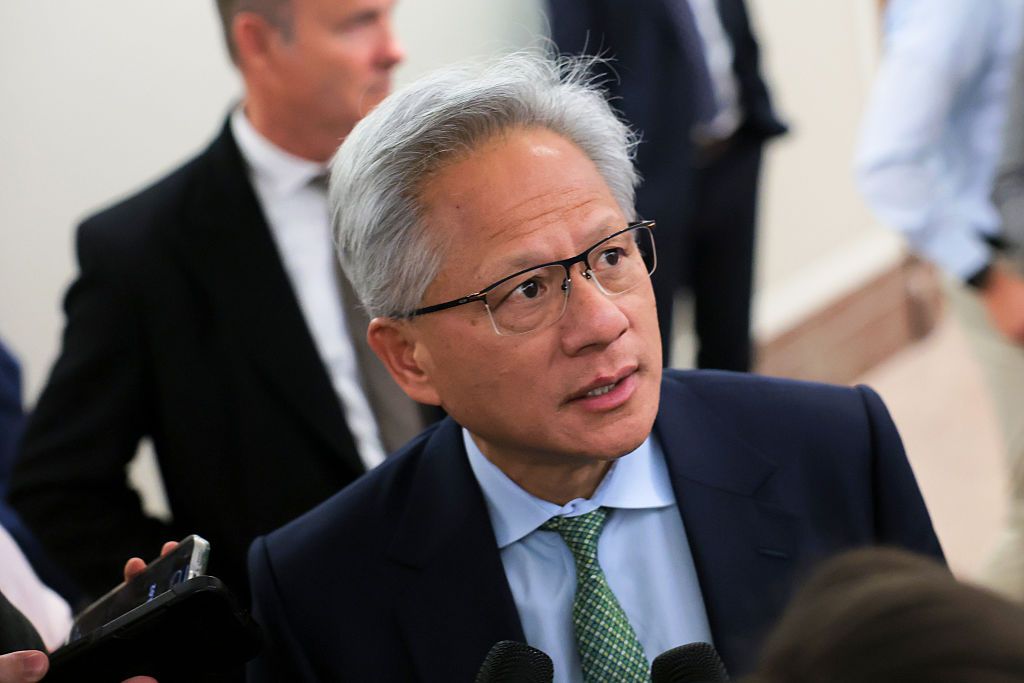
Many of America’s foremost national security assets have now moved beyond our military installations or government laboratories. A handful of uber-powerful industrialists, at the helm of companies worth trillions of dollars, are unbound by the obligations that come with maintaining security clearances. Their private vulnerabilities have consequences for the entire nation’s security, but is Washington paying them enough scrutiny?
We live in an era in which private industry can materially shift the balance of geopolitical power
Take Jensen Huang, Nvidia’s chief executive. America’s technological supremacy rests heavily on his company’s chips, yet recent allegations indicate that Chinese intelligence sought to infiltrate Huang’s life through an extramarital affair. The debacle raises an uncomfortable question: why should Beijing monopolize the art of the honeypot? Why not, as one technologist friend put it to me, set Jensen up with a nice American deep-state honeypot?
Alice Huang, who is a Chinese national, is a tech executive associated with Singapore-based Megaspeed, a major Nvidia client. She was allegedly recruited by the Chinese Ministry of State Security to gather information about Nvidia and influence its chip-export policies. What makes this affair unusual is not just that Chinese intelligence allegedly managed to reach Jensen Huang – it’s that the American government reportedly knew about the threat long before the public did.
Megaspeed reportedly purchased nearly five-billion dollars worth of Nvidia chips over the course of two years, all the while facing scrutiny over its role in bypassing US export restrictions. Meanwhile, Huang has long been a proponent of easing restrictions on chip sales to China. While there’s no evidence that Jensen Huang’s stance was in any way influenced by his relationship with Alice Huang, the prospect of a foreign intelligence asset gaining access to a person with such vast commercial and political influence demonstrates why this episode is worthy of the public’s attention.

The New York Times has reported that President Trump was briefed on the matter roughly a year before it became public knowledge. He may or may not have alluded to it in his CBS interview with Ross Douthat, which aired yesterday. Yet, despite glaring red flags, Huang’s behaviour was not reined in. He maintained that his interactions with Alice were innocuous, and Nvidia’s board only announced an independent investigation after the nature of the Huangs’ affair became public. Thus, a disquieting question is presented: if Washington had advanced knowledge that the head of America’s most valuable technology company was potentially being cultivated by foreign intelligence, why was the threat not stopped sooner?
The absurdity of this situation becomes more apparent when one considers the scrutiny faced by government employees and contractors trusted with classified information. To obtain clearances, employees and officials are subjected to extensive investigations and financial disclosures. Foreign contacts are pored over meticulously. Some foreign travel must be reported in advance and is, in many cases, subject to approval. Tech executives in the private sector, however, operate largely outside of this framework. The mere fact that Nvidia supplies the computational infrastructure upon which much of the world’s artificial intelligence development depends implies that decisions made in its boardroom have profound implications for the United States’ military and technological primacy. Nevertheless, individuals making decisions of importance to national security aren’t necessarily subject to the same counterintelligence safeguards as the bureaucrats or contractors protecting less consequential secrets. In an era in which private industry can materially shift the balance of geopolitical power, this distinction merits scrutiny.
Thus, we return to my friend’s crude suggestion: if foreign intelligence agencies are willing to exploit the personal vulnerabilities of America’s most consequential industrial leaders, then there is a case for evaluating whether American counterintelligence should be empowered to test those vulnerabilities before our adversaries do. If nothing else, America’s intelligence community should ensure that Beijing isn’t the only government paying mind to whom Silicon Valley takes to dinner.





Comments