
Beignets are one of those unusual foodstuffs that are on the one hand wildly popular in their birthplace, even going so far as being part of its sense of identity and tradition, but despite this having for some reason never quite made it beyond state or county lines.
For at least the past 165 years they have been virtually synonymous with the city of New Orleans, a must-try on the tick-list of every visiting traveller, and a genuine punctuation in the day of many New Orleanians. But for whatever reason, beignets simply haven’t spread to other regions or countries. Of course, this also means that they haven’t been adopted and then bastardised, deconstructed and reconstructed, gone viral and then become passé and finally been rediscovered. None of that. Those little squares of fried dough, sitting under icing sugar and alongside a cup of coffee, have stayed in exactly the same format and exactly the same context that they would have been found in at their inception.
There is little that will get in the way of New Orleanians and their beignets
If you don’t see them outside the Big Easy, when you step into the French quarter of New Orleans, you can’t move for the things. Clouds of icing sugar chase you down Decatur Street, the smell of frying loiters on corners and boxes of beignet mix flank shop fronts. Café du Monde, the oldest and most famous of the beignet cafés, nails its colours to the mast by offering nothing beyond the classic beignets (served only in portions of three) and a small clutch of drinks, including the traditional café au lait.
Standing in its original position – although joined now by several other outlets – since 1862, with its distinctive green-and-white humbug-striped awning and sprawling open space, it is littered with scrunched napkins and cups that once held chicory coffee, and dusted with negative imprints of the doughnuts’ fine sugar. Open at least 17 hours every day, it closes only on Christmas Day and ‘on the day an occasional hurricane passes too close to New Orleans’. There is little that will get in the way of New Orleanians and their beignets.
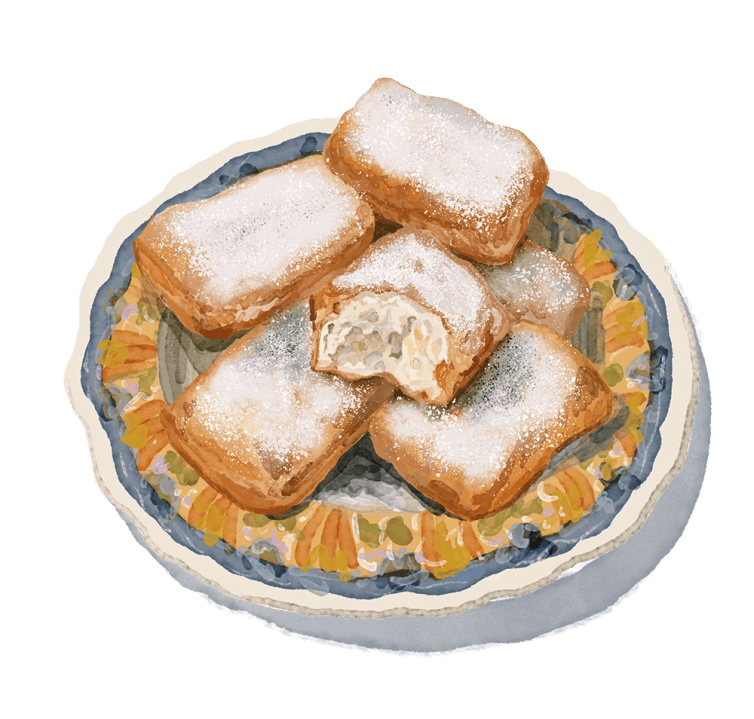
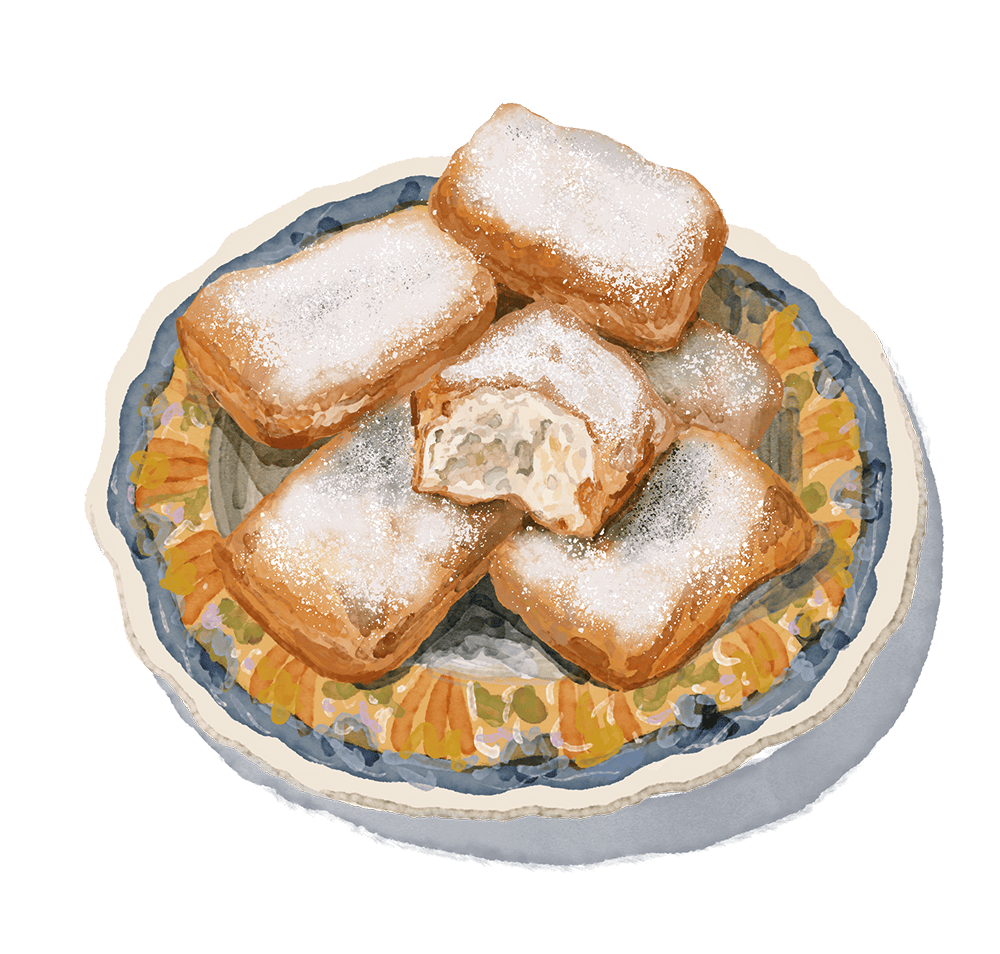
A beignet is, taxonomically, a fritter: a dough or batter that is dropped into hot oil and deep fried. More specifically, it’s a type of doughnut: a yeasted, enriched dough that is mixed and given time to prove before being fried. Unusually, rather than rounds or rings, the dough for a beignet is shaped into squares or rectangles.

As they fry, they puff up, like little cushions, plumped and ready for guests. Inside, it is soft and plush, the colour of pale sand; outside it is crisp and taut and dark gold. Not that you’ll ever see that dark gold colour because, as is tradition, the beignet will be coated in a snowdrift of icing sugar. However much icing sugar you think that might indicate, double it and then double it again – at which point a New Orleans beignet maker would probably still see that as parsimonious. If the powdered sugar doesn’t catch in your throat as you bring it towards your mouth, you’re not getting the true experience.
As an old hand when it comes to doughnuts, it’s taken me a while to come round to beignets. I’ve been burned before (figuratively and literally) by the labour involved with a doughnut: the double-proving, the stickiness of the enriched, yeasted dough, their mercurial behaviour both in and out of the oil, and the absolute faff of rolling them in sugar by hand and then filling them with custards, creams and jams.
When it comes to beignets, however, all those problems vanish. They are a dream to make: the dough only has to prove once, it is pliable without being sticky, rolled and cut with a knife, rather than being shaped, and – thanks to its dimensions – fries evenly and easily. And then, of course, instead of coating or filling them, you just sieve a ton of icing sugar over the top – which has the added bonus of covering a multitude of ineptitudes. Not a piping bag to be seen. It’s a dream of a doughnut. And unless you’re booking your flight to New Orleans as I write this, this is your closest way of experiencing it.
Serves: 25
Hands-on time: 20 minutes
Cooking time: 15 minutes
Beignet dough
- 250g strong bread flour
- 30g caster sugar
- 1 tsp fine salt
- 4g fast-action dried yeast
- 300ml whole milk
- 30g unsalted butter, very soft
- 1 large egg
- 125g evaporated milk
- 750ml vegetable oil, for frying
Coating
- 25g icing sugar
- Combine the flour, caster sugar, salt, yeast, milk, butter, egg and evaporated milk in a large bowl. If you’re using a stand mixer, use a dough hook attachment to bring the mix together, on a low speed, and then use it to knead the dough for ten minutes at medium speed. If you’re doing it by hand, turn the dough out onto a floured work surface and knead for 15 minutes, before returning to the bowl. Cover the bowl with clingfilm, and refrigerate for 8-24 hours.
- Remove the dough from the bowl, and lay it out on a lightly floured surface. Roll it into a rectangle
about 20cm by 25cm, 1cm thick. Using a sharp knife, cut the dough into 20 rectangles. - Place the oil in a large, deep-sided pan (it shouldn’t come more than halfway up) and bring it up to 180°C over a medium heat. In batches of 4-5, fry the beignets. When they float to the top, turn them over. Once golden brown on both sides lift from the oil and place on kitchen paper to drain. Continue frying in batches.
- Arrange the drained beignets on a plate, and liberally dust with icing sugar. Enjoy while still warm: they are by far at their best eaten on the day they’re made.
Join Olivia Potts for Truffles and Trattoria in Rome 2-6 December 2026. For more details about this Spectator Club trip, go to spectator.com/tastings.




Comments