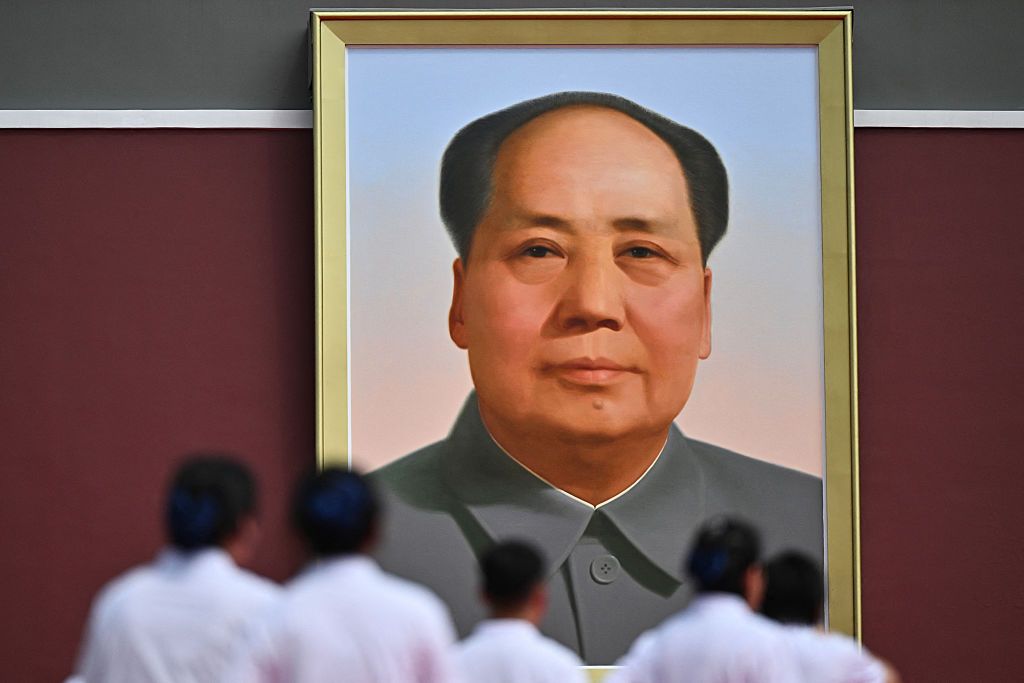
It’s been a bad couple of days for Kylian Mbappé, the French soccer superstar and Real Madrid forward who was, until yesterday, still being tipped as the heir to Messi and Ronaldo. First he lost the Ballon d’Or to Harry Kane – must be hard losing to the English once again – and then an old clip from the French talk show The Bridge was mysteriously resurfaced, where in response to a question about his favorite meme, Mbappé said the funniest is “the one where they put my face on a guy, a Chinese dictator I think.” The Chinese dictator in question was Mao Zedong, who till today, still smiles down serenely from his giant portrait above Tiananmen Square.
Once it started spreading on Chinese social media, the fallout was swift and massive. Within hours, energy-drink giant Dongpeng, dairy producer Mengniu and cheese maker Milkground all cut ties with him (the Dongpeng and Mengniu deals alone were reported to be worth a combined $7.5 million alone). The three companies issued near-identical statements terminating their agreements with immediate effect, citing zero tolerance for words or actions that “hurt the feelings of the Chinese people.”
Mao’s aura still underpins the CCP’s founding narrative and continued rule
Not only did Mbappé manage to offend one billion people simultaneously, he also prompted the cancellation of La Liga broadcasts on Chinese television, a full institutional kowtow from the league itself, and had to issue an obligatory multi-language struggle-session apology. To complete the rout, the US House Select Committee on the CCP weighed in to declare that he should not have apologized at all because Mao was, in fact, a dictator, potentially setting off a diplomatic crisis.
The irony is that Mbappé wasn’t trying to be critical at all. In fact, it was a lighthearted attempt at self-deprecation. Back when he was the star at Paris Saint-Germain, his individualistic, occasionally domineering style earned him the half-joking nickname “The Dictator.” Internet meme culture did the rest, generating a series of photoshopped images that placed him in the uniforms and poses of various figures universally recognized as tyrants – Stalin, Mobutu Sese Seko, Kim Jong-un, Gaddafi, and, among others, Mao Zedong. The Mao version was simply one of the set. In singling it out as his favorite, Mbappé wasn’t expressing any dislike or moral judgment of Mao; he simply found the meme funny and endearing, embracing it affectionately as part of the joke about himself.
These images have circulated online for ages as pure soccer banter but not once did it ever draw outrage from the Russians, North Koreans or Libyans. So what explains the melodramatic Chinese reaction? Was it over a joke about not knowing who Mao is? Or was it for calling a dictator, a dictator? One wonders what the problem with the latter is given that Mao himself, in his 1949 speech “On the People’s Democratic Dictatorship” openly embraced the label (“You are dictatorial… that is just what we are”) and the current Peoples’ Republic of China (PRC) constitution still defines the state as a “people’s democratic dictatorship.” Either way, the only other historical figure that is elevated to such an infallible, sacred status, where ordinary critique becomes blasphemy and routinely draws disproportionate responses, is the Prophet Muhammad.
Mao’s aura still underpins the CCP’s founding narrative and continued rule, though in modern times the Chinese state has officially conceded that he was “70 percent right and 30 percent wrong.” The admission was unavoidable because the death toll from the Great Leap Forward and the Cultural Revolution, estimated at around 50 million, was simply too glaring to ignore. By that measure, of all the dictators whose likeness was superimposed with Mbappé’s face, Mao was arguably the worst – and the one whose personality cult burned hottest.
In China today, state media and education maintain a positive narrative on Mao, and any harsh criticism online or in public can lead to censorship, surveillance, or worse. Outside China, nationalist or pro-CCP voices (including paid propagandists, bots or younger users educated under the system) frequently respond aggressively to such criticism, treating it as an attack on national dignity or the Party’s foundational legitimacy. Once a foreign actor is accused of “hurting the feelings of the Chinese people,” nationalistic outrage is whipped up that can be easilyshaped and directed toward any purpose, brow beating the target into ideological submission. In this heightened emotional frenzy, further inquiry into facts, context, or proportionality becomes difficult as continued questioning risks being framed as unpatriotic. With no limiting principle, it always results in a gross overaction.
One of the more comical aspects of the affair is that, behind the Great Firewall, Mbappé’s actual comments were censored on Chinese media and social media; simply reporting them would have meant touching the third rail. The irony is hard to miss. A fairly reliable proxy for Mao’s status as a dictator, or China’s status as a dictatorship, is whether one is allowed to say that Mao was a dictator. Even Chinese AI models such as Doubao and DeepSeek refuse to answer questions about what Mbappé said regarding the Mao meme. The result is that most Chinese netizens only knew that he had insulted China, but never learned the substance of the “inappropriate” remarks. How, then, could feelings be genuinely hurt by words they were never allowed to hear?
The insane backlash for plainly describing Mao as a dictator is an exercise in psychological conditioning. Consider what is really going on when progressive activists demand that one affirms that men can become women. To repeat something so obviously false is to incur a reputational cost that functions as a loyalty signal, sorting the compliant from the non-compliant. Accepting the claim, or even remaining silent while others are punished for rejecting it,demonstrates that commercial relationships, access and social standing matter more than observable reality. Mbappé stands to lose several million euros and La Liga has already paid a price, but the entire charade is staged for everyone else watching. It is meant to illustrate the consequences of refusing to toe the line. What follows is the gradual contraction of the range of statements that can be made by non-Chinese citizens without commercial penalty.
Javier Tebas, President of La Liga, was the first to prove his compliance, saying that La Liga “deeply regrets Mbappé’s comments,” and offering “sincere apologies to the Chinese people.” He took care to stress the league’s relationship with China must not be damaged by one individual’s remarks. Barely an hour later, Mbappé posted his own apology calling his own comments “ill-judged, and acknowledging how much his words hurt many people in China. He went on to say it was not his intention and expressed respect for the Chinese people and their history.
Having extracted this concession, Chinese state media let Chinese netizens know that Mbappé had apologized but again couldn’t tell them why, leaving many as utterly confused as they were before. Oh how one wishes Monty Python were still around to skewer this humorless authoritarian reflex. Which leaves a particular duty to those of us outside the firewall, and those of us who have the luxury of using the internet without a VPN. We are obliged to do what Chinese citizens are no longer permitted to do, and what a growing number of rich footballers with Chinese merchandising contracts have decided they can no longer afford to do: to state the obvious, to refuse to submit to the required fiction, and to keep on creating memes of dictators.




Comments