
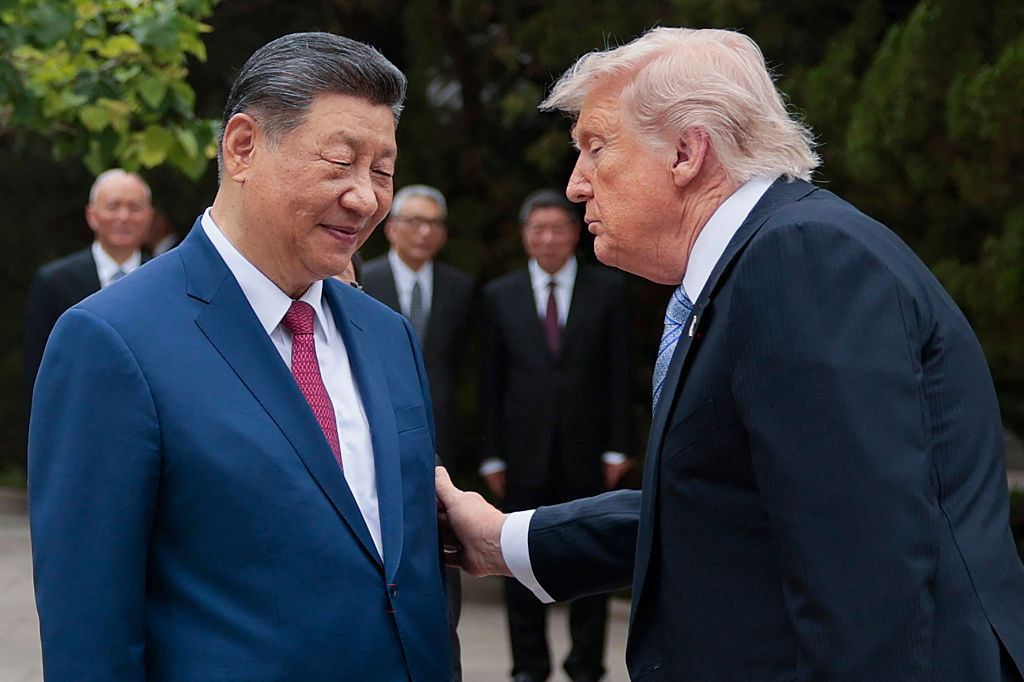
Air Force One is in the air as I write, whizzing from Beijing back to Washington – and Donald Trump leaves China with many questions unanswered. There were warm words on both sides and plenty of friendly symbolism in the President’s big summit with Xi Jinping. But the fundamental great power tensions remain – over trade, technology, and war and peace in the Middle East and Taiwan.
Washington and Beijing agree that Iran should never have a nuclear weapon – though it remains unclear the extent to which China will help reopen the Strait of Hormuz. Its closure hurts the Chinese economy, of course, but China has significant energy reserves and Xi knows that the pain spreads around the world to his advantage.
A leaked US intelligence report this week suggested China has already capitalized on the Iranian impasse. The conflict has drained the munitions stockpiles of the US and its allies, which empowers China in its near abroad and emboldens Xi in his quest to absorb Taiwan. It also gives the Chinese Communist party an opportunity to sell its own arms and technology to Middle Eastern states.
In other words, Iran has shifted the balance of global power further eastward. The White House disputes that, naturally. But it is clearly a major concern at the highest levels of western power.
Operation Epic Fury was an extremely high-stakes gamble. If it had somehow collapsed the Iranian regime and produced a more biddable government in Tehran, it would have resolved one of the free world’s biggest problems and set back China’s international program.
But if it failed – and the war is currently unresolved, which is a failure – Trump’s mistake was always going to empower Beijing, which can now present itself as the patient and reliable power, as opposed to the US wrecking ball. The CCP line is that Trump’s America moves fast and breaks things; Beijing operates slowly and resolves matters.
Trade relations, meanwhile, between China and America remain extremely difficult and uncertain. Trump’s great weapon against Beijing has been his tariffs, which he knows hurt China most of all. But Beijing understands that the Supreme Court and other adverse legal judgments have hampered Trump’s protectionist agenda – and that weakens Washington’s hand in any, and all, trade talks.
In his public remarks to Trump, Xi asked: “Can China and the United States transcend the so-called ‘Thucydides Trap’ and forge a new paradigm for major-power relations?” People online joked that Trump would have no idea what Xi was talking about. But the Thucydides Trap is the theory that one superpower cannot threaten to displace another without a major war risk. Xi knew that by mentioning it he was asserting China’s status as the new world leader, and America’s as the old. No wonder Trump appeared to be scowling after various meetings in the Forbidden City.
And Trump would clearly have understood that message. In his first Truth Social post about the visit, he stated: “When President Xi very elegantly referred to the United States as perhaps being a declining nation, he was referring to the tremendous damage we suffered during the four years of Sleepy Joe Biden and the Biden Administration, and on that score, he was 100% correct. Two years ago, we were, in fact, a Nation in decline. On that, I fully agree with President Xi! But now, the United States is the hottest Nation anywhere in the world, and hopefully our relationship with China will be stronger and better than ever before!”
Trump is a master of spinning positive messages for his domestic audience. But on the world stage, there can be no doubt that China increasingly demands to be treated by America as an equal.
This article originally appeared in Freddy Gray’s Americano newsletter, which you can subscribe to here.



Comments