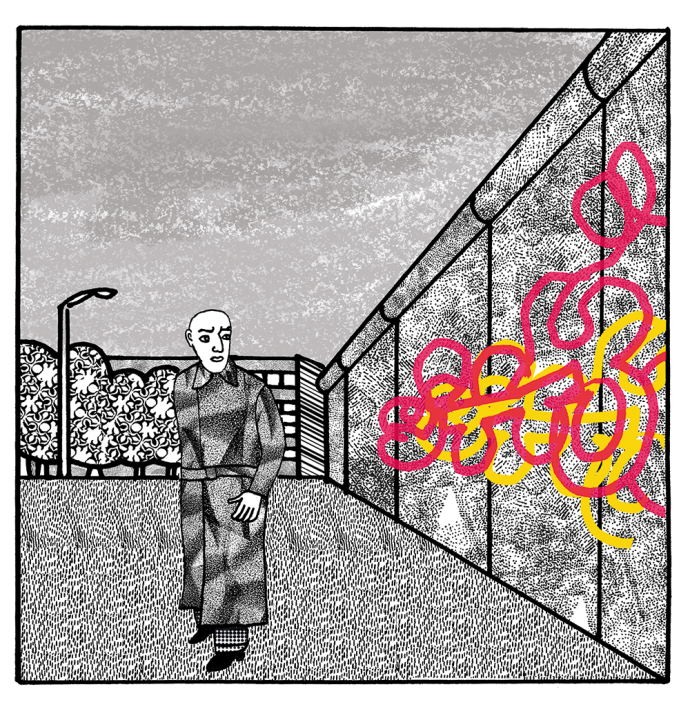

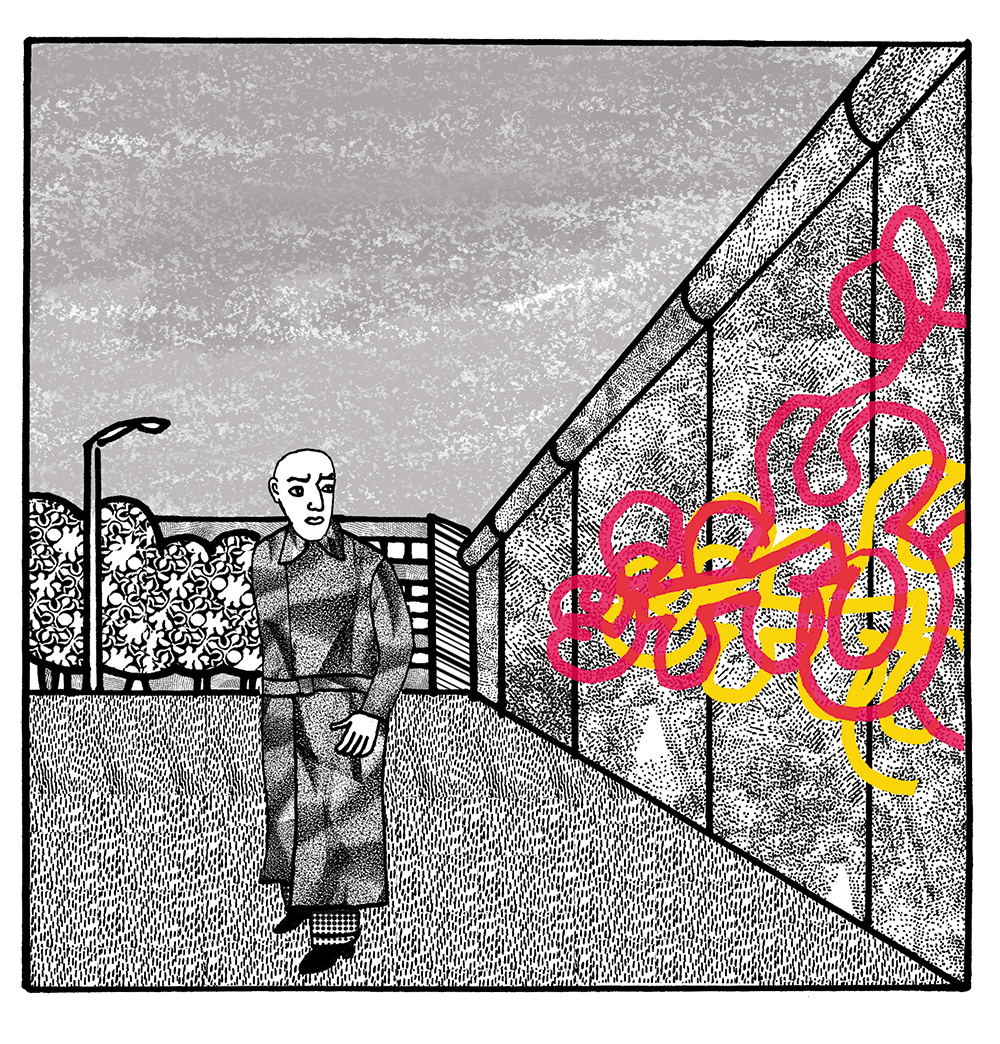
Each time I return to Berlin – that wonderful, awful city where I whiled away the best days of my misspent youth – I take a walk along the cobbled path that marks the route of the Berlin Wall. Half a lifetime since it came tumbling down, there isn’t much left to see. A few stretches have been preserved as memorials, but it’s mainly an absence not a presence – a ghostly gap between the backs of buildings, a fissure between past and present, between the hard truths of the last century and the uneasy ambiguities of today.
Why do I persist with this melancholy Wanderung, year after year? Because a walk along the Mauerweg (as Berliners call that zigzag footpath) is the best way to take the temperature of this Faustian metropolis. When I first walked it, 35 years ago, the differences between East and West were vast. The West was brash and glitzy, the East was dull and funereal – the apotheoses of capitalism and communism, side by side. Now these twin cities are so similar, you’re often unsure which side you’re on (the old border meanders so much that it can be tricky to get your bearings).
The West was brash and glitzy, the East dull and funereal – apotheoses of capitalism and communism
Built in 1961, to halt the mass exodus of Germans from East to West, the Berlin Wall – or “anti-fascist protection barrier,” as the East German authorities liked to call it – ran right around West Berlin, not only separating it from East Berlin but also cutting it off from the East German countryside that surrounded it (the West German Bundesrepublik was more than 100 miles away). The entire wall was 96 miles long, but the outer suburban section is of less interest and more difficult to navigate. It’s the inner-city section, about ten miles long, which I walk along, year after year.
The best place to begin is at Bernauer Strasse, site of some of the most dramatic escape attempts. One of the first to succeed was East German border guard Conrad Schumann, whose leap to freedom was captured by West German photographer Peter Leibing, in one of the classic images of the Cold War. A week later, the Wall claimed its first victim when Ida Siekmann jumped from the fourth floor of her apartment block, in the East, on to the sidewalk, in the West. Thereafter, West Berliners caught escapees in blankets. When the East German authorities bricked up the windows, East Germans dug elaborate tunnels. Hundreds more escaped.
The East German response was to build a bigger wall – actually two walls, separated by a so-called “death strip.” Here in Bernauer Strasse, that death strip has become a garden. There’s a simple chapel (built to replace the parish church which ended up in no man’s land and was dynamited by the East Germans) and a few dilapidated remnants of the Wall. Trains trundle through Nordbahnhof subway station (shut up throughout the Cold War, now open once more), disgorging troupes of bemused, bewildered tourists. What are they all doing here, in this drab and dreary suburb? The same thing as me, I suppose. We’ve come to marvel at the Cold War’s ultimate absurdity, a city divided into two separate worlds.
From here the Wall snakes west, through a forest of unruly saplings. I spy a children’s playground, full of busy toddlers in hi-vis vests. I trudge through the Invalidenfriedhof, that stately, shabby cemetery where the best and worst of Germany’s fallen warriors are buried. Around the corner is an East German watchtower, built to guard the border – not from western invaders but from eastern escapees. It’s preserved by Berliner Jürgen Litfin in memory of his brother Günter, who was shot dead by those border guards as he tried to flee – one of 136 civilians who died trying to cross the Wall. I walk across the River Spree and wander through the new governmental district, a grand yet graceless campus erected in the 1990s after the Bundestag’s return from Bonn. Beyond here is the Reichstag, the bombastic seat of Germany’s patched-up parliament, crowned by Sir Norman Foster’s shiny new cupola – the symbol of a new beginning. Opposite, across a busy road which once marked the boundary between the Warsaw Pact and the Free World, is the Brandenburg Gate, Germany’s most iconic landmark. Beyond is Peter Eisenman’s austere ‘Memorial to the Murdered Jews of Europe,’ a wave of weathered concrete blocks, a maze of unnamed gravestones.
Now we’re in Potsdamer Platz, Berlin’s answer to Times Square, a barren bombsite during the Cold War, now a cluster of shiny skyscrapers crowded with revelers, oblivious to what came before. I walk on, past Checkpoint Charlie (the most famous, infamous border crossing, now a tourist trap besieged by coach parties), past Daniel Libeskind’s jagged Jewish Museum, and back across the dank dark Spree. Journey’s end is the East Side Gallery, the most incongruous remnant of the Wall. Since this section flanked the road to Schönefeld, East Germany’s main airport, it was the only section that visiting VIPs were bound to see. Consequently, its rough gray concrete was prettified with a coat of smooth and silky whitewash, the ideal canvas for graffiti artists after the Mauerfall (as Germans call the fall of the Wall).
The reunited Germany is no paradise. Indeed, like every other European nation, it’s beset by problems, but the big difference between past and present is that its problems are normal problems – not the issues of a tyranny but those of democracy. For all its limitations and frustrations, I believe that’s something worth celebrating. And that’s why I’ll be back again next year, to take another walk along the Wall.



Comments