
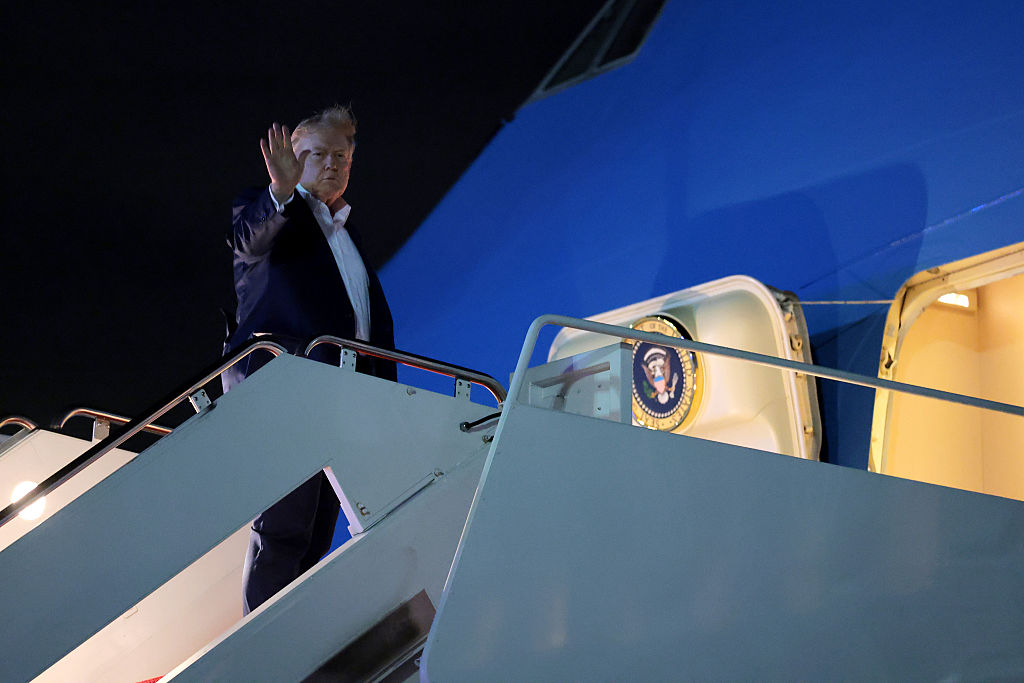
President Trump is giving peace a chance in the Persian Gulf, and for Iran’s leadership this is literally a matter of life or death. If Iran had continued to fight, one of two things would have happened. Either the war would have resumed its original tempo, leading to the extinction of another generation of Iranian leaders and the loss of yet more of the nation’s military capabilities, only for Tehran to strike a deal much like this one after realising the futility of its efforts; or the war would have escalated, as the US employed greater force – potentially including ground troops – to force open the Strait of Hormuz.
The latter scenario would have been costly to America and the world, but it would have been fatal to Tehran. President Trump preferred from the outset not to conduct the Iran war like George W. Bush’s Iraq war. He could have chosen to do so. Iran’s leaders, having already seen what had happened to their immediate predecessors, did not want to lose their own lives along with their regime.
Israel has much at stake in Trump’s success. Iran’s leaders have even more at stake
This, of course, is not how America’s cartoon pundits of cable news or glossy magazines see things. They were convinced that Iran was winning the war and, in so many words, that Iran was right – so why should Iran’s leaders stop? The real villains were Donald Trump and the Israelis. They started the war, and if Iran’s quest for a nuclear weapon was their reason for doing so, they, and not the Iranians, deserved the blame for Iran’s nuclear programme as well. Trump had withdrawn the US from the JCPOA – the Obama-negotiated Joint Comprehensive Plan of Action – that was meant to have put Iran’s nuclear ambitions on hold, in exchange for sanctions relief and other benefits. Iran was an innocent victim of the modern humanitarian left’s real enemies, Trump and Israel.
And now, the story goes, four months of war have only succeeded in restoring the status quo ante, and Iran might get a deal even more generous than the JCPOA once negotiations with Trump are done. (For the moment, the ‘memorandum of understanding’ (MOU), for a ceasefire has been agreed to and is set to be signed Friday in Switzerland, after which the hard details for dealing with Iran’s nuclear programme will continue to be worked out.) Washington’s permanent class of foreign policy chatterers has agreed amongst themselves that Obama was right all along. Of course they’d think that.
Yet there is no return to the status quo ante for Ayatollah Khamenei or other Iranian leaders culled in the war. Iran’s military forces are now far weaker than they were at the time of the JCPOA. And what was then a threat – possibly an empty one – is now a demonstrated reality: the United States and Israel will use overwhelming force to prevent Iran from acquiring nuclear weapons. Iran can now tally the cost. That and more is the price that continuing to seek nuclear weapons will incur. And that is a very different grounds for negotiation, and guarantee of contractual performance, than what had underwritten the JCPOA.
Nor did Trump force Iran to leave Obama’s agreement, for that matter. After the US left the JCPOA, Europe continued to uphold the agreement with Iran. It was the Iranians who ultimately chose to abandon the JCPOA altogether, at which point they speedily embarked on enriching uranium to weapons-grade.
That was the absurdity of the JCOPA all along. It was not designed to ensure that Iran would never have a nuclear weapon; it was meant only to postpone the crisis, while Iran would only grow richer and more technologically advanced in ballistic missiles and defensive capabilities. The JCPOA was based on the same idea that had proven false in respect to Communist China after the Cold War – the notion that if a dangerous regime grows rich, it will become liberal and unthreatening, too. Iran’s support for terrorist paramilitaries through the period of Obama’s deal put the lie to that theory once again.
The Iranians will now have to work very hard to keep the peace that stands between them and damnation. Much more is on the negotiating table now, with Iran and America each having no illusions about the other. The peace is complicated by its overlap with Israel’s ongoing efforts since the 7 October massacre to wipe out the terrorist organisations that have long harried the Jewish State. Whether Iran can rein in its proxies will be a test of the Islamic Republic’s competence as well as its will. President Trump has made clear to Benjamin Netanyahu that he expects Israel to cooperate with the peace deal, yet Israel isn’t a party to the deal and has its own national interests. Nevertheless, those interests include curtailing Iran’s nuclear ambitions, and a deal between Trump and Iran offers the chance to do that. Israel has much at stake in Trump’s success.
Iran’s leaders have even more at stake. Trump is betting that they do not believe they have nothing left to lose, as heavy as the personal as well as military and political losses they’ve suffered so far have been. They also stand to gain a great deal by giving up their pursuit of nuclear arms once and for all. From these realities, Trump has an opportunity to forge a lasting peace, however difficult or delicate it may be at first. Yet he’s still left Iran with a choice – its leaders can fulfil the demands of peace or suffer the consequences of war.




Comments