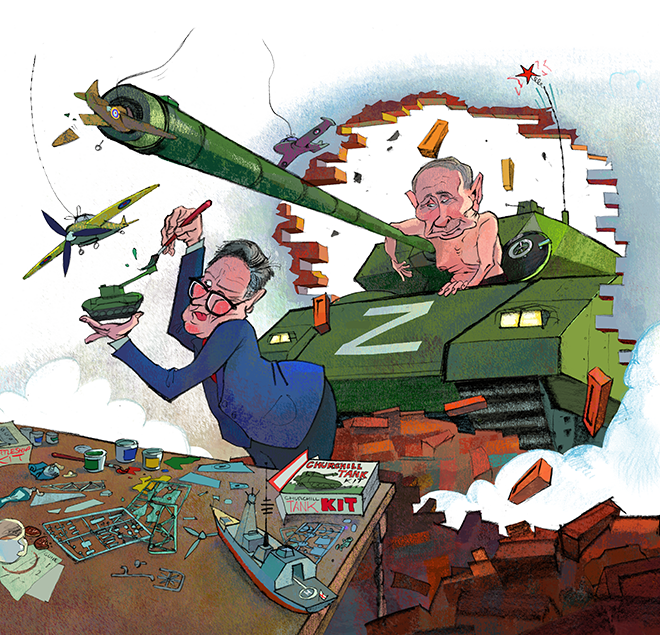


When Keir Starmer was told his pledge to raise defence spending to 3 per cent of GDP in the next parliament was not enough to fund his vision for the armed forces, as outlined in the strategic defence review (SDR), he put his head in his hands and snapped: ‘Why are you doing this to me? I thought this was costed!’
That striking image of a leader on the edge was widely talked about at the Munich Security Conference over the weekend. Three senior defence figures relayed it to me. Remove the self-pity and it is still a telling insight.
The SDR, drawn up by George Robertson, the former Labour defence secretary, retired General Sir Richard Barrons and Fiona Hill, an adviser to both George W. Bush and Donald Trump, outlined a ten-year plan to bring our forces to ‘war readiness’ when it was published last June. But there were always going to be gaps in funding for the next couple of years before the new money began to come through. ‘The report was clear on that,’ says a senior Labour figure.
Yet Starmer seemed unaware of this when defence chiefs warned John Healey, the Defence Secretary, and the PM in November that there was a £28 billion black hole in the budget. One Brit in Munich declared Starmer ‘a manikin’ and observed: ‘He’s been living in a storm of blissful ignorance in which people have told him he’s very good at foreign policy.’
‘The army has never been as small as it is now since the days of Cromwell’
Starmer has set a target of spending 2.5 per cent of GDP on defence by April 2027, with an ‘ambition’ to raise this to 3 per cent after the general election and then to 3.5 per cent, with another 1.5 per cent spent on defence infrastructure – matching the 5 per cent Donald Trump has demanded of Nato countries.
Instead, the Defence Industrial Plan, due out in November, on how the money is split between the three armed services and the order in which weapons systems are built, is not finished. General Sir Nick Carter, the chief of the defence staff between 2018 and 2021, says Munich was ‘the first time I’ve been to a major European event when I’ve actually felt a bit dispirited about being British because I don’t feel that we’re stepping up to the plate as fast as we should be’.
Remove spending on the Trident nuclear deterrent – a quarter of the MoD’s budget and a third of its equipment budget – and Britain is spending just 1.75 per cent of GDP on defence, around the same level as Spain and Portugal. The UK is on course to fall to 21st in Nato spending as a proportion of GDP on conventional forces. We were once second.
The Japanese complain Britain has failed to commit funds to a stealth fighter jet project called GCAP, the Global Combat Air Programme, being worked on by the UK, Japan and Italy. ‘The Japanese thought Italy was going to be the problem,’ says a retired commander, ‘but they’re calling us a ghost ally.’

Starmer used his speech in Munich to say, ‘We must build our hard power… On defence spending, we need to go faster’, but failed to provide any concrete commitment. James Landale of the BBC was briefed that defence spending will hit 3 per cent in 2029, election year – but Rachel Reeves, the Chancellor, has refused to find any more money.
‘What Nato needs is kit and troops which are deliverable on day one of a conflict,’ says a Labour defence adviser. Carter’s view is that the army would struggle to field more than 10,000 combat troops and the navy more than ‘ten combatant warships’. One Type-45 destroyer spent eight years tied up in port. ‘The army has never been as small as it is now since the days of Cromwell,’ says Carter. The RAF has 140 combat aircraft, a tenth of Cold War strength, and just two air defence squadrons. A 2024 report found them ‘not currently equipped to be able to defeat various forms of air threat’ including the ballistic missiles and waves of drones used by Russia in Ukraine.
The contrast with the Europeans is becoming embarrassing. The army will have 148 Challenger 3 battle tanks by 2030 but currently has more operational command headquarters than it does artillery pieces, having given 19 howitzers to Ukraine and replaced them with just 14 guns. In contrast, Poland will soon have 980 tanks and 685 self-propelled guns. Finland can mobilise 300,000 troops. Britain’s regular and reserve army totals only 90,000.
Air Marshal Edward Stringer, a former assistant chief of the defence staff, published a report in January for Policy Exchange identifying what he called the ‘Say-Do gap’ between the rhetoric and reality. ‘The armed forces of most other Nato nations are now visibly expanding while those of the UK continue to shrink,’ he wrote. Stringer says now: ‘It’s like the shop window of Harvey Nichols at Christmas. There’s lots of glossy stuff in the front window, but you go inside and the shelves will be empty by mid-morning and there’s no production line to restock.’
Those at Munich say Starmer had to act because the Trump administration is concerned Britain will have to make cuts in the next two years. A former minister reveals: ‘I’ve spoken to two members of Trump’s cabinet who basically say, “You guys aren’t taking this seriously.”’
Morgan McSweeney spent part of his final week as Downing Street chief of staff pressing Starmer to commit more to defence. ‘Morgan grabbed hold of the idea that the Americans would be highly alert if there was a short-term cut in the defence budget,’ says a former cabinet minister. ‘The McSweeney view was that the one way that Keir Starmer can rescue his premiership is to become a security champion.’
The Prime Minister is under intense pressure to overrule Reeves. He is acutely aware that both Healey and Al Carns, a former SBS commander and the armed forces minister who did five tours in Afghanistan, are being talked up as his possible successors. ‘John Healey being mentioned as a potential compromise prime minister creates leverage for defence at a critical time,’ says a Brit who was in Munich. Others say Healey needs to act because ‘Al Carns is coming for his job’.
Instead, the current Chief of the Defence Staff, Air Chief Marshal Sir Richard Knighton, whom one adviser calls ‘a genius with equipment programmes’ but who an ex-commander notes ‘has never been anywhere near a military operation’, is dragging his feet. Knighton dismissed the SDR at a select committee hearing as ‘an external document’.
A highly irritated Robertson responds: ‘We did it with the department. It’s a government report and they are tied to it. The Prime Minister accepted the report and all 62 recommendations.’ Robertson, Barrons and Hill are going to the MoD the week after next for an update on implementation. Robertson, who is also chairman of the House of Lords International affairs and Defence Committee, says: ‘Every two months we’ll examine the recommendations and the progress that has been made to implement them. We will be watching.’
Robertson agrees with the assessment of Ben Wallace, the former Tory defence secretary, that the army has been ‘hollowed out’. Wallace accuses Labour of repeating ‘all the bad behaviour I fought so hard to reverse’ such as ‘grand, unfunded commitments from No. 10’ and ‘Treasury tricks such as suspending the defence equipment programme’.
Senior officers recently told MPs at a private dinner that Britain would be practically defenceless against a military attack by Russia in the North, perhaps against the Orkney or Shetland islands. An aircraft carrier battle group, led by HMS Prince of Wales, will deploy to the ‘high North’ to patrol around Greenland – a mission designed to placate Trump and send a message to Putin. Around 2,000 Royal Marines are deployed in the Arctic Circle to deter Russian aggression.
One third of young people say they would never fight for their country
Allies say Starmer understands what is at stake. ‘He recognises there is a real threat to the nation,’ says Robertson. ‘It’s a fact of life that we are being attacked relentlessly – cyber-attacks, sabotage attacks.’ But the PM is also accused of undermining the special forces by indulging the human-rights lobby with legislation that will see SAS men and spies dragged into court years after they make split-second decisions on the battlefield.
Tom Tugendhat, the former security minister who served alongside the SBS in Afghanistan, says: ‘It feels like the government are against soldiers, intelligence officers and those who operate in the confusion of combat. With the US and our other allies turning to us more and more for specialist skills like special forces and intelligence, they are questioning our worth.’ He adds: ‘Even European partners, bound by the same ECHR as us, are astonished we are not willing to use the power of the state to support those we send to keep us safe.’
The other criticism of Starmer is that he has not persuaded the public of the threat. Recent polling by YouGov found that only 25 per cent of voters would support tax rises to fund higher military spending and just 24 per cent would support spending cuts in other public services. One third of young people say they would never fight for their country. Knighton had a go on Monday when he and General Carsten Breuer, Germany’s defence chief, issued a joint appeal for the public to accept the ‘moral’ case for rearmament.
These appeals would be more persuasive if the MoD got its house in order. Healey is admirable and serious. When he came in, he advocated a new Defence Reform structure. One body to set policy, one to generate war plans and a National Armaments Director Group (NADG) to order kit that is needed so that the three services could fight together. Instead, the Defence Investment Plan has dissolved into what Stringer calls ‘the usual inter-service bunfight’ with defence chiefs fixating on their own wish lists.
Stringer explains: ‘If you ask a taxi driver what he’d like to drive he’ll say “a Ferrari”. But if you’re running a taxi company you buy a fleet of Skodas or Toyotas which are reliable and the parts are cheap. The service chiefs all want Ferraris. They are desperate to keep up with the Joneses in the US Navy and Army.’ This approach, he says, means money is wasted on bespoke projects rather than spent on a co-ordinated menu. ‘If you run a restaurant, you wouldn’t let your three sous chefs all buy the ingredients they wanted,’ Stringer says. ‘You’d end up with foie gras and artichoke halves, when what you need is Maris Piper potatoes.’
Carter and Stringer both argue that Britain should focus sovereign capabilities on AI which will command the battlefields of the future. ‘If we don’t do that, there’s going to be some real gaps in our national resilience,’ Carter says. ‘We can’t afford to outsource that to another country.’
If Starmer is to survive as PM with his reputation as a statesman intact, he can’t afford to outsource decision making to the Treasury. Unless he forces Reeves to find the money, it will be the armed forces with their heads in their hands.
Tim interviewed Gen Sir Nick Carter, former chief of defence staff, about his thoughts on the issues facing Britain’s armed forces for the latest Coffee House Shots podcast:






Comments