
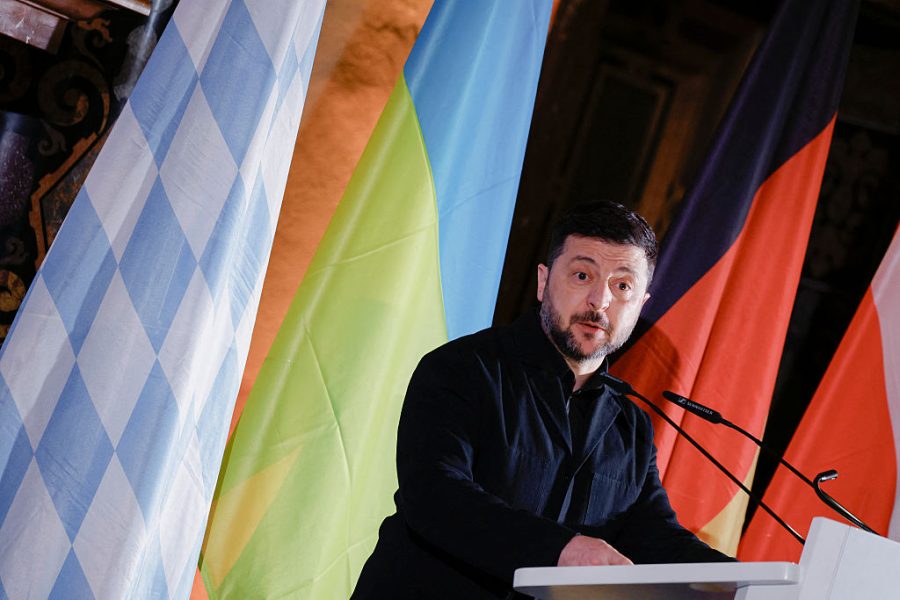
Is the latest round of Russia-Ukraine peace talks, sponsored by the United States and currently under way in Geneva, likely to hasten the war’s end? Donald Trump seems to believe so. On Friday, President Trump claimed that “Russia wants to make a deal, and Zelensky will have to hurry. Otherwise, he will miss a great opportunity. He needs to act.” Europe, for its part, remains deeply skeptical and is urging Ukraine to fight on. As the EU’s Foreign Affairs chief Kaja Kallas told the Munich Security Conference last week, “the greatest threat Russia presents right now is that it gains more at the negotiation table than it has achieved on the battlefield.”
Despite Trump’s claim that Putin is ready to end the war, there is as yet no sign of any newfound spirit of compromise from the Russian side. Kremlin spokesman Dmitry Peskov yesterday said that the principal issue for Moscow was “the demands we have put forward” on territory – namely, an insistence that Kyiv surrender the 20 percent of Donbas that Russian forces have so far not succeeded in taking. Russia’s deputy foreign minister Mikhail Galuzin – a member of the Russian delegation at the Geneva talks – made the bizarre suggestion that Ukraine could be temporarily transferred to UN rule while it held new parliamentary and presidential elections, as well as a possible referendum on ceding territory. And former culture minister Vladimir Medinsky, head of the Russian delegation, claimed that Russians are “ready to lose millions and live on bread and water for the sake of the special military operation.” Hardly conciliatory talk.
Trump is growing impatient to get a deal done
Medinsky – who, like the Kremlin’s chief White House negotiator Kirill Dmitriev, was born in Ukraine – is a longstanding hardliner well known for his love of Putin-style pseudo-historical lectures on Russia’s destiny. It was Medinsky who represented the Kremlin in the first rounds of peace talks in Minsk, Antalya and Istanbul in the weeks immediately after the February 2022 invasion. His new prominence in the latest round of talks seems to mark a shift from the two rounds of strictly military-technical talks held recently in Abu Dhabi between the chiefs of Russian and Ukrainian military intelligence to a focus on political, social and religious issues.
That does not bode well. As well as territory, the Kremlin has demanded reforms of Ukrainian laws on the use of the Russian language, on Soviet-era symbols and monuments, and the lifting of a ban on the part of the Ukrainian Orthodox Church still loyal to the Moscow Patriarch. That is what Putin continues to refer to as the “de-nazification” of Ukraine, a key Russian war aim.
Ukraine’s delegation is led by Rustem Umerov, secretary of Ukraine’s national security and defense council; David Arakhamia, head of Zelensky’s parliamentary party; and presidential chief of staff Kyrylo Budanov – until recently the ruthless and highly effective chief of Ukraine’s military intelligence agency. Missing is Zelensky’s former chief of staff, consigliere and business partner Andrei Yermak, who was fired last year after his close associates were arrested for embezzling hundreds of millions of dollars in state funds.
Arakhamia, Umerov and Budanov are rumored in Kyiv political circles to be more willing to swallow a deal with Moscow than Zelensky. Whether this represents a genuine divergence of judgment or something more calculated is an open question. But it is clear that Zelensky’s room to maneuver is shrinking by the day.
Public support for Zelensky and his Servant of the People party is eroding as corruption allegations pile up. His grip on a parliamentary majority is precarious and rides largely on Arakhamia’s ability to hold things together – the same Arakhamia who now appears to be pulling in a different direction. The arrest over the weekend of former energy minister Halushchenko, pulled by Western-backed anti-corruption police off a Poland-bound train on the border as he attempted to flee Ukraine, represents another blow to Zelensky’s credibility.
On the practical side, it appears a 20-point peace plan that Kyiv and Brussels have been pushing – their attempt to supersede the 28-point document Washington had hammered out with Dmitriyev and Umerov – is going nowhere. The Ukrainians also have to contend with a parallel set of negotiations conducted directly between the Kremlin and White House representatives Steve Witkoff and Jared Kushner, Trump’s son-in-law, which has reportedly included a Russian offer of $12 trillion in mineral and business deals once peace is concluded.
Zelensky said on Saturday that he hoped the Geneva talks would prove “serious, substantive… but honestly sometimes it feels like the sides are talking about completely different things.” He’s right. Russia has made it clear that it will not move from its hard-line demands. Trump is growing impatient to get a deal done. Ukraine is slowly drifting toward concessions, however reluctantly and fitfully. Europe, even though it has taken over funding and arming Kyiv, is not even in the room.
Meanwhile, even as the delegations traveled to Switzerland, Russian bombs and missiles continued to slam into energy infrastructure targets across swathes of Ukraine, inflicting severe damage on the power network in the southern port city of Odessa. The timeline of a final peace deal is uncertain – there are too many variables, too much noise. But the deal’s rough outline – territorial losses for Kyiv plus some kind of security guarantees from the West – is clear.





Comments