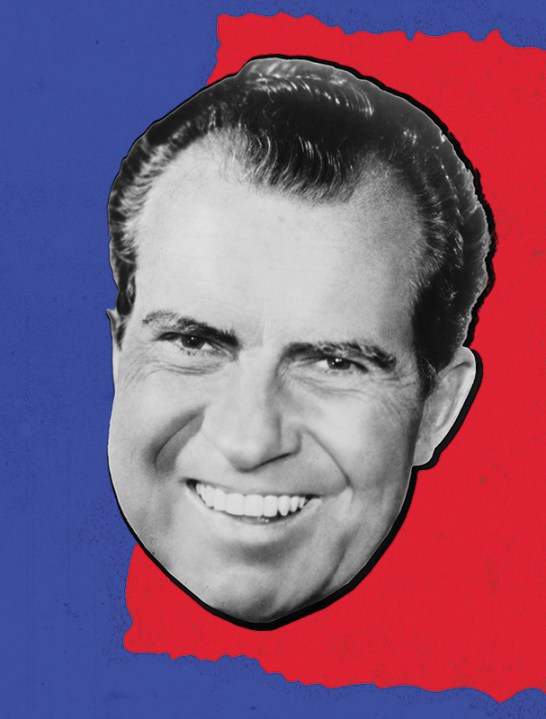
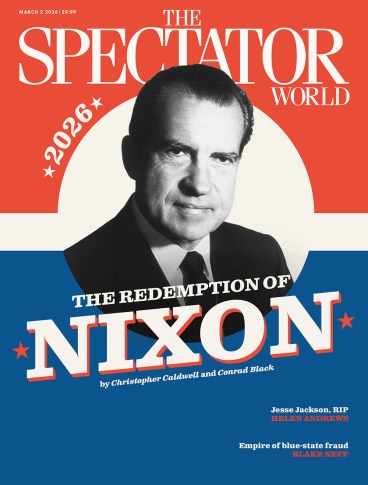
In the last five years of his life, when I knew Richard Nixon, nothing described him better than Milton’s “calm of mind, all passion spent.” During the most tumultuous political career in American history he had come back many times, but the greatest comeback of all was in full swing.
His enemies had seized control of the puritanical conscience of America to slay him, unjustly, and he was manipulating the same national conscience, which was founded on Plymouth Rock and has survived all the corruption and hypocrisy and violence of American public life, and when aroused, is insuperable. Since his political fall, and later his death, polls increasingly indicate public unease about the treatment of Richard Nixon. Far from being a singularly morally unsuitable chief of the American state, he is seen as a capable president who was a victim of the nastiest traits and methods of the American jungle that is America’s greatest strength and greatest weakness.
Nixon is seen as a capable president who was a victim of the nastiest traits and methods of the American jungle
America has tremendous levels of competitiveness and achievement in almost every field, but millions are pitilessly ground to powder. The America of Norman Rockwell and Walt Disney exists, but no one knew better than Nixon, who had climbed all the way up the rickety ladder of American life, that it was a facade.
In a dignified address, on August 8, 1974, he informed the country and the world that although he had committed no crimes, he had made serious errors and effectively squandered his political capital and that the national interest would be best served if he retired, abhorrent (and unjust) though he found that course.
His one full term as president (1969-1973) was probably only surpassed by Abraham Lincoln’s and by the first and third terms of Franklin D. Roosevelt as the most successful four years of any American president. But tactical errors of his own led to his fall, supplemented by the bloodlust of those who had never forgiven Nixon for gaining the vice-presidency at the very young age of 39 by successfully exploiting aspects of the Red Scare (in convicting former State Department official Alger Hiss of perjury). Nixon was always a traditional American patriot most concerned by the national interest. That was the reason he did not contest the doubtful results of the 1960 presidential election against John F. Kennedy, even when president Eisenhower urged him to do so. (Some of the ballot boxes from mayor Richard Daley’s Chicago are still the subject of an official search.) It was also why he would not subject the nation to the destabilizing indignity of an impeachment trial.
When Nixon was inaugurated on January 20, 1969, he was the first president since Zachary Taylor 120 years before to take office with his party controlling neither house of Congress. There were 545,000 conscripts at war at the ends of the Earth in Indochina, 200 to 400 of them coming home in body bags each week, with no exit strategy. There was widespread public distrust of the administration’s account of the war, and the only peace terms being offered were American departure from Vietnam with their prisoners of war, having handed over the government of South Vietnam to the communists.
There were race riots in many cities and anti-war riots on college campuses almost every week, as well as severe discord throughout the country, most tragically illustrated by the assassinations in the spring of 1968 of Martin Luther King Jr. and Robert F. Kennedy. The courts were ordering that millions of schoolchildren be transported against their parents’ wishes by bus all around the metropolitan areas of the US to achieve racial balance in schools. The United States had no relations with the People’s Republic of China, there were no peace discussions in the Middle East and there were no substantive discussions on any subject between the US and the Soviet Union.
Four years later, when Nixon sought reelection, the United States had withdrawn from Vietnam while retaining an anti-communist government in Saigon. Nixon knew that the North Vietnamese would violate the peace, but as the South Vietnamese had defeated the communists in the great invasion of April 1972, with only American air support, it was believed this formula could be invoked again. The Democrats prevented that: having pushed the country into the Vietnam War and betrayed their own president, Lyndon B. Johnson, they would not tolerate the Republican’s plan and cut off all aid to Vietnam after Nixon left office.
Nixon had opened up relations with China and negotiated and signed the greatest arms control and reduction agreement in history, in the course of which he restored American nuclear superiority. The de-escalation of the Cold War had begun. There was a productive Middle East peace process. Segregation had been completely abolished by local joint agreement throughout the country by racially balanced committees of distinguished citizens. The nightmare of moving millions of schoolchildren out of their neighborhoods every day had been avoided.
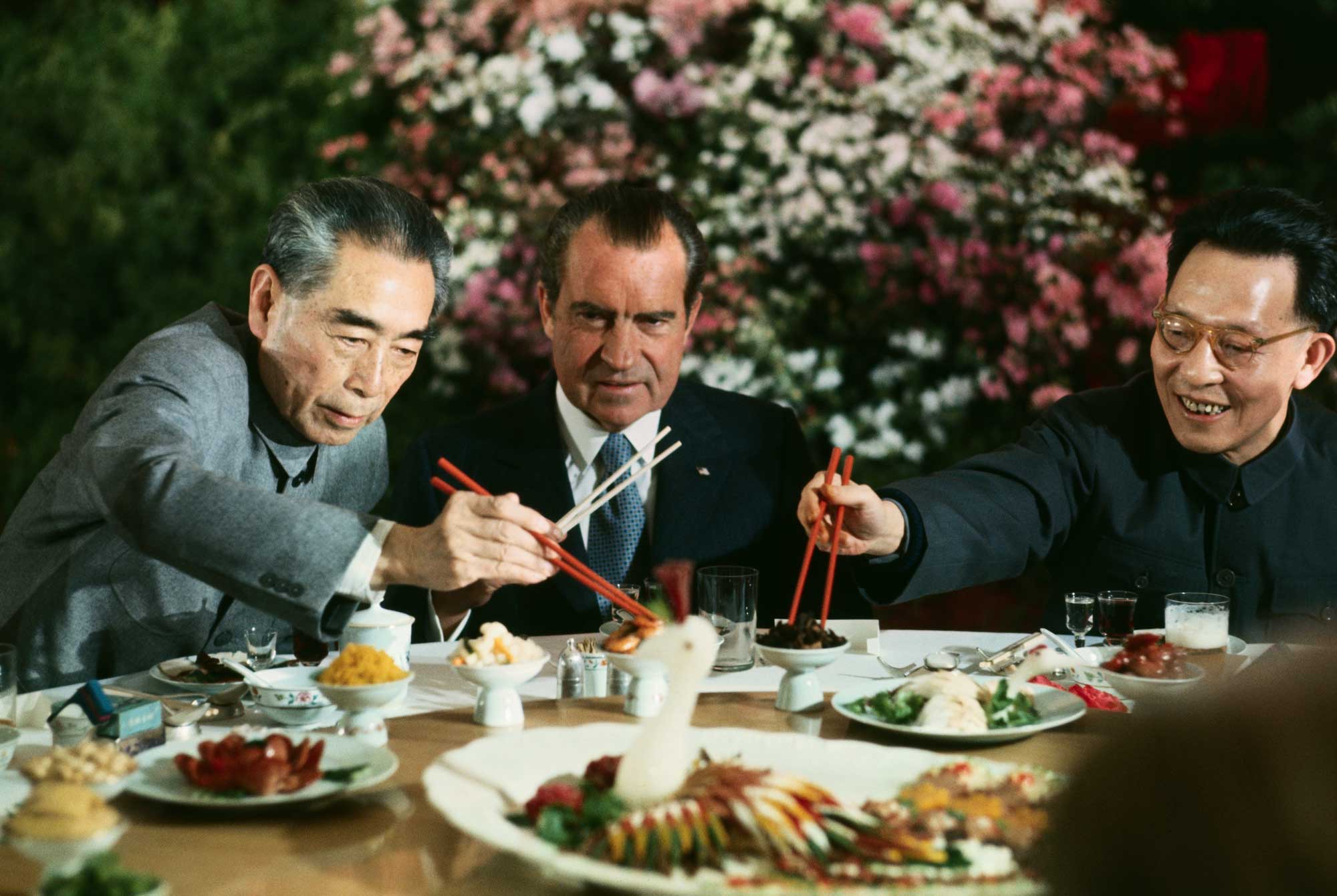
There were no riots or assassinations or skyjackings, crime rates had declined, the economy was strong, Nixon had abolished conscription and he had founded the Environmental Protection Agency and emphasized conservation without fumbling into lunacies generated by exaggerated fears of climate change. This was why Nixon was reelected by the unheard of plurality of 18 million votes, which has still not been equaled although the American electorate has doubled in size. The country confirmed that he was an outstanding president and he carried 49 states.
The Watergate affair was well depicted by Muriel Spark in a send-up of it called The Abbess of Crewe, in which a great controversy arose in a convent over the theft of a thimble. Some overzealous underlings in his campaign hatched the insane idea of forcing entry in the dead of night into the offices of the Democratic National Committee in the Watergate building to conduct political espionage. There was no damage, no one was injured, it was a complete fiasco. Nixon knew absolutely nothing about it and was shocked when it came to light.
Nixon made no secret of his desire to take a scythe to the government in his second term
Nixon, the great survivor, then made a series of inexplicable tactical errors. Instead of keeping his distance from the investigations or following them while recording his office conversations as he did, but ensuring that the tapes reinforced the probity of his conduct, he allowed his coarse and sometimes cavalier but not self-incriminating reflections to be used by his enemies to destroy his presidency.
The so-called “smoking gun” was the revelation that he had approved the suggestion of three members of his entourage to ask the CIA not to investigate the Watergate affair because the people involved in it were former CIA operatives and this could lead to damaging national security indiscretions. It was a foolish idea, but hardly a felony.
The CIA director and deputy director, Richard Helms and Vernon Walters, told me that they had no evidence that Nixon had committed any crimes. Only in the inflamed atmosphere that Nixon’s enemies had created could any of this be seen as the “high crimes and misdemeanors” that the Constitution requires to justify the removal of a president.
The judiciary committee of the House of Representatives voted to impeach Nixon for obstructing the investigation, endeavoring to misuse the Internal Revenue Service (not that he actually had misused it as many of his predecessors had), for abusing the constitutional rights of other citizens and for delayed responses to subpoenas for tapes. All of this was nonsense; he was conducting an orthodox executive privilege defense that had to be adjudicated.
The most recent release from the Nixon Archives indicates there was serious evidence he was being effectively spied upon on the orders of the Joint Chiefs of Staff. This connects with Nixon’s own views and his hostility to the political and government establishment, including the Pentagon and the State Department. He had made no secret of his desire to take a scythe to the government in his second term; the administration, military and civilian, was riddled with his enemies.
Nixon and many others including Ronald Reagan, Newt Gingrich, Henry Kissinger and Donald Trump, who also knew Nixon in his later years, believed the entire Watergate smear-hoax was designed to destroy or immobilize Nixon before he could assault the entire political class.
Nixon believed, with some reason, that his enemies had cooked up the fake slush-fund allegations of 1952. He also thought they had sandbagged him in the 1960 election. They had done everything they could to undermine his administration in his first term, and he did intend to settle accounts in his second term.
Trump knew that he was assaulting the political establishment much more directly and vocally than Nixon had, as Nixon had persevered through the system from congressman to senator to vice president, where Trump was a complete outsider. Trump operates on the principle of rousing public animosity against the political class and assaulting it hammer and tongs, with preemptive strikes at all its vulnerable points simultaneously.
Nixon was to some extent handicapped by his traditional desire not to embarrass the country or immerse the presidency in too much controversy. Trump is a garish showman and an extrovert who has no such reservations. Where Nixon was in some respects a morose man fighting negative premonitions, though confident he would prevail after enormous travail, Trump has believed all his life that he could accomplish almost any objective, and to the dismay of many, has demonstrated his ability to do that.
The bipartisan Washington political community rightly saw Trump as an even greater danger than Nixon as he campaigned directly against them. One member or other of the Bush or Clinton families had held the positions of president, vice president or secretary of state for eight consecutive terms from 1981 to 2013. We now know that the Hillary Clinton campaign (with the connivance of the Obama administration), the FBI and the intelligence agencies, commissioned a pastiche of lies and defamations about Trump and attempted to introduce it into the media just before the 2016 election as authentic intelligence. The director of the FBI, James Comey, signed false affidavits requesting telephone intercepts on the president-elect, and testified under oath to a congressional committee a year later 245 times that he did not recall those events.
Trump’s enemies exploited changes in voting and vote-counting rules in 2020, ostensibly to facilitate voting during the pandemic. The size of the electorate increased from 2016 to 2020 by 21 million votes, and declined by five million in 2024, indicating the proportions of the electoral fraud in 2020. None of the Trump campaign’s 19 constitutional challenges to the vote-administration techniques was adjudicated on its merits; the clock was allowed to run out. And when it became clear that Trump would seek reelection in 2024, an unprecedented barrage of spurious criminal charges was laid down against him; they collapsed in the courts, after Trump was acquitted by nearly 78 million voters.
There had only been one impeachment of a president in the history of the United States (Andrew Johnson in 1868, unsuccessfully), prior to Nixon, who resigned to avoid that fate, but the political community became addicted to frivolous and vexatious recourse to impeachment: Clinton and Trump. The only president between Nixon and Trump who expressed serious misgivings about the Washington political apparatus was Ronald Reagan, who ran against big government and cut taxes, built up the military, won the Cold War and presided over great prosperity, but did nothing to discomfit the vast bureaucracy beneath him.
The bipartisan Washington political community rightly saw Trump as an even greater danger than Nixon
Trump crashed into the White House, fought like a tiger, was cheated of reelection, survived assassination attempts and, in the first year of his second term, has already eliminated 300,000 federal jobs. He is wringing the necks of the corrupt Washington establishment. It is not surprising that in these circumstances, the reevaluation of Nixon is accelerating.
Nixon was a brilliant but awkward individual. He lacked the ease and felicity of his wealthy political contemporaries like the Kennedys and Adlai Stevenson and Nelson Rockefeller. He made a virtue of this perception of him as a little man. Throughout his public career of more than 40 years, he had an army of followers who identified with him as a man to whom success did not come easily. It was hard won and well used. That following never deserted him.
The most eloquent and concise summary of him was given by Henry Kissinger as the chief eulogist at his funeral, attended by all of the presidents who had succeeded him. “He led the nation and the world toward the vision of enduring peace that was the dream of his Quaker youth… he scaled pinnacles that turned to precipices before him. He achieved greatly, and he suffered deeply, but he never gave up. He was devoted to his family, and he loved his country and service to it was his honor. It was an honor to have servedwith him.”
That is the Richard Nixon I knew – and that is steadily emerging, as he was confident it would, as the cant and emotionalism of his time subside.





Comments