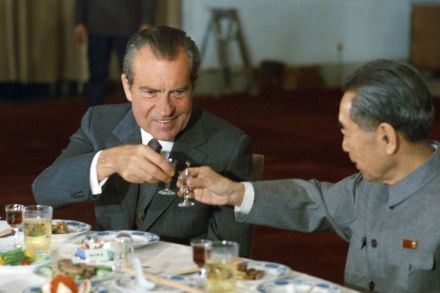
Richard nixon

Housing with Hamadeh

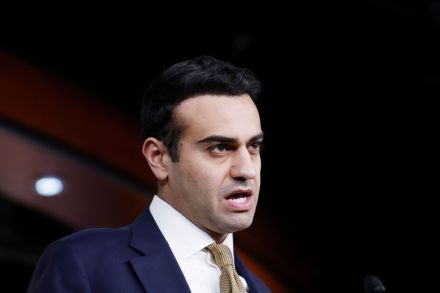
Abraham Hamadeh, a Republican congressman from Arizona, has reportedly been living with one of his male staffers, according to Juliegrace Brufke’s Sources Say News. The staffer, Will Hannen, now runs Hamadeh’s campaign. In recent weeks, Hamadeh’s team posted glamour shots of his office on Instagram where staffers sit and stand in staggered formation, like the cast of The West Wing, if they were House Republicans. At least one “looksmaxxing”-inspired video was posted featuring Hamadeh and his team titled: “Professional looksmaxxing office!” On the subject of Hannen being a live-in staffer, Hamadeh spokeswoman Lori Hunnicutt “denied the relationship was romantic, telling Sources Say News: ‘The Congressman and Mr.

abraham hamadeh
donald trump

Is Trump’s quest for peace doomed?

J.D. Vance jokingly compared himself to Richard Nixon yesterday. "Young senator, vice president, writes some bestselling books, is hated by the media... kinda sounds like J.D. Vance," he said at the Richard Nixon Library and Museum in Yorba Linda, California. "I’ve always liked Richard Nixon." At the same time, 8,000 miles away, in the Strait of Hormuz, Iranian forces struck another ship, further undermining what critics have called "the Vance deal" – the "Memorandum of Understanding" between Tehran and Washington. And that suggests, at a foreign-policy level, the Nixon-Vance parallel is more apt than the 50th Vice President realizes. Of course, Nixon was Commander-in-Chief and Vance is not. And the Vietnam War is very different to America’s current fight with Iran.

Why the Republicans are still more focused than the Democrats

The pundits and political professionals of Washington, DC have never had a very good understanding of the Republican party. They hate its conservative and populist elements, and they only know how to evaluate the prospects of those elements using irrelevant criteria, like a chess club judging a basketball team – only it’s the political right that’s more cerebral than the dead center. It doesn’t matter how many times the conventional opinion is dead wrong. The Republican right was supposed to be humiliated, broken and vanquished for good after Barry Goldwater’s landslide loss to Lyndon Johnson in 1964. And then again after Richard Nixon resigned in disgrace a decade later. Donald Trump, of course, was totally unelected in 2016.

republicans

Trump: the boy who cried war

From our UK edition

Did Donald Trump ever intend to obliterate Iranian civilisation?  Some will see the past week as one in which the world pulled back from the brink, when an unhinged US president experienced a rare moment of lucidity at the last crucial minute. Trump’s oscillation is, his defenders argue, the ‘madman theory’ in operation. This was the name given to the approach employed by Richard Nixon in Vietnam, when he tried to persuade the North Vietnamese that he had become so unstable he was capable of just about anything – nuclear annihilation included. Nixon believed his foe would have no option but to come to the negotiating table. Trump has succeeded in convincing many western commentators that he is genuinely on the point of lunacy – heedless of slaughter.

The deep state vs Nixon

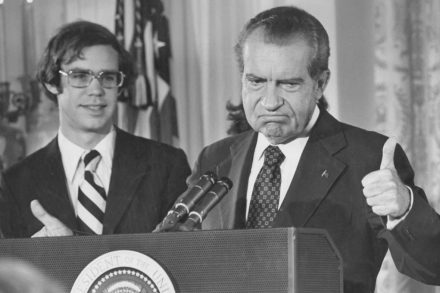
Americans took a break from their partisan vituperation in February to mull over newly revealed testimony that Richard Nixon gave to grand jury investigators in 1975, a year after the Watergate scandal drove him from power. James Rosen, a veteran Washington journalist and the biographer of Nixon’s attorney general John Mitchell, revealed the episode in the New York Times. Nixon had argued that his program of wiretaps had been made necessary by another spying operation that senior American military commanders were carrying out against him and his top aides.

nixon

The redemption of Richard Nixon

In the last five years of his life, when I knew Richard Nixon, nothing described him better than Milton’s “calm of mind, all passion spent.” During the most tumultuous political career in American history he had come back many times, but the greatest comeback of all was in full swing. His enemies had seized control of the puritanical conscience of America to slay him, unjustly, and he was manipulating the same national conscience, which was founded on Plymouth Rock and has survived all the corruption and hypocrisy and violence of American public life, and when aroused, is insuperable. Since his political fall, and later his death, polls increasingly indicate public unease about the treatment of Richard Nixon.

How to lose friends and alienate people

After two deadly shootings in confrontations between Donald Trump’s Immigration and Customs Enforcement agents and the activists obstructing them, Minneapolis was starting to remind people of Kent State. By “people” we mean progressive baby boomers, inclined to make the Vietnam War the measure of all things. For them, the massacre of four student protesters by a nervous detachment of Ohio national guardsmen in 1970 alerted parents to the war’s inhumanity. It started the groundswell against Richard Nixon that would force him to exit the war three years later – and the White House the year after that. The analogy is a bad one. Trump’s position differs a lot from Nixon’s. It’s stronger politically.

‘I could turn very nasty – I was an egotistical brute’, says Anthony Hopkins

From our UK edition

It’s a good job Anthony Hopkins is only an actor, as think what he’d be like as a dictator or grand inquisitor. ‘I could turn very nasty,’ he tells us in his memoir. Doing National Service: ‘I was beginning to enjoy the fisticuffs in my life.’ Encountering a Scotsman: ‘I felt a surge of hatred and anger. I head-butted him and smashed his nose so hard I heard it crack.’ To a director who’d annoyed him: ‘Learn some manners... or I’ll change the shape of your face.’ Mickey Rourke was told: ‘Touch me like that again and I’ll smash your face right into the back of your head.’ Hopkins is a nasty piece of work, and proud of it. He calls himself ‘a vindictive, cynical, insulting, horrible man’, adding for good measure: ‘I was an egotistical brute.

A short ****ing history of presidential swearing

On Tuesday, President Trump dropped a bomb – not a bunker-buster but the F-bomb. Talking to the press about Israel and Iran, he said, “We have two countries that have been fighting so long and so hard that they don’t know what the fuck they’re doing.” There is a lot to say about this statement – starting with the implied moral equivalence between the two countries. But let’s focus on the F-bomb. Has a president ever before used this word in public? Used it deliberately, in a public statement? Trump seems to have recorded a first. Plenty of presidents have had salty tongues. You may know a story about Harry and Bess Truman. It is quaint now. There are several versions of this story, but, essentially, it goes like this. Mr.

nixon swearing

Who started the Cold War?

From our UK edition

Over a few short months after the defeat of Nazism in May 1945, the ‘valiant Russians’ who had fought alongside Britain and America had ‘transformed from gallant allies into barbarians at the gates of western civilisation’. So begins Vladislav Zubok’s thorough and timely study of the history of the Cold War – or, as he nearly entitled the book, the first Cold War. For the themes that underpinned and drove that decades-long global conflict – fear, honour and interest, in Thucydides’s formulation – are now very contemporary questions. ‘The world has become perilous again,’ writes Zubok, a Soviet-born historian who has spent three decades in the West: Diplomacy ceases to work; treaties are broken. International institutions, courts and norms cannot prevent conflicts.

‘I had two jobs: to run the country and to survive’: an interview with President Trump

From the moment you enter Donald J. Trump’s Oval Office, you are surrounded, not by staff or Secret Service, but by presidents. In his second term, he has chosen to envelop himself in Americana to an unprecedented degree. He faces Franklin D. Roosevelt whenever he sits at his desk. Looking back are Teddy Roosevelt, Lincoln, McKinley, Polk, Jackson, Jefferson, and alone among them as a non-president, Franklin. Ronald Reagan looks over his shoulder for every decision he makes. “We took them out of the vaults. We have incredible vaults of things,” he tells me. “They have 3,900 paintings.” It’s a roster of the greatest American leaders assembled in an oval around him in their most sterling depictions. They serve as motivation.

My ringside seat at the Nixon resignation melodrama

From our UK edition

American politics seem particularly febrile in 2024. The sitting President has withdrawn from the election, days after his predecessor was shot campaigning at a rally in Pennsylvania. But American democracy is by nature restless and tumultuous. It’s worth remembering that 50 years ago this week, Washington was in turmoil over the question of whether Richard Nixon was going to resign. Those early days of August 1974 seem like yesterday to those of us who became swept up in them. At the time I was a 31-year-old MP, five months into my first parliamentary term as an opposition backbencher. My summer recess took me to the home of a hospitable Anglophile hostess in Georgetown.

Why America has more lawyers per capita than any other country

Despite the sharp polarization of American politics, there is surprising agreement on what went wrong with capitalism. Whether the writer or politician is coming at this question from the left or right, the blame often falls on four decades of “small government” ideology and free market orthodoxy since Ronald Reagan and Margaret Thatcher. Whether the flaw in question is slowing productivity growth, the rise of oligopolies, the export of jobs, or income and wealth inequality, its source is traced to excessive faith in the “magic of the market.” Capitalism’s flaws are “market failures.” The problem: this narrative is wrong on the facts.

lawyers

Republicans can’t figure out Kamala

Welcome to Thunderdome. The essential divide between Republican insiders on how to attack Kamala Harris is stuck, swinging back and forth between the question of inauthentic climber or authentic leftist. Is she an untrustworthy chameleon who was against fracking before she was for it? Or is she a San Francisco Democrat elitist who was the furthest senator to the left? When the George W. Bush re-elect had to tangle with John Kerry, they went the unreliable flip-flopper route — something Chris LaCivita is very familiar with as the then-media advisor to Swift Boat Veterans for Truth — to great success.

Biden and Nixon: presidential history is repeating itself

One of the advantages of not having been born yesterday is the ability to recognize certain trends of the news cycle when they come around again. Am I alone in thinking that every major American political manifesto since about 1848 has made a promise of reducing the taxation burden on its hardworking citizens, for example? Or that for Brits, like me, of a certain age (sixty-eight), our whole lives have been spent in the shadow of a stale and still unresolved debate about the nation’s place in Europe? More recently, I was struck by a sense of déjà vu all over again when comparing the final meltdown in Joe Biden’s White House to the events preceding Richard Nixon’s departure from office fifty years ago. The case for presidential history repeating itself isn’t hard to make.

nixon 1974

Pat Nixon, ambassador of goodwill

The Watergate scandal already commands a wide bookshelf. In the fifty years since Richard Nixon fell on his sword, we’ve had the big-ticket books by the tag-team of Woodward and Bernstein, and others, by contrast, seeking to exonerate Nixon and pin the whole thing on his adversaries; tales about secret sources and White House interns and plucky whistleblowers like the oleaginous John Dean and that human hand grenade Martha Mitchell; not to mention self-serving memoirs from all the principals, some now on their second or third helping at the table; or the ones saying it was all a conspiracy involving an unholy alliance of the FBI, MI6 and KGB, with the little green men from Mars thrown in.

Pat

Republicans show their fecklessness with Mayorkas

What is decadence? In popular usage, it is synonymous with “excess,” especially of a sensual or appetitive nature. I am not sure what it means that we encounter the word most often these days in connection highly caloric chocolate confections. Perhaps such linguistic degradation, in which serious things are reformulated in an atmosphere of ironic depreciation, is one sign we live in a decadent age. In any case, at its core I believe that decadence has less to do with excessive consumption or sensuality than with ontological attenuation.   What does that pretentious mouthful mean? It means that decadence is essentially about the hollowing out of vital institutions, not their surrender to gluttony, lust and profligacy.

mayorkas house republicans

Was China’s economic boom ‘made in America’?

From our UK edition

53 min listen

Today, the US and China are at loggerheads. There’s renewed talk of a Cold War as Washington finds various ways to cut China out of key supply chains and to block China’s economic development in areas like semiconductors and renewables. There’s trade, of course, but the imbalance in that (some $370 billion in 2022) tilts in China’s favour and only serves as another source of ammunition for America’s Sinosceptics. China, on the other hand, is also decoupling in its own way, moving fast to cut its reliance on imported technology and energy. At this moment, it seems like US-China tensions are inevitable – but look into the not so ancient history, and you’ll find a totally different picture.

A potted history of impeachments

Article II, Section Four, of the Constitution provides that “The President, Vice President, and all civil Officers of the United States shall be removed from Office on Impeachment for, and Conviction of, Treason, Bribery, or other high Crimes and Misdemeanors.” Other sections give the House of Representatives the sole power of impeachment and the Senate the power to try impeachments and to convict with a two-thirds vote of senators present. But impeachment has been very rarely used in this country. Indeed the House has voted to impeach a federal official only twenty-one times in the 234 years the Constitution has been in effect.  No official has ever been accused of treason and only three of bribery, all federal judges.

impeachment

In praise of Mike Pence

Mike Pence was never likely to win the Republican nomination for president, and today he recognized the inevitable. He withdrew from the race. Now is not the time to focus on why his candidacy never gained traction. It is the time to remember his great contribution to our nation on January 6, 2021. On that fateful day, Pence did the right thing, despite enormous pressure from Donald Trump and a rioting mob to do the wrong one. He resisted that pressure at great risk to his political future and personal safety. He deserves our praise and gratitude. On January 6, Pence was presiding over the Senate as the electoral votes for president were counted. The duty was a limited, constitutional role assigned to the vice president.