
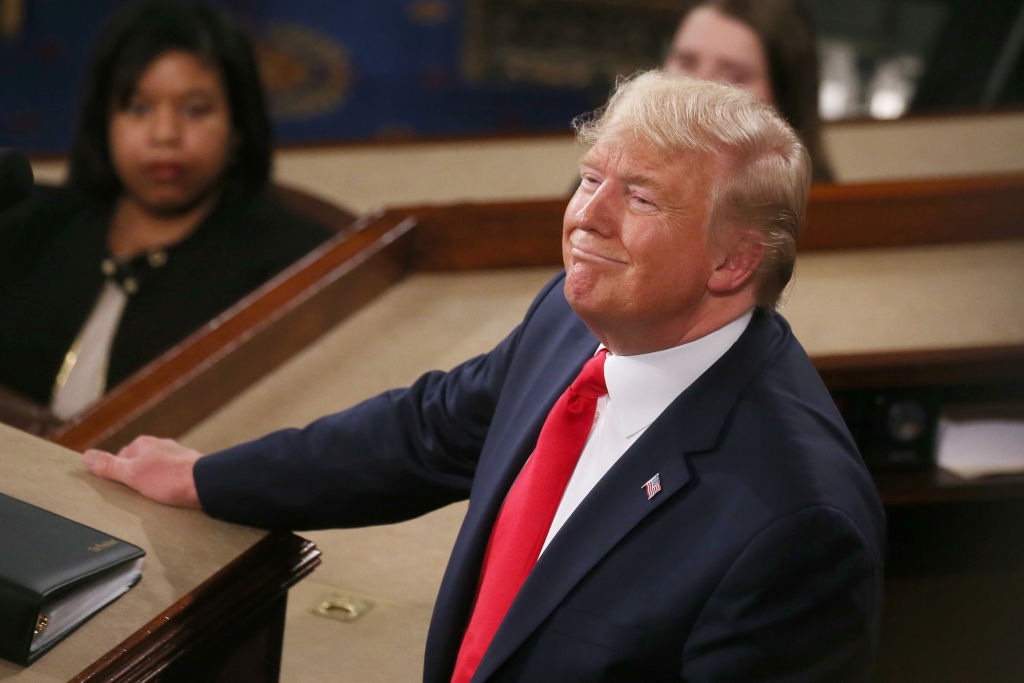
When President Trump speaks to Congress and the nation Tuesday night he will follow several familiar tropes. Like a long line of presidents before him, Trump will say the state of the union is great and take full credit for it. They all say that, unless we are in a recession or at war. They typically add that everything is getting better, too, thanks to their wise policies. In a nod to the next election, they warn voters that the only thing stopping our country from reaching even greater heights is the mule-headed opposition of the opposing party and a few Supreme Court Justices.
What differs each year are the specifics. This time, Trump is likely to focus on three topics that will move voters this November: the economy, including jobs, taxes, and inflation; illegal immigration; and Iran.
The economy dominates voters’ choices in every election. Recent polls show voters feel uncomfortable despite slowing inflation and GDP growth of well over 3 percent. Good as those macro numbers are, average Americans just aren’t feeling it. Unless that gloomy mood lifts by summer, Republicans will face a fate worse than the normal mid-term losses for the party in power.
Why the gloom? Three reasons stand out. First, consumer budgets are pinched. Trump would be wise to drop his previous efforts to tell people they aren’t feeling it. They know what they feel.
A far better approach is to emphasize that his policies are working, that voters will see their positive effects clearly in coming months, and that these policies are digging our country out of problems created by Democrats, who will only repeat their failures if they return to power. He will undoubtedly point to President Biden’s record of high inflation and slow income growth.

But voters are far less interested in that backward-looking blame game than in forward-looking policies that will lift them out of those troubles. Trump could tag Biden with those problems during his first year back in office but that “sell-by” date has now expired. It’s time to move on.
Voters want solutions they can feel. What Trump can say, without his usual hyperbole, is that he has already brought down inflation and raised incomes in real terms. That means real incomes are rising, though not dramatically, and it means prices are becoming more affordable. Some, like gasoline, have dropped significantly. The lingering problem, the one many voters feel, is that their budgets are stretched thin, their credit cards are maxed out, and their jobs are insecure in a rapidly-changing economy.
The second, major economic problem is that younger voters face high hurdles buying their first homes. That’s a crucial step in family formation, and their frustration readily turns into anger at the ballot box. Trump needs to say how his policies will help.
There are several dimensions to the “housing affordability problem.” None have simple solutions. One is that potential buyers are already saddled with lots of debt, some from old student loans and some from high-interest credit cards. Trump’s idea of capping credit card interest rates is dreadful, and he seems to have dropped it. Good. Government price fixing never works. In this case, it would effectively cut off credit to all but a sliver of consumers with high credit ratings. Others, with lower scores, aren’t worth the risk because the payoff is lower.
There are a myriad of other housing problems, too: restrictive zoning, slow-moving local regulations, and high construction costs, compounded in some cases by tariffs. Sales by older homeowners, who want to downsize, are limited because they want to avoid capital gains on what is essentially monetary inflation. That is, the real, inflation-adjusted price of the house hasn’t changed, but they have to pay taxes on the nominal increase. Other homeowners would move if they could carry their old, low-interest mortgages to another property instead of paying much higher rates after moving.
Trump could tag Biden with various problems during his first year but that “sell-by” date has now expired
That brings us to the biggest problem in the current housing market: high mortgage rates, mostly a lingering consequence of Biden-era inflation. Those rates are starting to come down, along with inflation, but they are still a major obstacle for homebuyers.
Trump’s best sales pitch here is to stress his proven success in curbing inflation, which should lead to lower mortgage rates. He will undoubtedly couple that positive story with his familiar attack on Jerome Powell, the outgoing chairman of the Federal Reserve Board, whom Trump blames for keeping interest rates too high, too long.
The third reason for economic gloom – and the least tractable – is rapid technological changes. The good news is that they are increasing productivity and incomes, making the country much richer. The bad news is that they are creating troubling uncertainty among workers at every level in every occupation. Many workers worry, with good reason, that the swift growth of artificial intelligence and highly-mechanized production could swallow their jobs. It’s hard for them, or for anyone, to know what kinds of jobs will be created by AI and automation, where they will be located, what they will pay, and what skills are needed to fill them.
Trump’s likely response will be to stress the good macro news: his track record of strong economic growth, the surge of foreign investment coming into America, thanks (he will say) to his tariffs and trade deals, his deregulatory agenda, lower energy prices, and, of course, the tax cuts and refunds voters will soon see from the “Big Beautiful Bill.” Democrats will respond by emphasizing income inequality and “affordability.” Neither party will talk about the mammoth national debt, which keeps piling up with no end or solution in sight.
Turning to illegal immigration, Trump will stress the border he closed, contrast it with the Democrats’ failure, and point out that Democrats consistently lied to the country by saying the border was closed when they knew it wasn’t. Trump can add some new policies to crack down on illegal immigrants driving big-rig trucks. And he will undoubtedly note that a closed border has made drug- and sex-trafficking much harder and lowered national crime rates.
Alongside that positive news, he needs to address the policy that has tanked his popularity on immigration issues. The public is deeply concerned about violent street clashes like those in Minneapolis, and they are torn about deporting non-violent aliens, despite their illegal entry. Trump was smart to reduce the tension in Minneapolis by sending in Tom Homan. He can also highlight the administration’s success working with cooperative cities like Memphis, a sharp contrast to “sanctuary cities.” In short, he needs to underscore the policies the public likes (closing borders, deporting violent criminals, and reducing cross-border drug trafficking) and downplay the unpopular ones, which have cratered his popularity.
On the international front, Trump will undoubtedly emphasize the administration’s extraordinary success in capturing Nicolas Maduro and gradually moving Venezuela from an enemy to a friend. He might point to his efforts to make similar inroads in Cuba, where we are using economic pressure to effect change, or so we hope.
The most pressing foreign issue is, of course, Iran. The President has prepared the US military for war. A vast armada has moved into theater and is ready to attack. But he hasn’t prepared the public. He must do that in the State of the Union. President Trump needs to lay out his aims and explain why they are in America’s interests, despite the costs and risks associated with any military action. He needs to stress that he tried to achieve those aims by negotiation but that Iran refused to make essential concessions. That explanation would be important before any military undertaking. It is especially important for Trump because he ran on a platform of avoiding foreign wars and managed to do so in his first term.
Trump surely knows that his administration could sink under the weight of an unsuccessful military action, particularly one in which American troops were killed. By now, he knows Iran’s Islamic regime has no interest in giving up its crown jewels: its nuclear weapons program and the missiles to deliver them and conventional explosives. If negotiations fail, or achieve little more than a pause in Iran’s malign activities while leaving the regime in place, as seems likely, Trump will face the most difficult foreign-policy decision of his presidency. Before he makes it, he needs to bring the public along with him. That is his most important task on Tuesday night, when he speaks to the nation and the world.


Comments