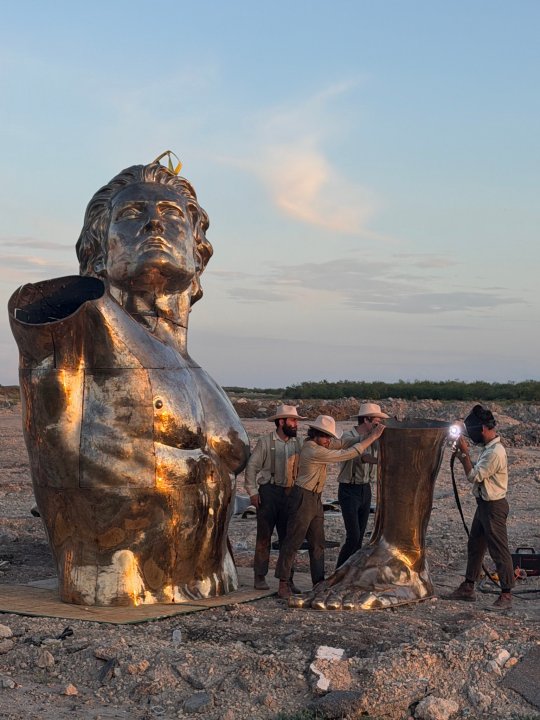
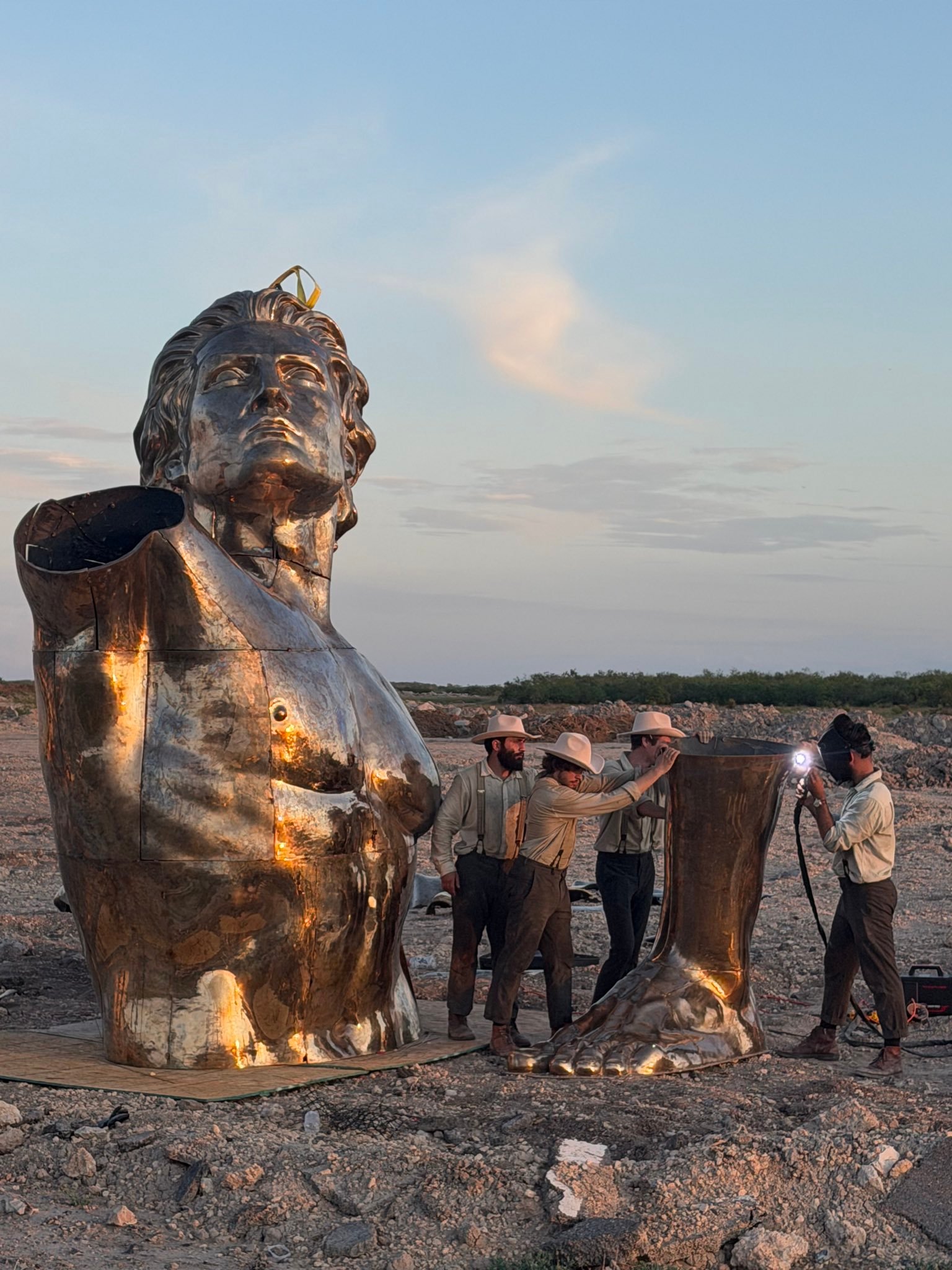
It averaged a brutal 91 degrees this week in Cameron County, the southernmost tip of Texas, and a group dressed as the cast of O Brother, Where Art Thou have been there sweating away at something big. A colossal limbless torso is parked on the dunes and a head, suspended from a crane, is swaying very gently in an ocean breeze. There is the smell of metal and hot dust.
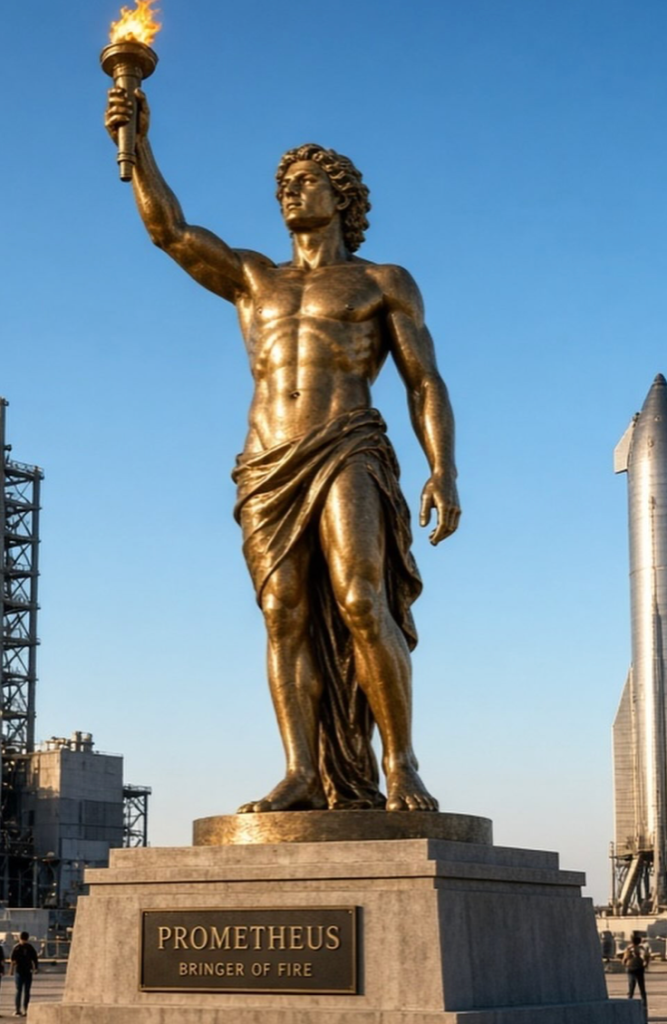
Pending some finishing touches and last-minute dabs of glue, this Atelier Missor’s Prometheus, soon to be unveiled at SpaceX’s Starbase launch site – standing contrapposto, torch aloft, bidding the rockets a comradely “Adieu!” It is Prometheus who gives the gift of fire, and thus technological civilization, to man, and so it is to him that we owe stainless steel, the internal combustion engine, the nuclear bomb and, in a roundabout way, Elon Musk.
A grabby attitude to money seems to be the common thread
The statue is big. Very big. Very very big. But things are not quite as they should be. Initial plans for a 65-foot Prometheus in titanium have been reduced to a more modest 50 feet and a respectable, third-place bronze. Worse, the head does not sit quite flush with the neck, drawing a long gash right across the jugular, and a patchwork construction of welded sheets draws undue attention to the fact that it is hollow. The titan has the look of an inflatable; he is so obviously empty. The body is weightless. The face is faceless. The eyes are mute. Even at 50 feet tall Prometheus is set to look strangely vulnerable. I (who come knocking on the door of five foot eight and a half in a new pair of brogues) feel quite confident that, should my shoelace ever get snagged under his foot, I could tilt him an inch off the ground by pressing my shoulder against the ankle and set myself free with relative ease. I imagine a Giacometti falling over makes the sound of a church bell striking one in the morning; Missor’s Prometheus falling over makes the sound of a rollercoaster accident.
Who is responsible for this clumsy giant? Who, or what, is Atelier Missor? Founded after the eponymous Missor Movahed received a vision of Napoleon while drifting about the Place Vendôme, Atelier Missor is a foundry dedicated to the revival of Classical sculpture at grand scale. They have not been without success: previous commissions include a Hercules for the city of Rueil Malmaison, a Joan of Arc on horseback for Nice, along with a stern-faced Napoleon not yet installed. An earlier version of their website positioned all this more-or-less explicitly as a response to the toppling of public statues back in the heyday of BLM (“It was this ingratitude that filled me with such contempt…”), though the current version is rather less dour, more optimistic: “Gigantic titanium statues will lead us to a beautiful future.” We are met with a collage of AI videos of towering Prometheuses amidst bustling, neoclassical megacities, crisscrossed by high-speed rail.
The outlook is well-summed up by a semi-recent post on X: “We don’t believe we can craft statues more beautiful than Greek statues. But we can make them larger.” Scrolling through their profile, we see a lot of lines like this one, a lot of job listings (the outfit seems perpetually in need of more welders), and a lot – a lot – of the phrase: “We are seeking investors.” Atelier Missor has not set out to contribute anything novel, aesthetically speaking, to the development of Western art, nor do they pretend to. They have set out to procure huge amounts of money, seemingly from the tech world (hence the move to San Francisco), to fund replicas of Greek sculpture that will be bigger and shoddier than anything mankind has yet seen.
A grabby attitude to money seems to be a common thread among the cast of rude mechanicals who make up the emerging right-wing art scene. Mæcenat Gallery, representing a number of these figures, is the prime example; the Twitter feeds of both the gallery and its artists are full of indignant demands for a stable of Lorenzo di Medici figures to step forward and bankroll their careers. The “About” section of the website, jam-packed with airy Roger Sruton-isms about “the good, the beautiful and the true,” tells us the name comes from Gaius Cilnius Mæcenas: “a Roman statesman who used his private fortune to support Virgil, Horace, and the other poets of the Augustan age.” A seductively flattering comparison for the potential customer, and an even more flattering comparison for the artist. The “æ” ligature is used, they explain, as a “symbol of the partnership between Artist and Endower.” What is not explained is the -at ending, which, in Latin, would suggest a verb rather than a noun. We can roughly translate that verb in its usage here as: To give me money. “-At” would be the third person singular ending, as in: “He/She/It gives me money.”
Artists expecting to be compensated for their work is not unreasonable but the hyper fixation here is, frankly, unattractive – if not inexplicable. The logic seems to be something like this: the contemporary art establishment, which skews politically to the left, comes armed with its own set of wealthy donors, endowments and trusts, and until artists on the right can muster their own equivalents, the dictums of postmodernism and abstraction will rule the day. In this, they are perhaps the first movement in the history of art which has decided how it would like to be financed before it has decided what exactly it is going to make.
Fen de Villier’s sculptures clearly draw from the Italian Futurists, while William Paquet opts for a more conservative, naturalistic style, with a Gothic inflection inspired (and this is admitted quite freely) by comic books. Over in the painting section, there is a fine selection of the perfectly pleasant, ice-cream colored pictures you find in the provincial galleries of seaside towns, along with nods to Klimt and German New Objectivist painters like Christian Schad from Zach Brown and Damian Chávez. Moving on to photography, Ethan Clay’s “New York No. 2” (a lone balloon drifting over Hudson Yards) reminded me, for the first time in years, of a black-and-white photo of Paris the landlord had up in my old apartment which I threw out immediately upon moving in, resulting in a £25 deduction from the deposit. Had it been one of Clay’s, that little indiscretion would’ve set me back £1,250. That price does not include a frame. Which is ironic, because it does look very much like the sort of picture which comes, whether we like it or not, with the frame.
Beyond a vague preference for Classical subject matter, we cannot discern across this portfolio any sense of what a 21st century right-wing art might look like, what principles it holds to, what it has to offer us beyond alternating forms of pastiche. Mæcenat asks us to become “patrons of the good and the true,” to which we can say with Pilate: “What is truth?”
Am I being mean? When you ask for money in such pompous, insistent terms, on the basis that our refusal to do so is all that stands between you and the art world’s dashing rescue from the jaws of woke, you invite people being mean. Whether they find it or not, the model of patronage they are after is a bad one. Our patron class today are not quite so refined as those of the Quattrocento, and when buyers are not buyers but philanthropists championing a pet cause or a fad, art naturally drifts in the direction of their tastes and their politics. It is not the model that gave us Manet, Giacometti and Francis Bacon; it is the model that gave us Banksy and Damien Hirst, and it is also the model that explains why Missor’s Prometheus so perfectly embodies the shallow, flashy approach to Classicism of Elon Musk – a man who has vowed to produce a full-length feature film of The Odyssey generated entirely by AI.
In either case, I suspect the tech money is going elsewhere. The young San Francisco millionaires have decided what kind of art they like already, and it’s not exactly “art” at all. The new high-ticket items at the auction rooms are dinosaur bones and sports memorabilia. Ways of putting something very showily expensive in your living room without having to pretend to dinner party guests that you know or care about high culture. This year, Sotheby’s sold Jalen Brunson’s Game 1 Knicks jersey from the last NBA Championship for $1.024 million, and a T. rex specimen nicknamed “Gus” for a record breaking $50.1 million. The buyer has remained anonymous, but CEO Charles Stewart guesses it’s “SpaceX to T. rex.” Per Atelier Missor’s price-list, that’s enough for 50 Prometheuses at 30 feet a piece, or 10 Prometheuses at 100 feet. Bulk order discounts may apply.






Comments