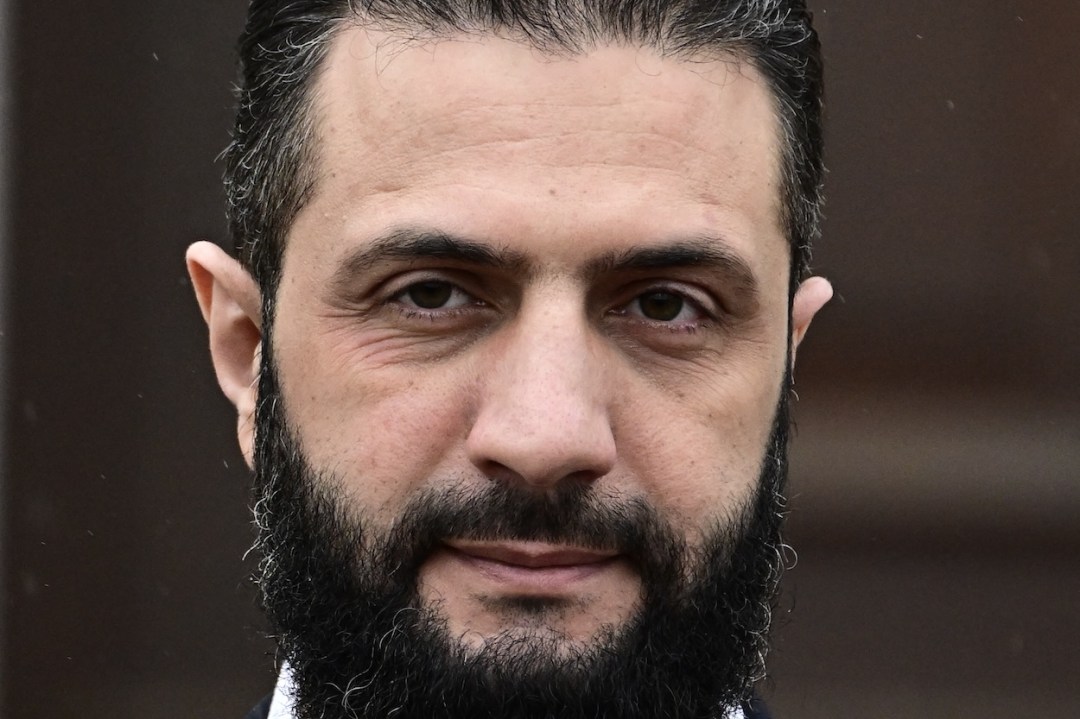
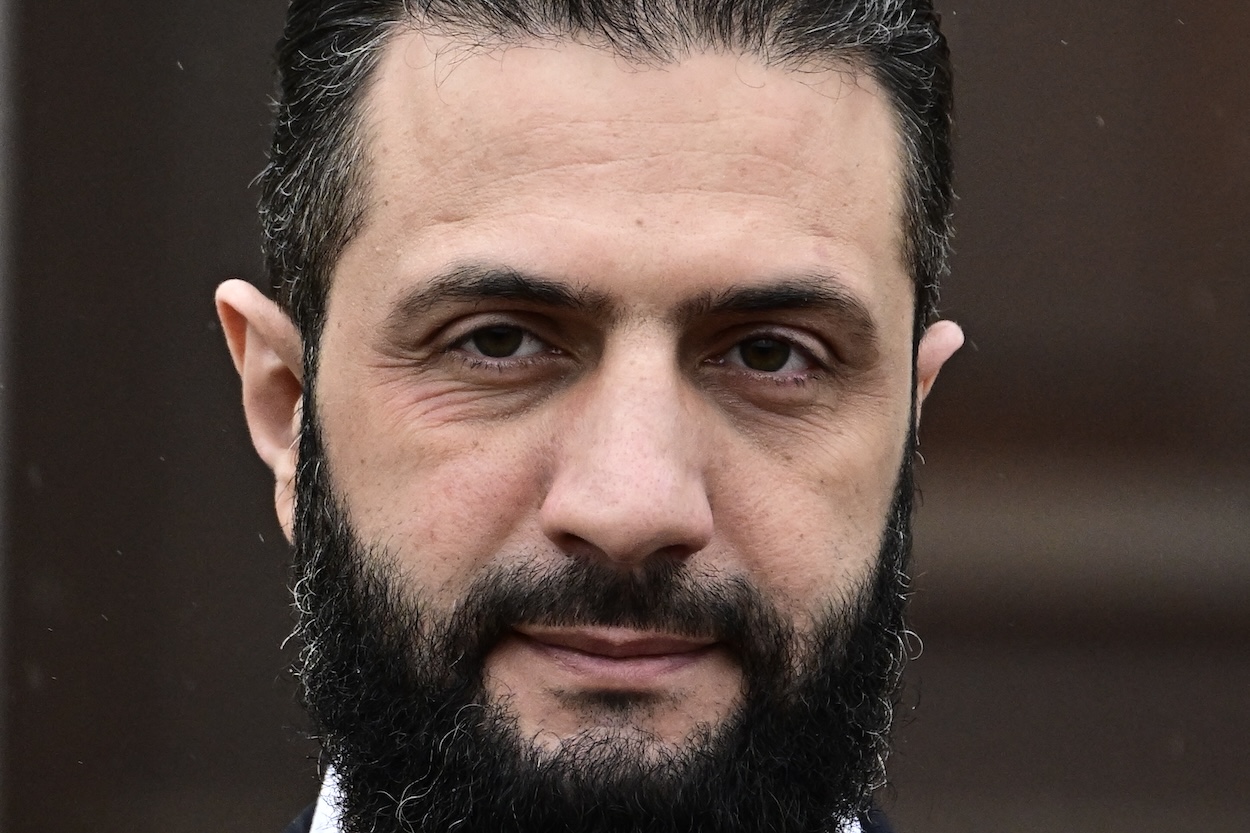
Trump’s Middle East tour in May last year felt like the end of an era. Here was the former al-Qaeda commander, Ahmed al-Sharaa, now leader of Syria, shaking hands with a vulgar American Commander-in-Chief, who resembles the caricature of a US president we might find in an al-Qaeda cartoon. Yet the War on Terror’s two leading men, the President and the Jihadi, having ended the last act at each other’s throats, have returned to the stage arm-in-arm to take a bow.
Al-Sharaa has trimmed his beard, put on a suit, replaced Bashar al-Assad as president and begun welcoming western investors to help him rebuild his country after a decade and a half of civil war. Trump has dropped the showy religiosity and moral posturing of his predecessors. Before the Iran ceasefire, Trump had told us openly that his motives for starting the war were straightforwardly material: “To be honest with you, my favorite thing is to take the oil.” Now, in part to snub Israel, he is asking al-Sharaa to take the fight to Hezbollah in Lebanon, something the Syrian leader has rejected. But that request is itself a sign of how much the relationship between the West and the Middle-East has changed.
The received wisdom from our intellectuals when it comes to political Islam leaves little room for him
If al-Sharaa has remained somewhat of an enigma to commentators in the West, it is in part because the received wisdom from our intellectuals when it comes to political Islam leaves little room for him. According to the view put forward by the documentary maker Adam Curtis and the popular left-wing philosopher Slavoj Žižek, Islamism, of the Salafist type that al-Sharaa belongs to, was born of a Middle East “exposed to western modernization abruptly, without a proper time to ‘work through’ the trauma of its impact.” Political Islam then emerges as a kind of group neurosis, in response to various abstractions such as “atomization” and “individualism.” We hear a lot of the phrase: “crisis of identity.”
Perhaps that says less about Islam than it does about us, perhaps it is really a projection of the western psyche, since this is exactly the worldview shared by virtually everyone in our own politics, from J.D. Vance through to Keir Starmer: that modernity is inherently “traumatic,” a force for alienation, a disruptor of “the social fabric;” that the internet has made us dumber, and it’s time to put the phones away.
But the pop-psychoanalytic is an inadequate explanation either of Ahmed Al-Sharaa’s program or of the phenomenon of political Islam in the late 20th and early 21st centuries. Political Islam has positioned itself principally as an anti-corruption movement, tentatively aligned with the Arab Spring, particularly as against the kind of nepotism, state thuggery and patrimonialism that came out of the secular Ba’athist regimes of the mid 20th century.
In his 2011 “Message of Hope and Glad Tidings for Our People in Egypt,” al-Qaeda emir Ayman al-Zawahiri speaks only of the corruption of the Mubarak and Ghaddafi governments; vagaries such as “atomization” and “the social fabric” don’t feature. This is precisely how Islam from its earliest days has understood its political role, as a rationalizing force come to set in order a world beset by cronyism, superstition, and the kind of clannish familial loyalties that Middle Eastern governments such as Assad’s have so often been built upon.
Al-Sharaa, previously known as al-Jolani, had been serving as the de-facto governor of Syria’s Idlib region, under the control of the HTS rebels’ Syrian Salvation Government. The period gives a slightly different picture of what life under an Islamist paramilitary group than we might expect. While it’s occasionally been said that al-Sharaa’s self-presentation – as the more western-friendly, more moderate face of political Islam – has been invented only upon his seizing control of the country at the end of 2024, the shift lies much further back.
It was his sense of moderation that, before the two parted ways in 2013, led one worried advisor to ISIS leader al-Baghdadi to write of the Syrian commander, with equal parts reverence and suspicion: “Your situation with al-Jolani is like that of Saladin with Nuradin.” This was alluding to Saladin’s initial reticence to crush the Shiites in Egypt, against the advice of his hardliner mentor – just as Jolani had ignored instructions, as he would complain of his ex-bosses in an 2021 PBS interview, for “an expansion of the sectarian warfare.”
Jolani’s unchallenged rule in Idlib did not involve a ban on smoking or mandatory veiling for women. In the address he gave in April 2023, he asserted that the right to prohibit belongs to God alone, and where there are differences of opinion between jurists, it is not for the state to intervene: “a swordsman at the door [of the court] is a dwarfing of Sharia […] we do not want a hypocritical society.” He did, however, thanks to a deal with Turkey, provide round-the-clock electrical power, after six years of rolling blackouts. He also, in a strange move for a rugged religious-fundamentalist warlord, built two swanky new shopping malls near the Northern border, the al-Hamra and al-Zahrawi markets.
When protests broke out across Idlib calling for him to be ousted, al-Jolani made a characteristically pragmatic compromise with his detractors, and opened an official Board of Grievances in July 2024 to hear their complaints; first among those complaints, naturally, was that the entire board was staffed by his lackeys and would not hear a word against him – a valid complaint, no doubt, though not a complaint that would matter for very long, because by the end of that year he would be ruling from Damascus.
Watching the way he has governed the country since, the pattern has remained very much the same; a reticence towards morality policing matched with an unwavering drive to develop. A proposed ban on alcohol in all but the Christian neighborhoods of Damascus last March was swiftly abandoned, following protests from the locals – in part because singling out the Christian neighborhoods threatened to render them targets for terrorism. The government response: “These areas are considered part of the beating heart of the capital […] The Governorate will reconsider the decision in a way that does not offend any of its constituent groups.”
Al-Sharaa has managed to keep his country out of the war with Iran, and provocations along the southern border from Israel have been left broadly unanswered. The remnants of the old Assad regime, however, have not gotten off so lightly. The remains of the Assad-era narcostate, the Captagon cartels that operate out of the country’s southern region, have also been brought to heel.
There are, let us hope, children born in Syria today who will grow up in a country very unlike the one their parents have known
Arguably, none of this quite settles the question of exactly what kind of state al-Sharaa is looking to build. His critics have pointed to HTS’s unsavory origins, the concentration of power around the Presidency, and, given the spate of persecutions (albeit carried out against al-Sharaa’s orders), the precarious position of Syria’s religious minorities. Those criticisms, while not unfair, sit a little awkwardly against the record of material gains already won by al-Sharaa over the course of his short tenure.
After 15 years, Mastercard works in Syria again. Some $14 billion has been secured for the renovation of Syria’s main airport, and for the construction of a metro system in Damascus. This May, the Syrian Investment Authority laid the groundwork by which it will allow foreign partners to assist in developing its state assets, and began pitching in London and Dubai. This year, for the first time in its history, Syria will attend the G7 summit. In the budget released by al-Sharaa in March, government spending had reached $10.5 billion, triple what it had been the year prior, thanks to GDP growth of 30-35 percent; about $3 billion of that will go on infrastructure. As Trump said of al-Sharaa following their first meeting just over a year ago: “He’s a young, attractive guy, a tough guy [with a] strong past […] He’s got a real shot at pulling it together.”
For those of us in the West, Jolani might signify something else. Here is a man who spent a decade and a half risking death, who betrayed orders from ISIS and lived with a $10 million bounty on his head in the hope of rescuing his country from the grip of a corrupt, nepotistic, gerontocratic regime. Because of him, there are, let us hope, children born in Syria today who will grow up in a country very unlike the one their parents have known. For their sake, no matter how uncomfortable his past might make us, we should hope he succeeds.
And we should hope so too because, if he does, it will be proof to us in the West – so often told that history is made by faceless socio-economic factors, that our politicians are paralyzed by telluric, impersonal forces like the bond markets or the “deep state” – that the ambition, cunning and clarity of purpose of one man are still enough to move the needle.



Comments