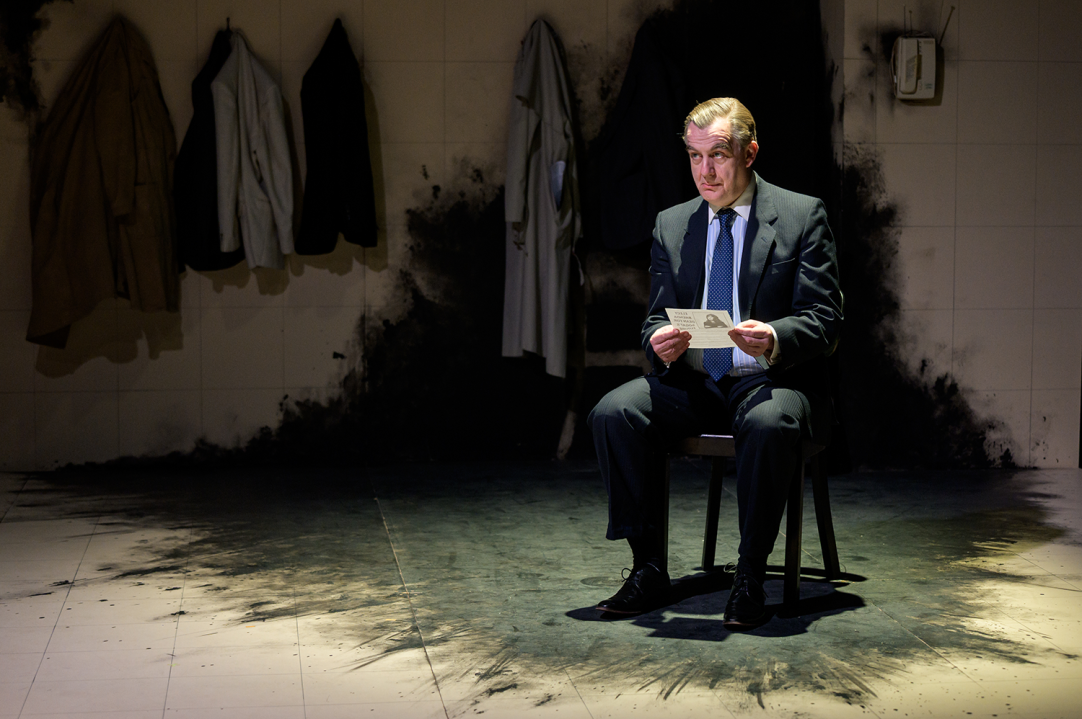


In The Print is a docudrama about the bitter war between Rupert Murdoch and the unions in the mid-1980s. Murdoch was determined to computerise the production of his UK titles and to terminate the far left’s stranglehold on his business. Daily papers are vulnerable to last-minute strikes and his thieving employees made no secret of their larcenous tactics. The print workers, known as ‘inkies’, earned £1,000 a week for 16 hours’ work and their union, Sogat, behaved like a bunch of racketeers. They laughed at Murdoch by submitting wage claims for employees called ‘Donald Duck’ and ‘Ronald Reagan’.
Murdoch fought back with smart, imaginative tactics that Sogat, under Brenda Dean’s leadership, couldn’t handle. He announced the launch of a new daily, the London Paper, and set up a factory in Wapping to deal with the printing. The newspaper was a hoax. Sogat discovered too late that Murdoch had interviewed no journalists for his new venture and that he hadn’t hired a PR firm to celebrate the first edition.
As soon as he moved his central London headquarters to Wapping, the unions called a strike. Murdoch sacked them on the spot. Legally, this prevented them from picketing outside the new print works so they sent activists to swarm the site posing as ‘protestors’. Violence erupted. Union activists threw missiles at lorries and pelted police horses with darts. Meanwhile they hoped that Murdoch’s American backers would lose faith and pull the plug.
This is an amusing and exhaustive study of an ugly period in British history. As a drama, it’s a little unsatisfying because the chief pugilists, Murdoch and Dean, don’t fight hand-to-hand. They communicate through intermediaries and their war never feels personal. Formidable characters like Kelvin MacKenzie and Andrew Neil are lightly drawn as skin-deep caricatures.
The writers seem eager to demonise Murdoch as a scheming hothead but Alan Cox gives him a suave and unflappable exterior. He’s like Julius Caesar in a business suit and he has no difficulty trouncing his dim and fickle opponents.
Claudia Jolly (Dean) delivers a great performance as the calm, decent and courageous peacemaker. She dresses in a smart blue frock and pearls, like a duchess in charge of an orphanage, and the script seems unwilling to examine her hypocrisy. She complains that hundreds of female workers have lost their jobs thanks to Murdoch but she keeps quiet about the crooks in Sogat who triggered the dispute by fleecing their boss and laughing about it. This play is a must for students of politics and for hacks who remember the 1980s.
The Authenticator is a Gothic mystery yarn set in a sprawling mansion. It starts with a tour of the estate. Two brilliant archivists, Abi and Marva, are invited to inspect the premises by the lady of the manor, Fen, who feeds them titbits about her family history as they proceed from room to room. Every few minutes the set changes to reflect the new surroundings. Pop-up cupboards appear, hidden bookshelves swivel into view, a wobbly ceiling rises and descends over the stage. It’s ingenious if dramatically rather inert. Engineers may enjoy the mechanical gizmos on display but theatre-goers want more.
The archivists penetrate the shadowy dungeon where Fen shows them a statue of a serving boy which turns out to be very important. But everything seems to be very important. The property includes a restaurant for tourists run by a wonderful chef, Madge, whom we never meet. The grounds are being used to film a new video by a grime artist whom we never meet either. Visitors to the dungeon are treated to ghost tours with recorded voices and scary noises on a sound-track. Are these important?
This play is a must for students of politics and for hacks who remember the 1980s
Eventually the story proper begins when Marva reveals that she knew Fen at Oxford and the old chums get drunk together and enjoy a karaoke session. Then they start arguing. Meanwhile Abi discovers that her forebears have a family link to the mansion and she may be the rightful heiress. It all depends on a document concealed within the statute of the serving boy in the dungeon. Then again, it may depend on an even more important document found in a dusty old account book. This piece of evidence bears the impression of a letter written by Abi’s ancestor, Susan. But was she illiterate? Is the letter genuine? And is it more important than the papers inside the boy’s statue?
This muddled show is almost impossible to follow. It’s just a rough sketch, clearly, and it contains all the false steps, dead-ends and experimental possibilities that the writer has to remove before the story can emerge with sharpness and clarity. The dramatist, Winsome Pinnock, didn’t bother refining her work and the producers didn’t bother suggesting it. No one at the National Theatre knows the difference between a first draft and a stage-ready script. They need help.





Comments