
How do we evaluate Hyperion’s Romantic Piano Concerto series, which over a period of 35 years recorded more than 200 works for piano and orchestra? Was it one of the glories of the catalogue or a repository of works whose ambitions exceeded their achievement? The answer, of course, is that it was both.
The paradox is unavoidable. You can’t assemble a giant collection of mostly forgotten concertos on the assumption that they all deserve to be famous – which, to be fair, Hyperion doesn’t claim: the liner notes often concede that a piece ‘perhaps understandably failed to secure a place in the repertoire’ or some such euphemism. But they may deserve to be recorded. Keyboard pyrotechnics can be their own reward, compensating for vapid melodies or structural lumps. And many concertos in the series rise above that level, albeit in very different ways.
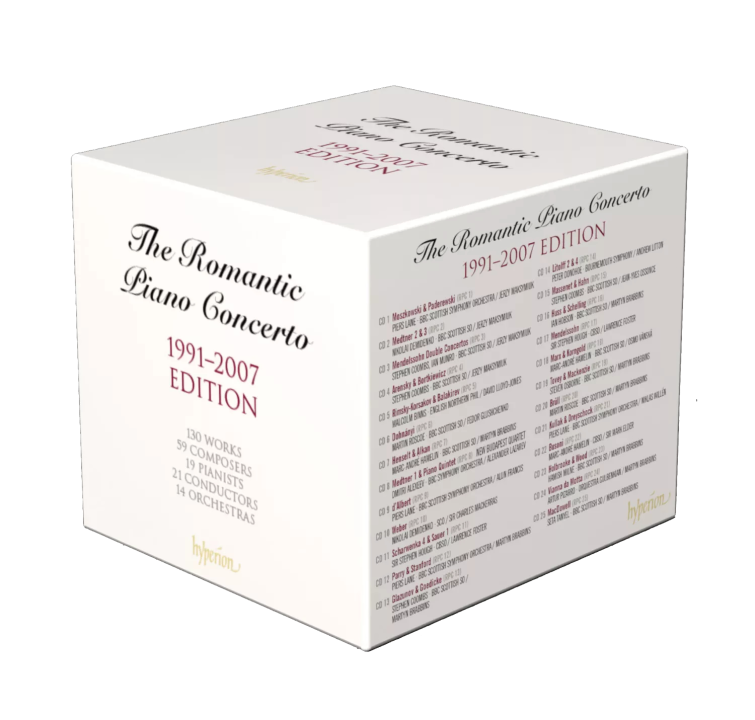
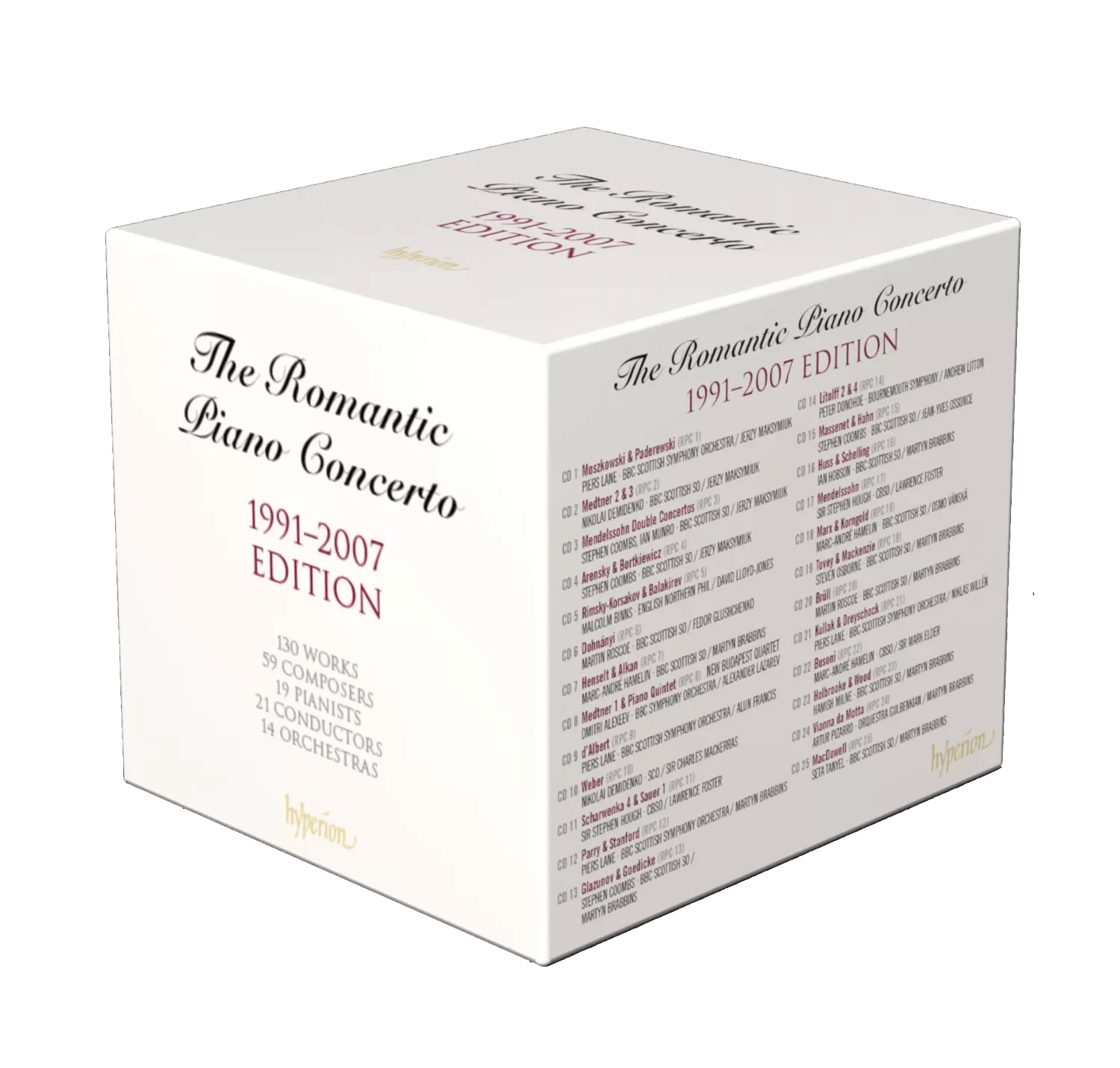
Hyperion has just issued the first of two boxes of the Romantic Piano Concerto Edition, which its website describes as the ‘first 50 volumes’ of the series. That’s not strictly true, as the original Volume 50 consisted of Sir Stephen Hough’s delicious set of Tchaikovsky’s complete works for piano and orchestra with Osmo Vanska and the Minnesota Orchestra. They’re not here but will presumably be in the second box, out later this year. However, we do get a Tchaikovsky First Piano Concerto by Nikolai Demidenko and the BBC Symphony Orchestra with Alexander Lazarev. That’s in the set as a ‘bonus disc’ because of the coupling – Scriabin’s Piano Concerto, which everyone describes as an apprentice work modelled on Chopin. True, but the melodies and orchestration surpass those of either Chopin concerto. In my opinion it’s a flaming masterpiece, especially under Demidenko’s fingers. After the euphoric climax of the third movement he lets the final piano chord reverberate for 12 spine-chilling seconds. I’ve never heard another pianist do this; if it’s not in the score, it should be.
I don’t know why the Scriabin, recorded in 1993, wasn’t among the original Romantic Piano Concerto volumes. Maybe Demidenko insisted that his album should stand alone. Likewise, Hough’s Rachmaninov piano concertos and Paganini rhapsody with Andrew Litton and the Dallas Symphony Orchestra were issued separately. Fair enough, given that they were acclaimed as reference recordings, the high point of Sir Stephen’s career up to that point. But here they are included as a whopping bonus to the first boxed set.
Obviously most of the music gathered here hasn’t reached the pantheon of the Schumann, Brahms, Grieg, Tchaikovsky and Rachmaninov concertos. Why? We can’t simply blame lack of inspiration. Consider the volumes featuring Marc-André Hamelin, who specialises in behemoths that defeat all but a tiny band of super-virtuosi. Let’s just say he makes the best possible case for the Busoni Piano Concerto – 75 over-stuffed minutes ending with a choral hymn to Allah. His performance of the Reger concerto, by contrast, traces madcap rhythms that transform our understanding of it. But if I had to live with just one Hamelin entry in the series, it would be the Romantisches Klavierkonzert by Joseph Marx (1882-1964), which makes Addinsell’s Warsaw Concerto from Dangerous Moonlight sound like Boulez. A masterpiece it ain’t, but then chocolate éclairs aren’t haute cuisine and who cares?
Some of the highlights of Hyperion’s tour d’horizon are beguiling oddities that can be forgiven for not quite working as concertos – the Delius, for example, whose relentless mellowness is offset by the perkiness of John Ireland’s Piano Concerto, arguably the finest by any British composer (though a second hearing of Donald Francis Tovey’s concerto makes me wonder if it ought to take the crown). The soloist is Piers Lane, one of a thoroughbred stable including Stephen Coombs, Steven Osborne, Martin Roscoe and Howard Shelley. On most discs the orchestra is the splendid BBC Scottish Symphony under Martyn Brabbins, who deserves a knighthood for services to British music. But no one has contributed more to this venture than the legendary recording producer Andrew Keener, without whose magic ears Hyperion might not have survived.
In the past fortnight I’ve listened to 40 of these volumes, most of which I bought full price. I keep being reminded why I forked out so much on this series: the joy of discovering unforgettable passages in works by second-tier composers such as d’Albert, Scharwenka and Rubinstein. They’re only unforgettable thanks to Hyperion. As for the pieces that struck me as obvious duds, I’ve learned not to rush to judgment. Last night I yawned through the Piano Concerto in D major by Eyvind Alnaes (1872-1932), which sounded like the portentous mishmash you’d expect when a Norwegian organist tries to do Rachmaninov. But it has been playing in the background while I’ve been writing this and I’m humming along.
We can’t afford to be snooty. When was the last time anyone wrote a piano concerto that your average concert-goer might recognise? I reckon the answer is 1957. I’ll leave it up to you to guess which work I’m talking about.
The Romantic Piano Concerto Edition – 1991-2007 is out now on Hyperion.




Comments