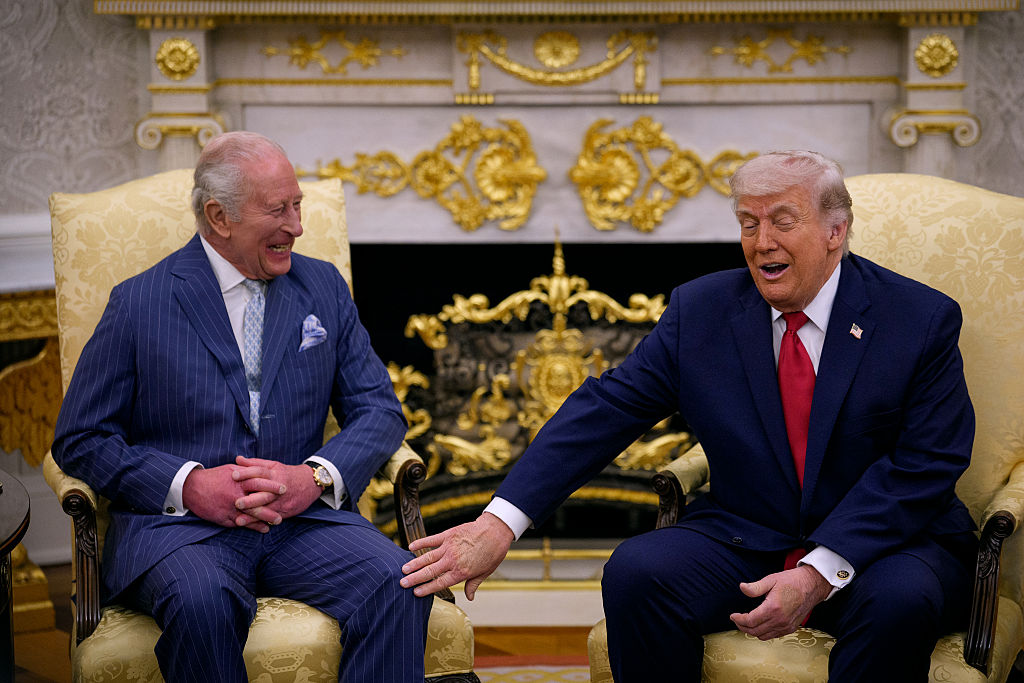
Perfect spring sunshine beamed down on King Charles III and Queen Camilla as they slowly made their way down the sloping lawn of the British Embassy in Washington this week. None of the hundreds of eager Americans gathered at the Embassy’s garden party had ever seen a British king in the nation’s capital. The last visit was in 1939, by King George VI, when a similar garden party took place in the shadow of the gathering storm in Europe.
Perhaps the King can perform a service even beyond that of repairing transatlantic ties
Yet if the assembled politicians, media celebrities, business leaders and occasional historian nibbling on finger sandwiches and sipping Pimm’s Cups thought at all about previous royal visits, it was likely Queen Elizabeth’s 1976 Bicentennial tour that occupied their thoughts. Few in the garden this week would have been included in such festivities a half-century ago, but the connection between that visit and the King’s for America’s 250th anniversary of independence served as a link across the generations.
Back in 1976, the Queen arrived on July 6, just two days after the climax of the celebrations and when bicentennial fever was at its height, but also when the country was still wracked by a decade of social unrest, Vietnam, Watergate, assassinations and economic recession. In contrast, the King arrived two days after a would-be assassin tried to kill President Donald Trump and members of his cabinet at the annual White House Correspondents’ Dinner.
Coming months before July 4, Charles has descended into the most fervid political atmosphere since the dark days of the 1960s. The question is whether his visit will not only be as successful as his mother’s, but whether he can patch up bilateral relations that have severely strained the “special relationship.”
Tom Tugendhat MP, formerly Britain’s minister of state for security, believes that “the personal relationship rubs off onto official relations,” noting that Trump not only sincerely respects the royal family, but understands that power and pageant are connected, making him receptive to the message of “renew and revitalize” that London hopes will sway the president. Indeed, in his landmark address to Congress, Charles lauded the “irreplaceable and unbreakable” relationship (which, of course, was first broken in 1776).
But perhaps the King can perform a service even beyond that of repairing transatlantic ties. As evidenced by the sincere admiration shown him by those gathered in Congress and at the Embassy garden party, is it possible that he can help Americans overcome their differences? After all, when he acknowledged this as the 250th anniversary of the Declaration of Independence, politicians of both parties in Congress leapt to their feet in cheers. It was perhaps not the most polite response, but there have been few moments when any speaker before Congress can get unanimity on any topic – something Trump humorously noted at the glittering state dinner that evening.
Bringing Americans together is certainly not the King’s responsibility, nor the focus of the trip. But as the most prominent state visit this year, the luster he and Camilla bring to the semiquincentennial celebrations may help Americans appreciate what they share in common, and not just what they disagree on. Despite some of the drama of recent years, the monarchy still represents a pinnacle of civility, something desperately needed in an America where the intolerant fringes are increasingly threatening the public square and the non-radical middle.
The King’s speech highlighted the vital necessity of maintaining unity and respecting our democratic traditions – which, after all, derive from English common law and Enlightenment thinking. If his reaffirmation of democratic norms and decency sparks a reassessment of our recent social behavior, then he will have played a role more important than most of our politicians, who toy with Spanish Civil War-style demonization of opponents, goading Americans to be at each other’s throats.
As the royal visit continues, there will be as many Americans hoping to have the better angels of their nature called forth by the King’s words as there will be those who revel in vituperation and condemnation. Such is the democratic estate, but it is always good to be reminded of just how precious our inheritance is, particularly by one whose country was the wellspring of our own tradition.




Comments