

Democracy has not been kind to William Shakespeare. His works may be read and performed more widely than ever, but readers and audiences understand less and less of what they see. Egalitarianism encourages narcissism, and narcissism interprets all art as autobiography.
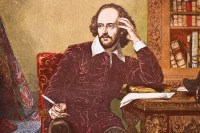
Shakespeare could only write about his own life, and if, in fact, he wrote about royal courts and noblemen, then Shakespeare must not have been Shakespeare, the actor from Stratford-upon-Avon. He must have been Edward de Vere, the earl of Oxford, or somebody like that. He could not have possessed the intelligence and imagination to transcend his personal identity, for none of us can do that. It would be superhuman.

That’s one foolish contention arising from the idea that writing must always be memoir. “Oxfordians” are admittedly detested by mainstream scholars. There are more sophisticated versions of the same self-centric fallacy, however. One of them is up for eight Academy Awards next month.
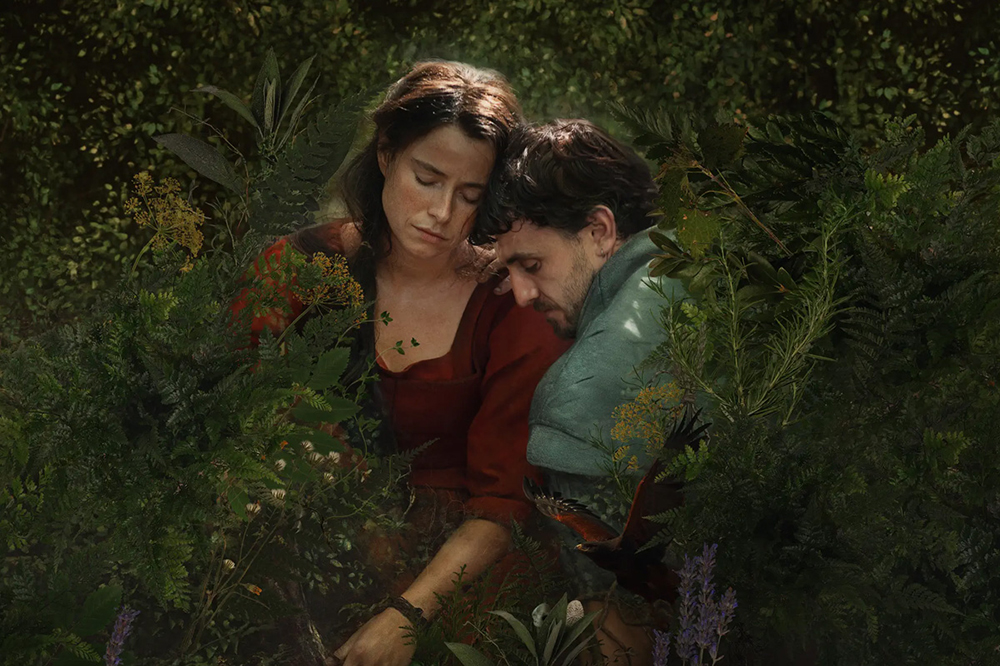
Hamnet is a film adapted from a novel by Maggie O’Farrell, who collaborated with director Chloé Zhao on the screenplay. Its premise is that Shakespeare wrote Hamlet to channel his grief over the death of his 11-year-old son, Hamnet. Fittingly, O’Farrell traces her own interest in Hamnet’s story to her experience as someone who’d suffered a serious childhood illness and is the mother of a child with a dangerous condition.
The Shakespeare we see in Hamnet could hardly be more relatable, assuming, that is, you relate to a stereotypical moody millennial manchild. He falls in love with a witchy woman – an actual witch, in this New Age telling. Like any good bohemian artist, or teenage pretender, this Shakespeare struggles against his family’s bourgeois expectations and his violent ogre father.
He’s a tormented artist struggling with writer’s block, drunk and weeping with frustration, lashing out at the papers on his desk like a thousand thousand other characters of this type, onscreen or in real life. You know this Shakespeare perfectly; he could be you. Even in a film like this, though, Shakespeare cannot be an everyman – because he is, after all, a man, and represents, at best, half the human race.
Hamnet is rather more interested in his wife, Agnes, and her birthing pains. She’s unusual in that she likes to head to the forest when she goes into labor. Yet she’s just what any enlightened woman in the 21st century is supposed to be, only more so – environmentally conscious, hostile to patriarchal Christianity, which she explicitly rejects in the film. This has nothing to do with the historical Mrs. Shakespeare, but it’s how the women behind works like Hamnet feel, so it must be how 16th-century English women really felt, too.
Jessie Buckley plays Agnes Shakespeare; William is Paul Mescal. They adopt a lowest-common-denominator technique to get their points across, grunting and gurning and screaming and bawling their way through the picture. The histrionics are so overblown they have the opposite of the intended effect: there’s no natural feeling in Hamnet. You never forget you’re watching a performance, and a strained one at that.
Shakespeare did not need a personal tragedy to prompt him to think about death and the hereafter
Yet what about the idea at the heart of the work? Whatever its flaws, does this film reveal how Shakespeare came to write Hamlet? The opening title card rightly tells us that “Hamlet” and “Hamnet” are variations on the same name. Doesn’t that make it obvious Shakespeare wrote Hamlet about his son? The play’s meditations on death and the afterlife, or lack of one, surely reflect Shakespeare’s mental state following Hamnet’s death.
The trouble is Hamlet existed at least seven years before Hamnet’s death in 1596. Thomas Nash, in his 1589 preface to Robert Greene’s Menaphon, refers to writers “that could scarcely Latinize their neck verse if they should have need; yet English Seneca read by Candlelight yields many good sentences… and if you intreate him fair in a frosty morning, he will afford you whole Hamlets, I should say handfuls of tragical speeches.” (Shakespeare had “little Latin and less Greek,” according to Ben Jonson.) An entry in the theater impresario Philip Henslowe’s diary notes a performance on June 9, 1594, of a play called Hamlet.
Some scholars twist themselves into knots to deny this early Hamlet was Shakespeare’s, insisting that Nash was referring to a lost work by Thomas Kyd, an ur-Hamlet for which there is no evidence. The Hamnet/Hamlet connection if anything argues against the possibility anyone other than Shakespeare wrote an early Hamlet. It also affords all the more proof that Shakespeare was Shakespeare, the actor from Stratford-upon-Avon, not the earl of Oxford or anybody else.
Records attest to Shakespeare’s son Hamnet being baptized in 1585. He was named, from all indications, after Shakespeare’s friend Hamnet Sadler, a Stratford resident. The name had no connection to the legendary prince of Denmark, who was known in historical sources as “Amleth,” not Hamlet. Whoever wrote the Hamlet of the 1580s changed the prince’s name to a version of the name of a man from Stratford and a child born to William Shakespeare. Would Thomas Kyd have had a reason to do that? Would anyone other than Shakespeare?
Shakespeare does seem to have revised Hamlet a few times, and possibly he made significant revisions after, and inspired by, his son’s demise. But he did not need a personal tragedy to prompt him to think about death and the hereafter, just as he did not need to be an aristocrat to write about aristocratic subjects. Shakespeare’s art is the study of man, not a mere study of himself, whatever he may have drawn from his own life. Our filmmakers would do better than Hamnet if they, too, took human nature, not themselves, as their subject.

Comments