
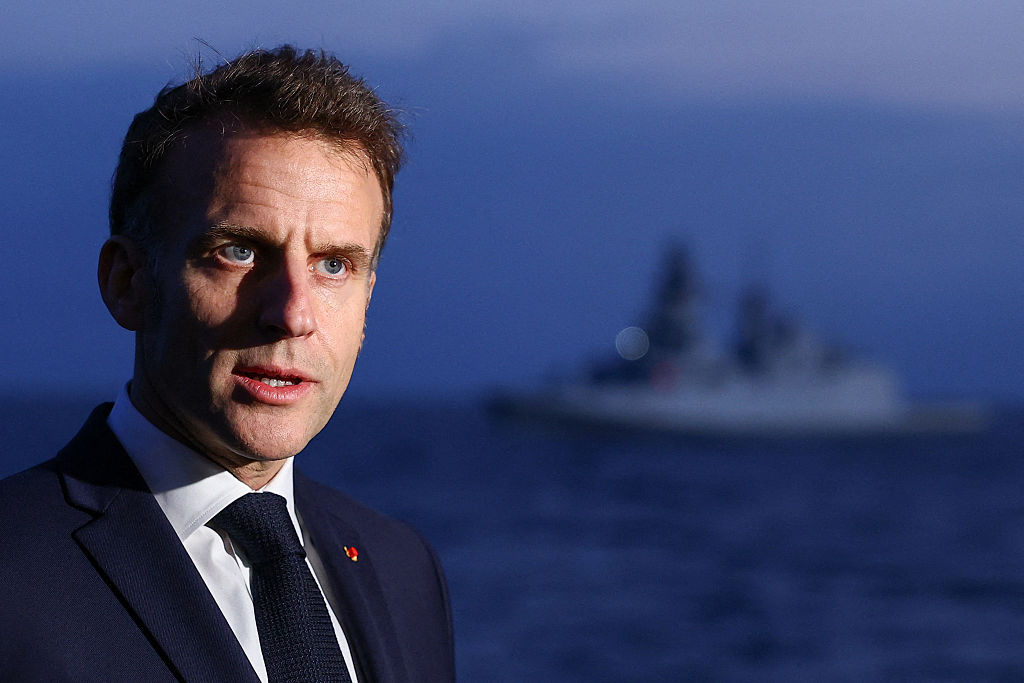
French President Emmanuel Macron’s approval rating rose by six points last week. It will likely continue to climb following his visit to the Charles de Gaulle aircraft carrier on Monday.
The pride of the French navy recently arrived in the eastern Mediterranean to protect Cyprus, and Macron was in his element as he strode across the deck of the carrier. A photograph of the occasion appeared in the New York Times underneath the headline: “France Is Sending a Large Naval Force to the Middle East.”
The last time there was a great conflagration in the Middle East, France was very much on the sidelines
Macron was helicoptered onto the Charles de Gaulle from a press conference at an air base in Cyprus. Standing alongside Cypriot President Nikos Christodoulides and Greek Prime Minister Kyriakos Mitsotakis, Macron had declared that “when Cyprus is attacked, it is Europe that is attacked.” It was a reference to the Iranian drone attack on a British Royal Air Force base the previous week.
Macron added: “The defense of Cyprus is obviously a key issue for your country, for your neighbor, partner and friend, Greece, but also for France and, with it, the European Union.”
The defense of Cyprus should be a key issue for Britain, but the bulldog isn’t in the best of health these days. He has lost his bite as well as his bark, and as a result the French cockerel is crowing louder than ever.
A Royal Navy destroyer finally sailed from England on Tuesday and should arrive off Cyprus at the weekend, two weeks after the US and Israel went to war against Iran.
Too little, too late, in the opinion of Donald Trump, who has expressed his bitter disappointment with the timorous Prime Minister Keir Starmer.

France, on the other hand, has been praised by the President for its “great” response to the conflict.
Macron’s latest initiative is to dispatch eight frigates and two helicopter carriers as part of an international escort force for ships wishing to navigate the Strait of Hormuz. This is the key shipping route used for about one-fifth of the world’s oil supply, and which is being targeted by Iranian forces.
In the last 24 hours three ships in the Strait have been hit by “unknown projectiles,” including a vessel that was abandoned by its crew on Wednesday morning after it caught fire. The US military says it has destroyed 16 Iranian mine-laying vessels in the area and Trump warned Tehran against laying mines in the Strait, saying America would “permanently eliminate any boat or ship attempting to mine the Hormuz Strait.”
Protection for vessels in the Strait will be on the agenda this afternoon when Macron hosts a video summit of the G7, the first opportunity for members to discuss the situation in the Middle East. France holds the rotating presidency of the G7 and so Macron will be center stage: where he believes he belongs.
The last time there was a great conflagration in the Middle East, France was very much on the sidelines. In 2003, Jacques Chirac, then president of the Republic, refused to join George W. Bush’s “Coalition of the Willing” against Iraq. Americans scorned the French as “cheese-eating surrender monkeys.” The insult stung much more than the puerile nonsense of renaming French fries “freedom fries.”
In that same year, Macron was a student at the École nationale d’administration, the elite academy for French technocrats. He and his classmates would have been acutely aware of the ridicule heaped on France; not just by neoconservatives, but also by liberal newspapers such as the New York Times, which declared that “France is becoming our enemy.”
In 2026 France is America’s closest European ally in the conflict with Iran. For the moment Macron has majority support with two-thirds of the country approving of his decision to send a naval force to the Strait of Hormuz. They believe Macron when he describes the mission as “purely defensive” in order to facilitate the passage of ships through the Strait.
Would this support crumble if one of the French frigates was sunk by an Iranian mine or struck by a drone?
In an editorial in Wednesday’s centrist Le Figaro, the newspaper described Macron’s initiative in the Strait of Hormuz as a “high-risk military engagement.” It warned that “in seeking to play its legitimate role in the Middle East, France is preparing to make strategic choices in a war it did not want.”
It is not just Trump who is gambling on a short war with few casualties. So is Macron. His ambition is to rehabilitate his own reputation in American eyes as well as that of his country’s military.




Comments