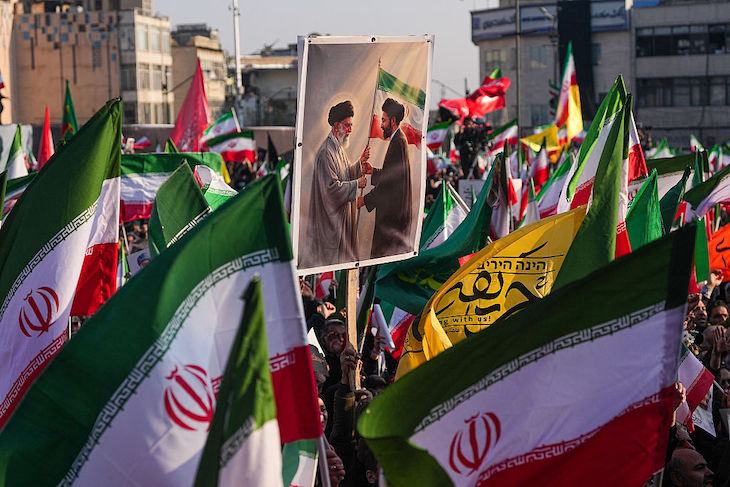
What next for Iran? Donald Trump appears to have a plan: the Venezuela model. The US president has hinted that, just as with the South American nation, he wants to try working with elements inside the existing regime, rather than backing exiled opposition figures.
The biggest massacres in Iran’s recent history happened under so-called reformers
“We have a formula, Venezuela, smart country,” he said this week. “We’ve taken out 100 million barrels of oil which is now in Houston…being taken care of and made so beautiful in refineries.” But if Trump really is planning on copying his playbook for Venezuela in Iran, he should be warned: it will be a disaster.
Why? Because, put simply, the Islamic Republic idolizes death over rational thinking. For Iran’s leaders, martyrdom isn’t a risk; it’s the ultimate honor. That is what sets Iran apart from Venezuela. Venezuela’s Chavistas believed in ideology, but they were not, in most cases, willing to die for it. But in the Islamic Republic, dying for your beliefs is seen as the ultimate virtue.
Whenever a high-ranking official dies, the Iranian regime declare that person has achieved the highest rank before Allah. Khamenei once said that “Martyrdom is the highest reward and recompense for jihad in the path of Allah.” The Basij and IRGC security forces are trained to believe this way of thinking. Their members learn Quranic verses that teach them that “Should you be martyred or die in the cause of Allah, then His forgiveness and mercy are far better than whatever wealth those who stay behind accumulate.”
Comparing Iran to Venezuela also ignores the structure of Iranian politics. Venezuela, despite its corruption, still allowed opposition figures like María Corina Machado to organize parties and contest elections, even if those elections were later manipulated. Nothing comparable exists in Iran. Party politics is effectively banned, and the system is engineered to detect and eliminate internal opposition. If someone like Reza Pahlavi, the eldest son of the last Shah of Iran, attempted to enter Iranian politics as Machado did in Venezuela, he would almost certainly be killed. In systems where even minimal opposition is tolerated, compromise becomes necessary. That dynamic doesn’t exist in the Islamic Republic, which for decades has cultivated a kleptocratic regime enriching a few at the expense of all.
Even those deemed reformers are, in reality, anything but. Instead, these men resemble Stalin’s apologists posing as Gorbachev on the international stage. Let’s not forget that the biggest massacres in Iran’s recent history happened under so-called reformers: the bloodshed in January this year took place under the watch of Masoud Pezeshkian; the Bloody Aban of November 2019, when more than 1,500 protesters were killed in three days during an internet shutdown – and the downing of Flight PS752, when 176 civilians were burned alive – happened under Hassan Rouhani’s government. They may say they had no control or knowledge but they can’t get away from the fact these incidents happened under their presidency.
With these so-called reformers, the Venezuela model would amount to nothing more than another JCPOA. Barack Obama was proud of his Joint Comprehensive Plan of Action, or Iran nuclear deal, but it was never clear why. Even when the ink was still drying on that 2015 agreement, Qasem Soleimani, the commander of the Quds Force, was transporting weapons and cash aboard in violation of the agreement. Iran had no desire to stick to the agreement. Soleimani, and Ayatollah Khamenei, have both gone, but that mindset of defiance is alive and well in the upper echelons of the Iranian regime.
Yesterday, as bombs continued to rain down on Tehran, Ali Larijani – the Secretary of the Supreme National Security Council of Iran, and a man many in the West try to market as a “pragmatist” – was busy tweeting threats to Donald Trump: “Watch yourself-least you be eliminated!” he wrote. If men like Larijani are the future, why are they not advocating de-escalation with the United States? The truth, long known to Iranians but forgotten by Western analysts, is that they are Islamic Republic loyalists. Their role has always been to lend legitimacy to the regime’s violence. They were successful under Obama and Joe Biden. Iranians hope that Trump won’t also fall for their tricks.
Trump isn’t an academic historian, but he has a good sense of history. He knows a deal with the Islamic Republic won’t work. What he needs to understand is that the rest of the regime is no different. That’s why all the so-called reformers mourned Khamenei’s death: without the Islamic regime, they have no role in a secular, democratic Iran. They are fighting for their own survival, not Iran’s. The solution isn’t within the system – because, if it were, it would have been destroyed long ago. The solution lies in historical continuity. Iran should not attempt a French-style Jacobin revolution, but rather return to its roots: the monarchy. The truth is that the Venezuela model has no place in Iran.




Comments