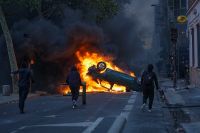
Marine Le Pen is the political winner from the anarchy that erupted in France at the weekend. A poll conducted in the 48 hours after the nationwide riots found that the leader of the National Rally is the only figure whose approval rating has increased. Le Pen is now up to 38 per cent, a popularity not seen since Francois Mitterrand enjoyed widespread support in the 1980s. According to Frédéric Dabi, one of France’s leading political scientists, Le Pen is regarded as ‘the representative of the party of order, the party of those who can no longer tolerate the chaos’.
Her nearest rival is Jean-Luc Melenchon, the leader of the far-left La France insoumise, the party that much of the country holds responsible for stoking disorder in recent weeks. But Melenchon trails Le Pen by more than 20 points and is suffering from the emergence of Raphael Glucksmann. The social democrat has syphoned off some of Melenchon’s bourgeois support and will continue to do so in the wake of last weekend’s violence.
Lisnard is the closest France has to a British Tory
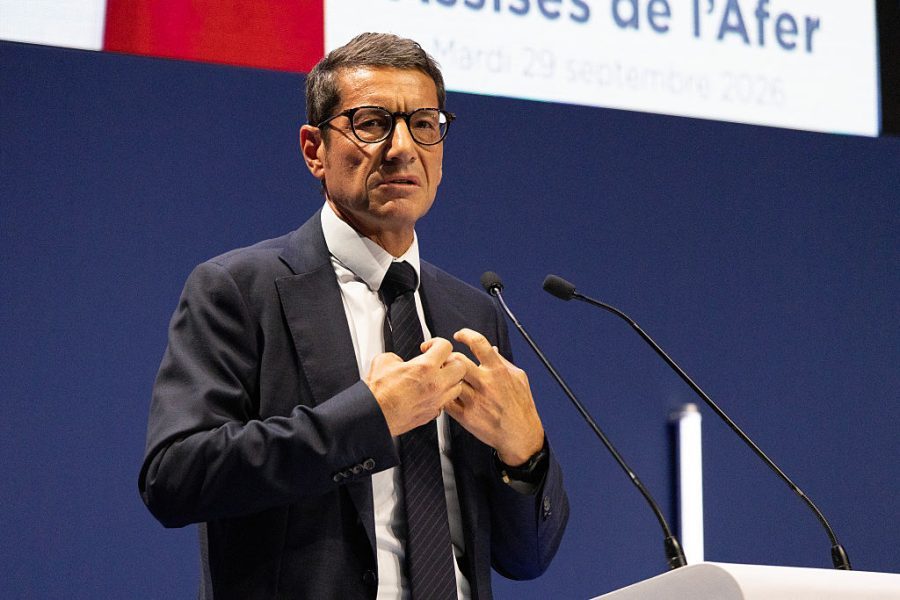
But arguably the politician who has the strongest wind in his sails this week is a rank outsider called David Lisnard. The 57-year-old mayor of Cannes quit the centre-right Republicans in March this year to launch his own party. He did so, he explained, because France’s political class had become ‘completely discredited’. He included the Republicans, who he accused of becoming ‘the crutch of a waning Macronist regime’.
Lisnard is economically liberal and socially conservative. ‘I want my country to change its policies,’ he said in a speech last year. He says a ‘technocratic, collectivist’ doctrine has resulted in ‘forty years of social statism that are holding us back’. He talks tough on immigration, particularly the legal sort from North Africa. He promises to take back control of the borders.
Along with Bruno Retailleau, the presidential candidate of the Republicans, Lisnard is the closest France has to a British Tory. Retailleau’s handicap, however, is his personality; he lacks charisma.
In the space of six months, Lisnard has caught up with Retailleau in the presidential election polls. At just 7 per cent, they are streets behind Le Pen but voices on the centre-right have started calling on Retailleau to drop out. The media have taken note. ‘Lisnard: the surprise liberal’ was the headline of one profile last week.
Lisnard will also profit from the growing unpopularity of two former centrist prime ministers. Edouard Philippe was once considered a front-runner for the presidency but he has lost six approval points this month. Also on the slide is Gabriel Attal, who once took pride in being Emmanuel Macron’s protégé. That was before the President became toxic. These days Philippe and Attal go to great lengths to distance themselves from their erstwhile mentor.
Philippe has criticised Macron’s vapid response to the riots and his decision to jet off to the Middle East for three days. ‘Our country needs strong leadership,’ he wrote on X.
The French agree. Lisnard believes he has that strength. He has demanded the closure of far-left communes in central France, which are allegedly used as paramilitary-style training camps. The alert was first sounded several years ago but successive governments just shrugged.
The biggest of these camps is in Limousin, forty miles east of Limoges, the scene of some of the worst violence on Saturday. On Tuesday, police arrested a veteran far-left militant in connection with the arson attack that destroyed Limoges’s city hall.
Other troublemakers at the weekend seem to have other motivations. Last Saturday was 17 October, a symbolic date for French Algerians. On that day in 1961, scores of Algerian protestors were killed by the police during a demonstration in Paris. Many of the rioters last Saturday sported Algerian flags and among the myriad graffiti was ‘October 17, 1961, neither forgetting nor forgiveness’.
During a television debate about the riots on Tuesday evening, a left-wing student in the studio audience suggested France had only itself to blame for the mayhem. ‘Can you remind us what happened on 17 October 1961?’ asked the student.
Lisnard tried the softly-softly approach at first. It was a ‘tragic’ event but it had happened 65 years ago. The student persisted so Lisnard cut her off. ‘I couldn’t care less, I couldn’t give a damn,’ he snapped. ‘I wasn’t even born when Algeria gained independence.’
The left were beside themselves but the silent majority cheered. For too long they have been made to feel guilty by the left for the deeds of their ancestors. Lisnard is the first to fight back.
Lisnard has called his party ‘New Energy’. He has enlivened political discourse this week and he is starting to galvanise bourgeois conservatives. Marine Le Pen remains the bookies’ favourite but perhaps a dark horse will emerge from the anarchy of the autumn.


Comments