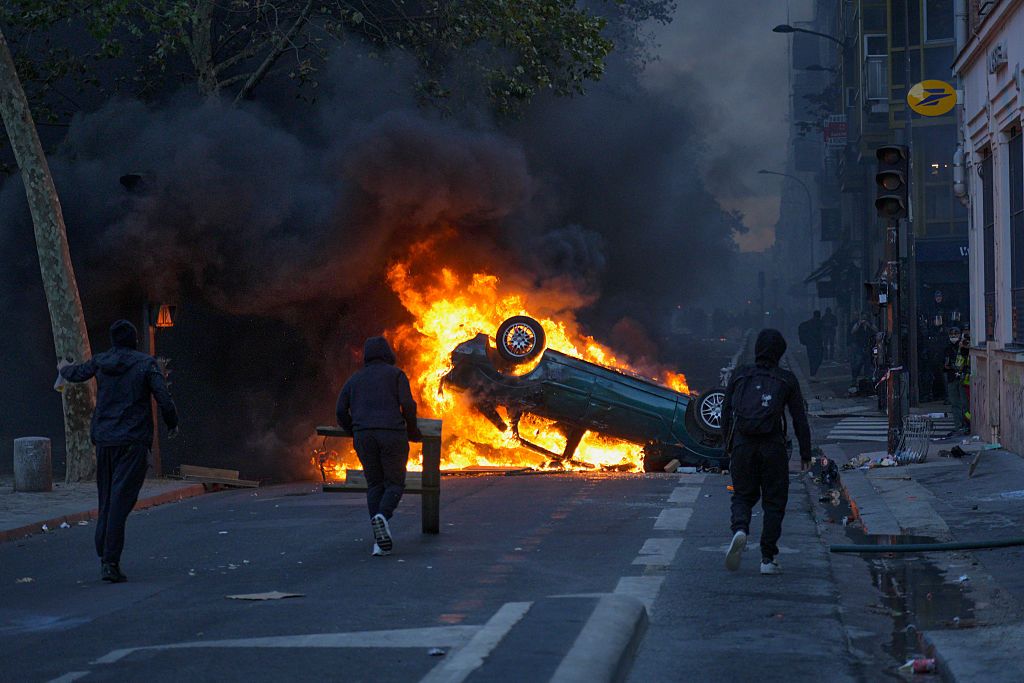
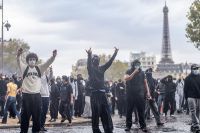
France experienced its first night of calm since the weekend on Monday evening after the imposition of curfews in several cities and towns. The Prime Minister, Sebastien Lecornu, said he is ‘absolutely determined to restore order’ in the wake of the weekend’s urban warfare that stunned the Republic.
Lecornu delivered his promise after a crisis meeting in which a series of measures were discussed. While the Premier held back from declaring a state of emergency – for the time being – Lecornu said the curfews in cities such as Paris, Nice, Lyon and Lille were necessary.
Rioters are rarely jailed and so far the sentences given to those arrested on Saturday have been derisory
‘The French get the impression that it’s chaos everywhere,’ said Lecornu. ‘Fortunately, that’s not the case. The disorder is highly concentrated in urban centres.’
The cities that experienced the most violence have two things in common: large numbers of far-left activists and a significant immigrant population. There has been barely any rioting in the provinces where last Saturday high school protestors joined forces with Yellow Vests in numerous peaceful demonstrations.
In an insipid address to the nation on Sunday evening, President Emmanuel Macron blamed the anarchy on the ‘ultra-left’, a term that Lecornu repeated on Monday. He said that the ultra-left was seeking to ‘orchestrate deep unrest across the country’ ahead of the presidential election next year.
Alongside the Prime Minister was the interior minister, Laurent Nunez, who revealed he had tendered his resignation to Macron but it was rejected. Nunez admitted that the police ‘lost control’ on Saturday evening but vowed that it wouldn’t happen again. ‘Starting this evening,’ he said, ‘we will further increase the number of police officers and gendarmes deployed on the ground’.
A series of second Yellow Vest demonstrations have been organised for Saturday across France and the fear is that they will once again be used by the far-left and other assorted hoodlums to loot and destroy.
One of Lecornu’s predecessors, Gabriel Attal, said in an interview on Monday that he wanted to see the army temporarily deployed on the streets; the government dismissed the idea.
Curfews and a greater police presence may quell the insurrection in the short term but what about the long term? Macron – who is currently on a three-day visit to the Middle East – promised in his address that the State will be ‘uncompromising’ with the troublemakers.
He said something similar in June 2025, after thousands of youth ran amok in Paris following the victory of PSG in the Champions League. There was no crackdown, and 12 months later there was a repetition of the violence when PSG retained their title. On that occasion Macron used the same word as he did on Sunday, vowing to be ‘uncompromising’ with the thugs.
He is as soft as most of the judiciary. Rioters are rarely jailed and so far the sentences given to those arrested on Saturday have been derisory. Contrast the leniency of French judges to their English counterparts, who, after the Southport riots of 2024, jailed hundreds of people for between two and nine years.
This impunity encourages French vandals to loot, burn, destroy and battle the police. Even if they are caught the chances are they won’t be punished. France, to a paraphrase a former British prime minister, needs to get tough on crime and tough on the causes of crime.
It also needs to get tough on Jean-Luc Melenchon’s La France Insoumise. Lecornu has accused the party of stoking tension in recent weeks, telling Melenchon: ‘You cannot call for an end to the violence whilst at the same time making excuses for those who commit it. This is YOUR political responsibility.’
Some prominent LFI politicians have been accused of inciting violence, like the mayor of Saint-Denis, Bally Bagayoko, who earlier this month said sometimes violence ‘can be legitimate’. Bagayoko has previously called for a ‘popular uprising’ in the event Marine Le Pen wins the presidency next year.
In an interview earlier this month Bruno Retailleau, the presidential candidate for the centre-right Republicans, floated the idea of banning LFI. Accusing the party of being ‘insurrectional’ and ‘fascinated by violence’, Retailleau – who served briefly as the interior minister in 2024/25 – warned that the ongoing school protest movement is a ‘rehearsal for what might happen in 2027’.
In recent years there have been calls to ban Le Pen’s party as well as the AfD In Germany and Vox in Spain. The European elite has long regarded right-wing and far-right parties as the greatest danger to democracy. Perhaps that will start to change after Saturday’s anarchy in France.


Comments