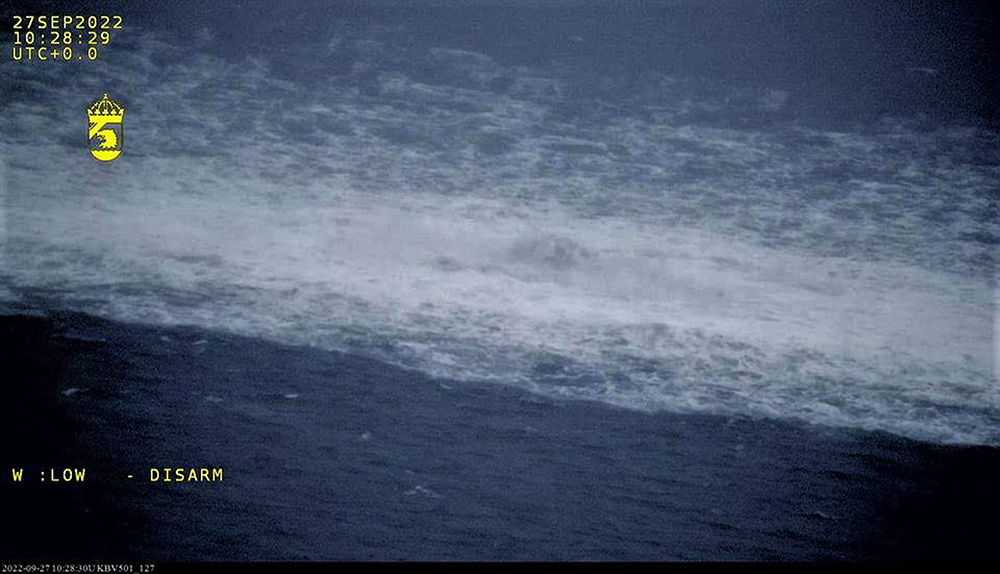


Six months after undersea explosions ripped through three of the four Nord Stream gas pipelines between Russia and Germany I wrote a 2,500-word story for The Spectator entitled ‘Were Ukrainians behind the Nord Stream bombings?’ Citing senior European security sources, the piece revealed a conspiracy of silence – for fear of an anti-Ukraine backlash – by western intelligence agencies, law enforcement authorities and government to cover up what they all knew to be the truth. Forensic evidence and a German police investigation had disclosed that pipelines carrying the Russian gas on which the economies of Germany and many other European countries depended had been blown up by a tiny team of Ukrainian saboteurs. The piece concluded:
Expect more details to come out soon, not from anonymous spooks and much less from Vladimir Putin, but from old-school gumshoe investigation by police and journalists.
Now with the publication of The Nord Stream Conspiracy, the Wall Street Journal’s Berlin correspondent Bojan Pancevski has produced the definitive account of the most impactful special operation in the history of warfare. He has interviewed not only the German detectives who unravelled the plot but also, jaw-droppingly, the Ukrainian spymaster, intelligence officers and soldiers who planned and executed the operation. The result of this extraordinary access is not just investigative journalism of the highest order but a gripping thriller. ‘Like a spectator at a high-stakes poker game, I’ve had the extraordinary privilege to glance over the shoulders of both sets of players and see their hands before they laid down their cards,’ Pancevski writes.

When a series of detonations ripped Nord Stream open on 26 September 2022, seismic monitoring stations across Europe sounded earthquake alarms as colossal geysers of methane nearly a kilometre in diameter erupted from the floor of the Baltic Sea. But the geopolitical impact of the sabotage attack was no less seismic. For decades, Germany had been building up its energy dependence on Russia – ironically enough, a response to political instability in the Middle East – and under Gerhard Schroeder the ambitious Nord Stream project was born. Soon after Nord Stream 1 was completed in 2012 Russia was supplying more than half Germany’s gas, a volume that was set to double after the completion of Nord Stream 2 in 2021. But it was equally clear that Europe’s energy dependency gave Putin diabolic leverage over the continent as he planned his invasion of Ukraine.
Twice in the summer of 2022 Gazprom shut down or slowed gas pressure in the pipe, citing technical reasons everyone knew was thinly disguised Kremlin political pressure not to back Ukraine too vigorously. In Kyiv, Putin’s energy weapon was rightly viewed with alarm as a fundamental restraint on European support for their desperate struggle to resist the Russian invaders. A clandestine Ukrainian unit Pancevski calls ‘the Startup’ – an informal special operations cell operating outside the military and intelligence hierarchy – reached a ruthless and breathtakingly ambitious conclusion: Nord Stream had to go. But because the consequence would inevitably be to spike Europe’s gas prices and sabotage the very economic basis of Germany’s cheap, energy-driven prosperity, the operation had to be a covert one.
The Startup’s two principal figures were ‘the General’, a senior intelligence officer, and ‘the Colonel’, described as a bold, methodical special forces commander with a talent for deception. The plan they drew up was dubbed Operation Diameter. The first technical challenge – getting to the pipe –was easy enough as much of Nord Stream lay in 80 metres of water. That’s deep for scuba divers but not too deep for professionals. The next was how to pierce the pipe, which was made of 26.8mm steel shell encased in 300mm of concrete. A veteran explosives engineer, whom Pancevski calls ‘the Grandpa’, quickly realised that Nord Stream’s main vulnerability lay inside itself. Though NS2 had not yet been certified for operation, all four pipelines were filled with gas pressurised at between 160 and 220 times atmospheric pressure. ‘Punching even a small hole in a pressurised pipeline at the bottom of the sea would unleash a reaction that would rip open the pipes, not unlike piercing a balloon,’ Pancevski writes. ‘Make a small incision in the shell, and the pressure will do all the work.’
The bombs designed by Grandpa were made using hexagen – the Russian name for RDX, a common demolition explosive – cushioned by silicone and fitted with a steel plate to direct the blast. They weighed no more than 40 kilos and were packed in divers’ bottles for easy smuggling. The sabotage team consisted of seven operatives, some military and some civilian: ‘The Captain’, Skipper the sailor, divers Iceman, Smiley and Freya (the only female member of the team), plus Soldier and Cousteau, who provided the muscle. Their craft was the Andromeda, a 15.57-metre, 11-berth German-flagged Bavaria Cruiser 50 motor yacht, hired from Mola Yachting GmbH for €2,998 by a Polish company owned by two Ukrainians.
A clandestine Ukrainian unit reached a ruthless conclusion: Nord Stream had to go
Pancevski interviews Freya about the operation: ‘The Iceman made a circle with his thumb and index finger, a gesture meaning “I am OK – are you OK?”,’ Freya confirmed. ‘The Iceman made a thumbs-up gesture: “Ascend. Dive over.” The job was done in less than 20 minutes.’ Bombs laid on joints in the pipes and timers set, the Andromeda made a beeline for port. The team dispersed, leaving a trail of paperwork, false passports and even forensic traces of explosives on board, which German investigators soon discovered.
Within days of the attack police and intelligence services in Germany, Sweden and Denmark were pretty sure that the trail led to Ukraine, though exactly how far up the operation was authorised remains a mystery. Pancevski establishes that the chain of command for Operation Diameter ran through the General up to Valeriy Zaluzhny, then Ukrainian commander-in-chief, now Ukraine’s ambassador in London and currently the front runner to replace Volodymyr Zelensky. Whether Zelensky himself knew is a question the book leaves deliberately open.
Among Pancevski’s most explosive revelations is that western intelligence agencies had prior wind of the attack and tried to stop it. Dutch military intelligence had intercepted information about the plot months earlier and shared it with the CIA. The CIA, in turn, briefed Germany’s BND – but the intelligence was labelled ‘low-confidence’ and characterised the group as ‘rogue’. As a senior CIA official later told Pancevski:
We were clear with Ukrainian services that this was a really bad idea and that we would be opposed. We thought this could be a big problem in terms of allied support for Ukraine. We had been assured that it had been stopped, but it hadn’t.
The CIA’s station chief in Kyiv personally confronted the General and demanded he call the operation off – to which he replied, evasively, that he ‘would not officially be part of Operation Diameter’. Other senior CIA and national security officials who had spent years trying to prevent Nord Stream 2 from coming online were, Pancevski writes, ‘not necessarily averse to someone putting the pipeline permanently out of commission’.
The destruction of Nord Stream changed the geopolitics of Europe. Putin’s gas leverage on the continent and Gazprom’s massive profits were destroyed at a stroke. Europe, and particularly Germany, were radically weaned off their dependence on the Kremlin, freeing them to ramp up their support for Kyiv. In the months after the attack many – including the hundreds who denounced The Spectator’s report fingering the Ukrainians, one of the first in the British press to make the allegation – believed (inexplicably) that it was the Kremlin who blew up its own pipeline. Others, including the legendary reporter turned demented conspiracy theorist Seymour Hersh, accused the CIA. But with this book Pancevski presents chapter and verse. It was the Ukrainians. And they did a brilliant job.


Comments