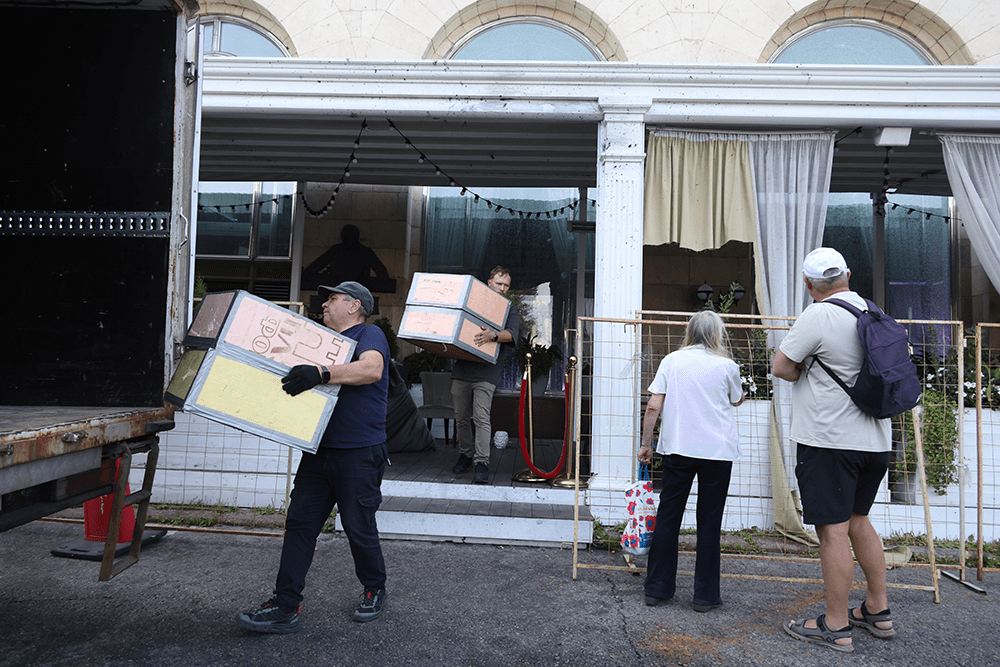


When is extrajudicial killing just war by other means, and when does it become a state-sponsored act of terror? “We were not terrorists but fighters for freedom who fought with our eyes open,” Menachem Begin wrote of Irgun, the irregular group of fighters he led during the 1947-48 civil war in Mandatory Palestine, the tactics of whom included bombings and assassinations. But where does the August 1 bombing of the Balzi Rossi restaurant in central Moscow – which killed at least five people and injured more than 20 – stand on the scale?
Some would describe the attack as a legitimate military operation. The bomb targeted the lavish birthday celebrations of Colonel-General Aleksandr Chayko, commander-in-chief of Russia’s Aerospace Forces (whose son-in-law died in the blast). Chayko commanded the northern group of Russian forces which advanced to the outskirts of Kyiv in February and March 2022, which pro-Ukrainian bloggers maintain makes him ultimately responsible for the massacres of civilians in Bucha and Irpin. Following that logic, the attempted assassination of Chayko stands alongside heroic partisan killings of war criminals – for instance the shooting of Reinhard Heydrich, Reichsprotektor of Bohemia and Moravia, gunned down on a Prague street by British-trained Czech agents in May 1942.
But if you believe the Balzi Rossi bomb was justifiable, what, then, is the difference between that attack and the Irish Republican Army’s 1981 nail-bombing of British soldiers at London’s Chelsea Barracks, or bomb attacks on Household Cavalry troopers and an army band in Hyde Park and Regent’s Park the following year? All were assaults on military personnel in a civilian setting in the cause of overturning a colonial occupation.
We can say that it’s fine when Barack Obama smites his enemies,but bad when Putin does it
Our answer obviously depends on how we feel about the righteousness of the perpetrators’ cause. The US and UK have been taking out al-Qaeda and ISIS members in Iraq, Syria and Afghanistan by drone attack for years, accepting collateral damage to unlucky civilians as part of the butcher’s bill. Few would shed tears for Mohammed Emwazi – “Jihadi John” – killed in a US-UK drone strike in Raqqa in November 2015, or “White Widow” Sally-Anne Jones, terminated using a Predator drone in 2017. Israel’s Mossad, with its arsenal of exploding pagers and pinpoint hotel-room strikes, is a world leader in taking out enemies wherever they find them.
Nevertheless, approving of extrajudicial execution opens a moral can of worms. We can say that it’s fine when Barack Obama smites his enemies but bad when Vladimir Putin does it because we approve of one but not the other. But that argument quickly slides into a dangerous moral ambivalence, a whataboutism of the kind the Kremlin loves to exploit.
Kremlin-controlled Russian media have blamed Ukraine for organizing the latest Moscow bombing. Officials in Kyiv, meanwhile, have remained silent. But the Balzi Rossi explosion is the latest in a long string of bombings targeting Russian officers, occupation officials and propagandists. In August 2022, Darya Dugina, a 29-year-old pro-war commentator and daughter of the nationalist ideologue Aleksandr Dugin, died in a car bomb blast presumably aimed at her father. In April the following year Maxim Fomin, a pro-war military blogger known as Vladlen Tatarsky, was killed by a bomb concealed inside a statuette presented to him as a gift during an event in St. Petersburg. Zakhar Prilepin, a nationalist novelist and commander of pro-Russian forces in the Donbas, was badly injured by another car bomb.
Similar devices have, since 2022, killed three Russian lieutenant generals, a deputy mayor of Stavropol and the founder of a pro-Russian battalion in Ukraine. Ukraine’s SBU security service has either denied responsibility or said nothing about bombings on Russian territory. But it has claimed several identical bombings inside occupied Ukraine, including two lawmakers in the Russian-installed assembly in Luhansk, an official at the Russian-controlled Zaporizhzhia nuclear power plant and the former head of the Olenivka prison in Donetsk, all blown up by improvised explosive devices. Occupiers are “a completely legitimate target,” SBU sources told Ukrainian media. Ukraine has also claimed responsibility for at least 15 assassinations or attempted assassinations by handgun that killed or wounded, among others, a Russian submarine commander, a cruise missile software engineer and the deputy head of GRU Russian military intelligence. Russia, for its part, has also organized at least six shooting assassinations inside Ukraine.
What makes some of these bombings especially morally complex is the apparent use of unwitting suicide bombers to deliver the devices. Darya Trepova, an anti-war Russian, maintained that she did not know the statuette that killed Tatarsky contained explosives (she was nonetheless sentenced to 27 years in jail for murder). Zaur Gurtsiev, deputy mayor of Stavropol, and Armen Sargsyan, founder of the pro-Russian “Arbat Battalion,” were killed by suicide bombers who were both apparently unwitting pawns with no known patriotic links to Ukraine and no observed desire to die for Kyiv’s cause. In October 2022, delivery truck driver Makhir Yusubov picked up a load of goods destined for Crimea after accepting an order on a logistics website. Halfway across the Kerch Bridge the truck detonated, killing Yusubov and damaging the bridge. Vasyl Maliuk, then chief of Ukraine’s SBU security service, publicly acknowledged the operation and admitted that Ukrainian services deliberately “used people in the dark.” It’s not known if the woman who delivered the bomb to the Balzi Rossi – reportedly wrapped as a present – volunteered for a suicide mission or whether she was just another expendable human carrier.
Is there a difference between killing a Russian commander on the battlefield and blowing him up at his own birthday party? You can argue that all’s fair in love and war, that the horror inflicted by Russia on Ukraine justifies killing enemy officers even when they’re unarmed and off-duty. But that moral choice comes with an uncomfortable trail of logical contingencies. As Aleksandr Solzhenitsyn wrote, every man who commits evil does it for reasons he considers good.
In the wake of the Hyde Park bombing, the IRA put out a statement justifying killing British servicemen because “the Irish people have sovereign and national rights which no occupational force can put down.” The Kremlin liquidators sent to murder KGB and GRU defectors Alexander Litvinenko and Sergei Skripal undoubtedly saw their victims as traitors who had betrayed their country – and themselves as righteous executioners. Menachem Begin, in his memoir The Revolt, claimed that US president Harry Truman “said that he would have joined the ‘terrorists’ had he been in Eretz Israel during the rule of the British.”
Ultimately we judge the actions of our heroes and villains by who they are, not what they do
Yes, that’s a list of very different cases – bombing as an act of war vs poisoning as an act of state revenge, postcolonial independence movements vs sovereign warring states. But that’s the point. Circumstances matter. Motivation matters. And here’s the nub of the problem. We can easily agree that our ends sometimes justify extrajudicial means, but not the ends of those with whom we disagree. Ultimately we judge the actions of our heroes and villains by who they are, not by the things they do.
To return to the original question: where does the Moscow bomb attack lie on the scale? Operationally, ordering this kind of suicide bombing is an outlier by the standards of any western army or security service – including the Israelis. Accurate targeting, as well as minimizing civilian casualties, is an important part of the moral equation for any democracy. Even if drones inadvertently blow up whole wedding parties in Afghanistan the civilian chiefs who ultimately authorize such operations can be told it was a genuine accident. A 1kg bomb full of ball-bearings brought to a crowded restaurant, as the Balzi Rossi bomb was reported to be, is not, by any stretch of the imagination, a targeted means of assassination.
To be clear, there is no direct evidence that this attack was the work of the Ukrainian government. Indeed I honestly hope that neither the SBU nor the HUR was involved. Because whoever ordered the bombing is treading a dangerous path. First, being found responsible for an indiscriminate attack of this kind would erode the moral superiority that Ukraine undoubtedly holds as the injured party in this conflict. But more dangerously, it opens the door for a new tit-for-tat front in an already supremely vicious war, fought not by guns and missiles but improvised explosive devices in restaurants. Is there a difference between these two methods of dealing death to innocent civilians? For many people, the answer depends who’s doing the killing and who’s doing the dying.




Comments