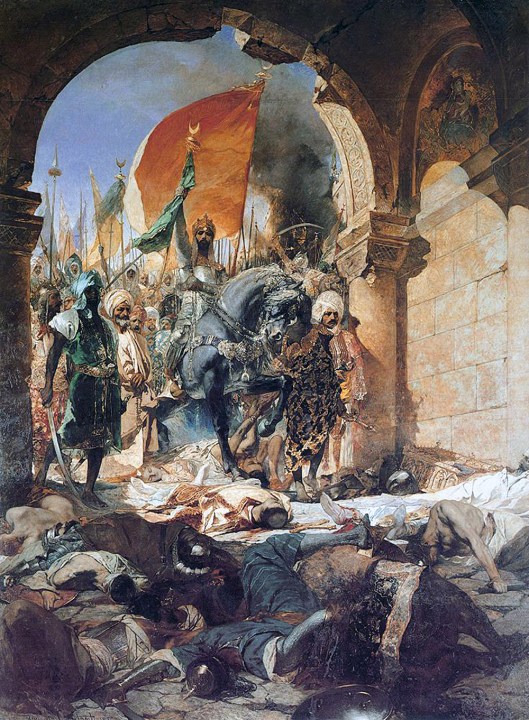
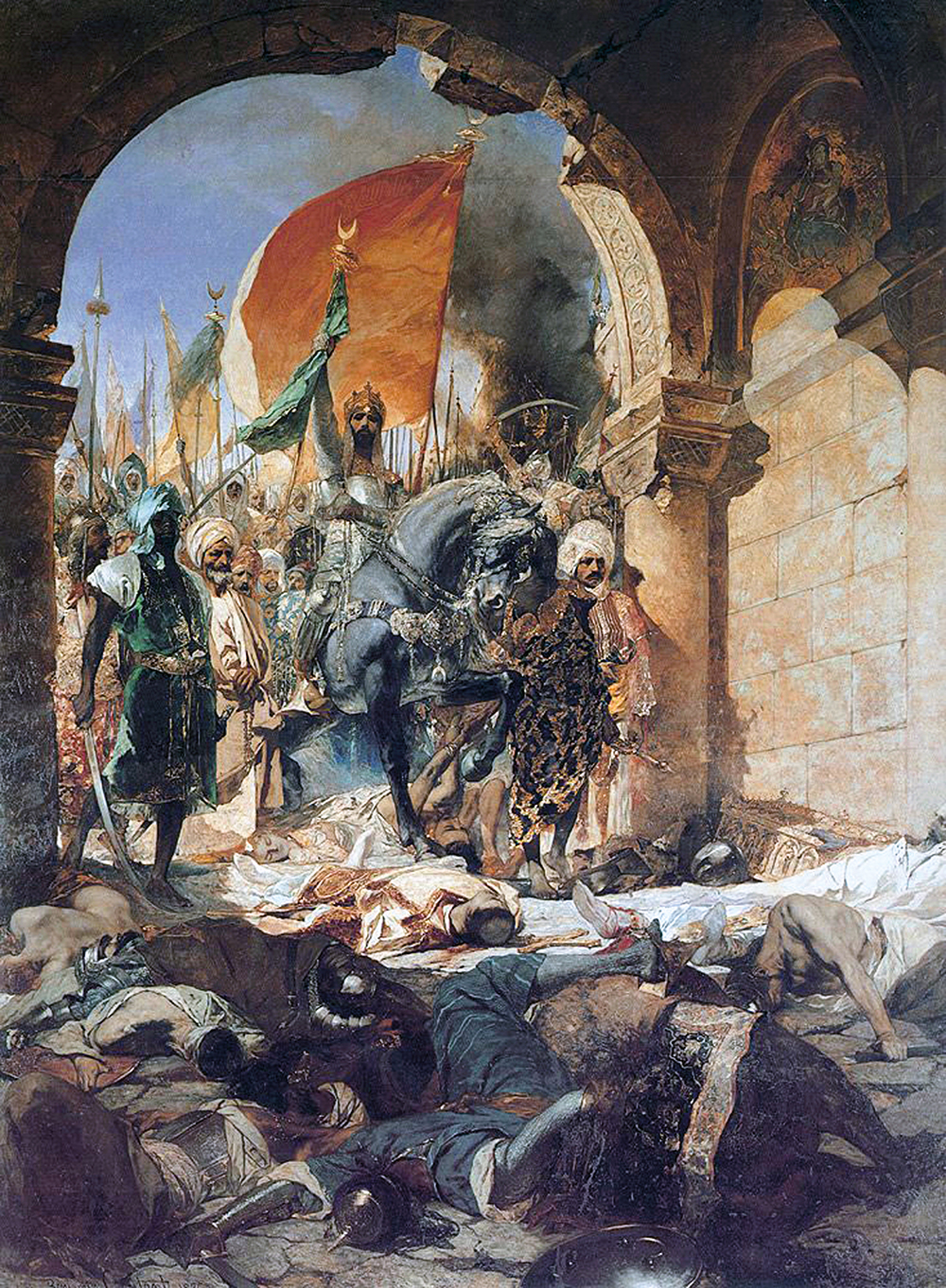
Is there really anything new to say about the conquest of Constantinople? In the absence of fresh archaeological discoveries, a previously unknown text or neglected eyewitness account, can we reasonably expect, almost 600 years later, to break new ground?
Anthony Kaldellis, a Greek-American classics professor at the University of Chicago, thinks so. His 1453 claims to offer a new perspective, namely that, contrary to almost all modern accounts, the Ottoman Sultan Mehmed II’s ultimate victory was ‘far less assured than is often thought’. It was a close run thing. Constantine XI, the last Byzantine emperor, almost won.
For many readers familiar with this story, that won’t sound especially new at all. Most studies worth their salt, and there are many, emphasise Constantinople’s massive Theodosian walls; its stirring history of successful resistance against eight centuries of Muslim-led attempts to take it; Mehmed’s near-mutinous generals; and his last throw of the dice with his crack troops, the Janissaries. In Islamic Empires, I wrote that, to all intents and purposes, the city was impregnable.
Where Kaldellis does deliver is in his richly-layered recreation of the siege, which began on 6 April and ended in a flurry of hacking, slicing, stabbing, slashing, shouting and slipping in blood on 29 May. An accomplished Byzantinist, he knows his material well and assembles it to dramatic effect, even if the detail may at times prove a little dense for the general reader. It is a pity, perhaps, that he does not delve deeper into Turkish scholarship and perspectives on this landmark conquest.
In an era where many see sectarianism as a peculiarly Muslim, Sunni vs Shia, weakness, he reminds us that the fraught relations between Rome and Orthodox Constantinople – and those who argued ferociously both for and against their union – played a decisive role in the run-up to the siege. As Grand Duke Loukas Notaras, Constantine’s chief minister, reportedly argued: ‘Better to see the Turkish turban in the middle of the city than the Latin headgear.’ He got what he wished for.
Mehmed is rightly portrayed as ‘an obsessive micromanager’. You don’t capture a notoriously impenetrable city without meticulous preparation, any more than, say, starting a war with Iran without clear objectives. In 1452, he knocked up in record time the fearsome fort of Rumeli Hisari, nicknamed the Throat Slitter, to block the Bosphorus to hostile shipping. It worked. Unlike British builders today, the 21-year-old sultan didn’t have to worry about bat surveys or hedgehog highways.
Yet, for all Mehmed’s manoeuvres and machinations – the constant bombardment of the walls by monster cannons, the public executions of prisoners by impalement, the showy hauling of the Ottoman fleet out of the Golden Horn, around the protective iron chain and back into the water – the fact was that, six weeks into the siege, Constantine had rebuffed every single Ottoman line of attack. The walls had been repaired, the mines discovered and destroyed, the siege towers repeatedly neutralised, the fleet held back from the sea walls. Constantinople’s faith-filled fatalists, men such as the anti-Union theologian Theodoros Agallianos, might have maintained that the city’s only hope was ‘to trust in God’s compassion and in the all-pure and holy Virgin’, but fortunately there were more sensible people in charge.
It was their misfortune that they didn’t have the numbers. Although the figures are notoriously unreliable, Kaldellis reckons, not unreasonably, that Mehmed mustered around 60,000 soldiers – nothing like the wildly exaggerated 300,000 suggested by contemporaries – against Constantine’s diminutive defensive force of approximately 9,000. The beleaguered emperor railed against his no-show Christian allies: ‘The whole of Christendom has been unwilling to help me against this faithless Turk.’
After the Janissaries, the deluge – a bloody flood of men pouring through the streets, bent on rape and plunder
On the evening of 27 May, Mehmed fired up his men in a motivational speech prior to the final assault. He reminded them that the city contained ‘very beautiful women, young and good-looking, and virgins lovely for marriage’. In the hours before dawn on 29 May, to the sky-filling storm of Ottoman horns, beating drums, clashing cymbals and blood-curdling war cries, the attack was launched in a frenzy of hand-to-hand fighting. Then, after the Janissaries, the deluge – a bloody flood of men pouring through the streets, bent on rape, plunder and enslavement.
A decade after conquering Constantinople, Mehmed razed the Church of the Holy Apostles and replaced it with the Fatih ‘Conquest’ Mosque. His dedicatory inscription above the portal prefigured the sort of Trumpian bombast with which we are familiar today. He was ‘the greatest sultan’ and conqueror of a city ‘whose like has not been created’.
Kaldellis brings to a close his action-packed narrative with some high-minded reflections on the conquest’s most important legacy. It exercised an irresistible pull on the Ottomans, transforming them from largely nomadic warriors to masters of a centralised state, headquartered in ‘the city of the world’s desire’. It dealt, if not the death knell, then at the very least a shattering blow to classical scholarship and literary composition in ancient Greek. And it helped entrench a bitter divide, enthusiastically nourished by the Ottomans, between the Catholic and Orthodox churches.
We can forgive Kaldellis his dig at Turkish triumphalism, witnessed in the rather pathetic annual celebrations of the conquest in Istanbul, when President Erdogan crows that the city and the peerless church-turned-museum-turned-mosque Hagia Sophia ‘will forever be ours’.




Comments