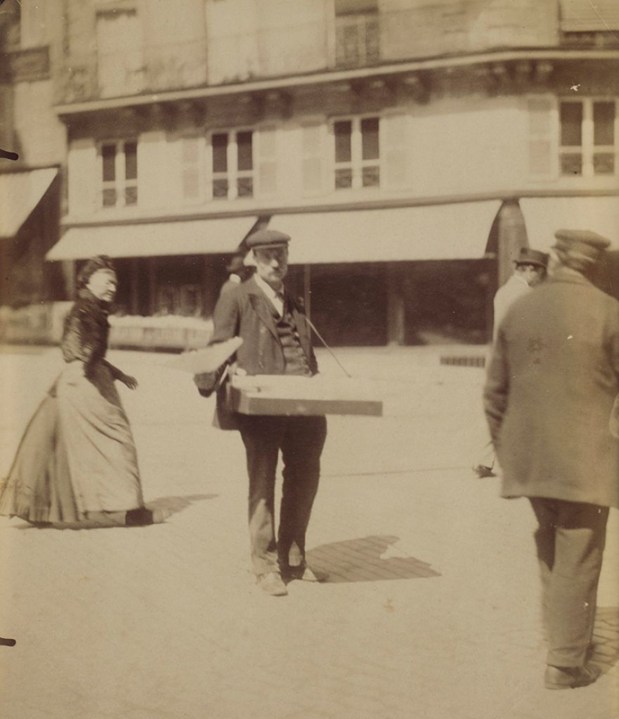

Few connoisseurs of the image are unfamiliar with the great French photographer Eugène Atget (1857-1927). But his name is, unfortunately, unfamiliar to the lay person. This is a shame: his gloriously detailed, sharply focused black-and-white images of late 19th- and early 20th-century Paris evocatively conjure the shadows and lights of the boulevards, parks and alleyways of the Belle Époque. His astonishing close-ups of finely crafted architectural details are as striking as his sometimes surreal views of storefront windows and food-stall displays. Whether training his bulky large-format view camera on scenes interior or exterior, he reveals an aesthetic sensibility exquisitely sensitive to the world around him.
His close-ups of architectural details are as striking as his sometimes surreal views of storefront windows
Yet as obvious as his genius seems now, his work was little known during his lifetime. Nor, apparently, did he himself regard his work as more than, well, his work: “Documents pour artistes,” read the homemade sign outside his fifth-floor studio. That shingle is what the great American photographer Berenice Abbott (1898-1991) saw when she first went to visit him in 1925. While working as an assistant to Man Ray, she had come across Atget’s photos. “Their impact was immediate and tremendous,” she wrote. “There was a sudden flash of recognition – the shock of realism unadorned.”
Almost immediately, she became Atget’s champion, encouraging one and all to seek out his work. He was already in ill health when he agreed to pose for a portrait for her in 1927 and died before she could show the prints to him. Stunned by the news, she tracked down his lifelong friends to find out more about Atget’s life. She began collecting his work, coming to own 1,415 of his glass negatives and approximately 8,000 vintage prints over the years – all of which became part of the New York Museum of Modern Art’s collection in 1968.
Without Abbott, would we even know Atget’s name? Eugène Atget: The Making of a Reputation, organized by the International Center of Photography’s creative director David Campany, aims to lay out Abbott’s role in building Atget’s fame. Too bad, then, that neither the exhibit’s frustratingly skimpy wall texts nor the minimally worded labels accompanying the approximately 100 photographs and other objects on display seems capable of giving us more than a bare-bones outline of the story.
With so little to go on, as I perused the 40 impressive-looking historic magazines and books all encased in glass, I could only assume that they were meant to demonstrate Abbott’s impact and influence. But if there were specific connections I was meant to perceive between the appearance of individual articles and Atget’s growing fame, I missed them. Oh well.
Yet there are still 50 reasons to visit the exhibit in the form of the 50 Atget prints on display, all from IPC’s collection. Both individually and collectively, these powerfully reinforce the magical immediacy of Atget’s work. In these prints, we get to see what Abbott saw: Atget’s instinctive ability, with each click of the shutter capturing an individual true-life slice moment from the larger, ongoing story of Paris, from the majestic monuments of old to the habitats of itinerant ragpickers to the modish clothing and faddish cafés of the moment.
In recording the history chronicled on the streets and in the buildings of Paris alongside the constantly changing saga of the contemporary moment, Atget allowed us to see through his own eyes, Abbott wrote, how “the now becomes past.”
Abbott described his artistry with the same clarity and depth she and Atget shared in their photography in her 1964 book, The World of Atget, which reproduces 176 of his prints alongside a long introductory essay written by her. It is available in most libraries and many used bookstores, but at ICP appears only within a closed glass case.
One of Abbott’s most striking observations in that book has to do with how Atget’s years as an actor – he had joined a traveling theater group in the late 1870s, only switching to photography in 1890 – influenced his approach to viewing the world through a camera lens. “To Atget, the visible world became the stage; man himself and the effects of man, the great drama,” Abbott wrote. “Men and women in the Paris streets became the cast of characters.”
This insight helps explain why, as I walked through the exhibition, his depictions of grand staircases, whether indoors or out, seemed to beg for a dramatic entrance or theatrical denouement. His lovely, lonely trees almost always appeared to await a forlorn lover. Sidewalks crowded with food stalls and shops practically pulled me into the storefronts. And the winding country paths and majestic gates made me feel as if I was intruding on the whereabouts of the characters of In Search of Lost Time.
In capturing all these scenes, Atget can himself be perceived as a character, except that his role was that of auteur. Embodying the part in real life, he routinely trudged through Paris and its environs, lugging up to 40 or 50 pounds of bulky equipment – tripod, large-view camera, heavy glass plates, and other accessories – before settling on a particular spot to set up shop and wait for what Henri Cartier-Bresson called the “decisive moment.”
Atget routinely trudged through Paris, lugging around his bulky equipment before settling on a particular spot
In the portrait of him on display here, Abbott captured Atget slightly hunched forward, as if unconsciously assuming a position similar to the one he would have taken while standing behind the black drapery of his camera. It’s tempting to imagine that his wide-open, curiously questioning eyes, creased brow and close-lipped smile also mirror the inquisitive expression his face would take on as he scanned his surroundings in search of a subject.
And it is impossible not to ask, what did Atget see as he stared back at Abbott? Not only did Abbott help make Atget’s reputation. He inspired her to pursue her own brand of documentary realism, capturing the city of New York in scenic detail in all its moods, at all hours and across its ceaselessly changing architectural facade. A more complete – and complex – subject of the exhibit would have been the making not just of Atget’s reputation, but of Abbott’s, too. But, in the meantime, this show will do.




Comments